Why is Black Friday won in Q1, not Q4?
Top-quartile brands don't switch on upper-funnel spend for peak, they hold it above 20% all year round. Here's the client data behind why Q4 is won early.
All
Learn More

Agentic commerce moves shopping research and some checkout away from the brand's site. Learn how it changes ad measurement, why targets drift and which sources to read together.
Agentic commerce is shopping where AI agents research, compare and sometimes buy for the shopper. For performance marketers it changes measurement because more of the research and purchasing happens where site tracking and click-based reports cannot see, so reported results understate what media drives and the targets built on them drift.
Measurement sits upstream of media decisions: the targets, bids and budgets a team sets are limited by the sales its reports can see, as Fospha’s Chief Product Officer, Dom Devlin, argues in Upstream of Every Decision. Marketplaces and retailers already moved sales away from the brand’s own site. Agentic commerce adds a second move: AI tools now handle part of the research, and some checkouts now complete inside AI tools and shopping apps, such as Google’s Universal Cart in Google Search and the Gemini app, ChatGPT or Perplexity, or a retailer’s own app rather than on a brand’s site.
Shoppers now use AI to research purchases and those who do rank it above traditional search, so most of its effect today is influence that no click records. 53% of consumers across 11 markets used AI for shopping in the past three months, according to a McKinsey survey of about 21,000 people fielded in June 2026. Among AI users, defined as people who used a consumer AI tool in the past three months, AI search tools were 3.2 times more likely to be ranked more influential than traditional search engines, and nearly a third of AI shoppers said AI chat or search was the biggest influence on their most recent purchase.
Completed purchases are smaller: 14% of AI users, about 9% of all consumers, have bought directly within an AI tool, and among US AI users that share grew from 10% to 17% compared with the previous survey wave.
They credit the clicks they can see, which are rarely the AI conversation that shaped the choice. Last-click reporting gives credit to the final click before a purchase, and a pixel, the tracking code on a brand’s website, only records what happens on pages that carry it.
When someone researches in an AI tool and later searches the brand, types the address or buys on a marketplace, the report credits branded search, Direct traffic (visits with no recorded source) or the marketplace, and the research that started it leaves no trace.
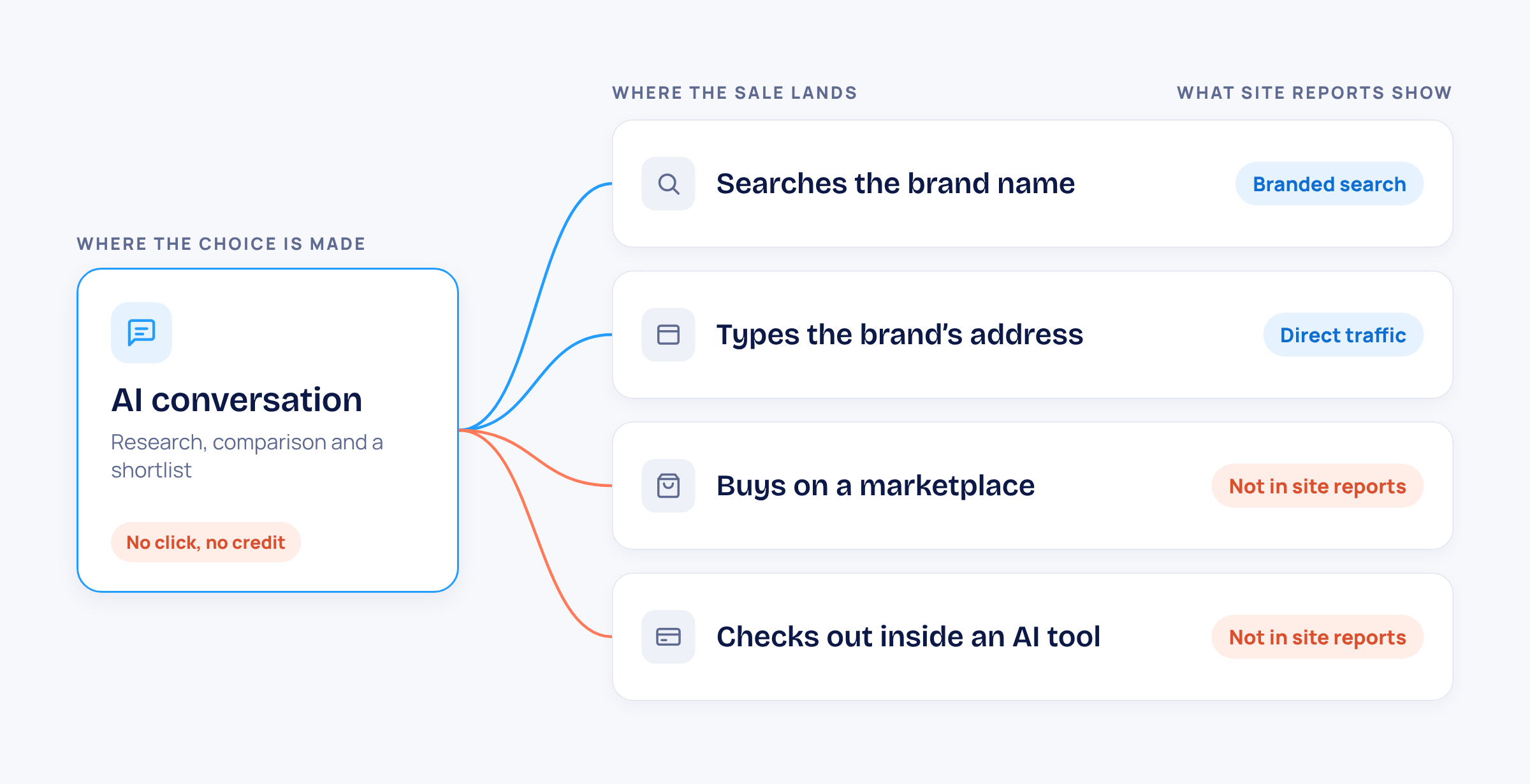
The same mechanism is already measurable with marketplaces. Fospha’s data for 80 brands that sell on their own site and on Amazon or TikTok Shop, from November 2025 to October 2026, shows last click credits the ads that create demand with less than one in five of the sales they drive. For nearly half of the marketplace brands Fospha measures, over half of sales land off the brand’s own site. Checkout completed inside AI tools would add one more place for sales to land.
If AI tools move more research and checkout off the brand’s site, the targets that ad platforms optimize toward are affected, because they are built from the sales a brand can see. A target built from website sales credits each campaign with only part of what it drives.
Ad platforms such as Meta, Google and TikTok optimize toward the conversions their own tracking records, and teams set goals such as cost per sale (the amount a campaign is set to pay for each sale) or return on ad spend (revenue per dollar of ad spend) built from website purchases. A campaign whose sales land on a marketplace or inside an AI tool looks weaker than it is, so the platform bids more cautiously to stay near the goal, and the campaign can sit on target while held back from customers the business would pay for.
On Meta, the same 80 brands show the scale: for the median brand, about 30% of what its sales campaigns drive lands off-site, and reported cost per sale looks about 30% higher than across everywhere it sells.
Targets rarely end up too tight on purpose. They follow from what the measurement can see, and the bid, the budget and the decision to keep or cut a channel inherit them.
A single source rarely sees the whole journey, so the working approach is to read several together, each for what it can see.
Fospha’s view is that teams should plan from one view of total commerce, with sales across the site, marketplaces and retail counted once, and validate it alongside tests and marketing mix models.
As AI tools take on more shopping research and checkout, more of what media drives happens where click-based reports and site-based targets cannot see it. Reading several sources together, and planning from one view of total commerce, keeps targets and budgets tied to the sales media drives.
Measuring marketing impact beyond your DTC website