Why is Black Friday won in Q1, not Q4?
Top-quartile brands don't switch on upper-funnel spend for peak, they hold it above 20% all year round. Here's the client data behind why Q4 is won early.
All
Learn More

Cross-channel halo measurement estimates the sales your ads drive on Amazon, TikTok Shop and retailers. Learn what it is and how brands measure it.
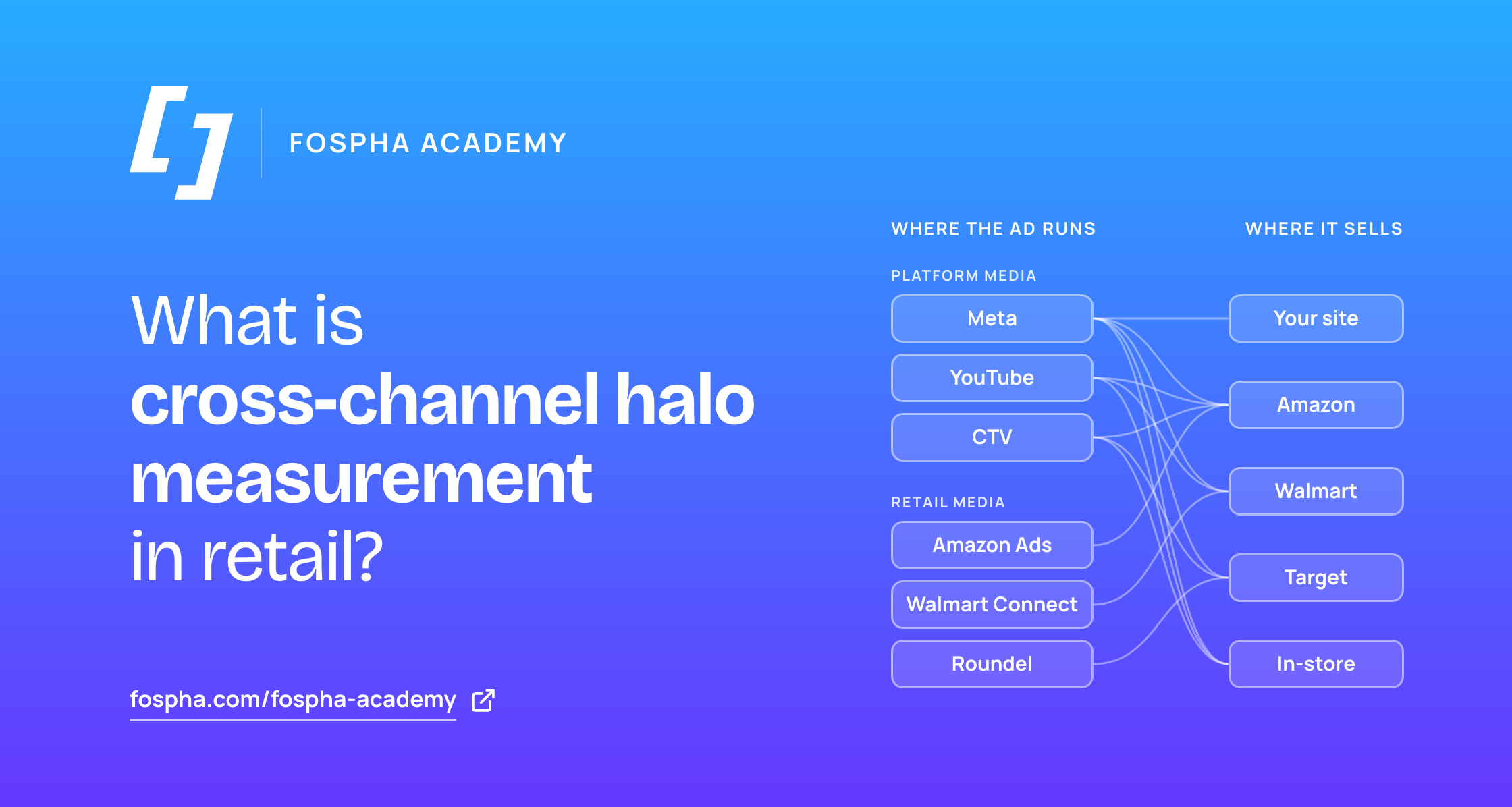
Cross-channel halo measurement is how a retail brand estimates the sales its advertising drives on channels the ad can’t track, such as Amazon, TikTok Shop and retailers like Sephora or Ulta. It adds those sales back into each marketing channel’s results, so budget decisions reflect everything the ad influenced, not just what one dashboard can see.
A brand cuts its TikTok budget because website sales look weak. A month later, Amazon sales dip too, and nobody connects the two. Each report was right about its own patch and wrong about the whole picture. Halo measurement exists to fix that.
The halo effect is when advertising in one place lifts sales somewhere else. Think of an ad as a shop window and the sale as the till. If customers pay at a different till, the window looks like it isn’t working.
Picture someone scrolling past a TikTok ad for a moisturizer. They don’t click. Two days later they remember the name, search for it on Amazon and buy it. TikTok reports no sale. Amazon sees a shopper arriving from search. The ad did its job, but no report connects it to the sale.
Three terms matter here:
Not long ago the path between them was short and fairly linear. A shopper saw an ad, clicked, and bought on the brand’s website or in a store, so the ad and the sale were easy to connect. Today, many brands sell on their own site, on Amazon, on TikTok Shop and through retailers, often all at once. Each of these systems keeps its own records and rarely shares them. When a campaign prompts a sale somewhere else, the credit often doesn’t make it back to the channel that earned it, so that channel looks weaker than it is.
With retail media networks, the ad and the sale can even happen on the same platform, which blurs the line between a marketing channel and a sales channel. Amazon, TikTok, Walmart, Target, Sephora and Ulta now sit in the middle of the journey, and direct-to-consumer (DTC) sales through a brand’s own site are only one destination among many.
The result is a web of links, not a line. Every marketing channel can lead to every sales channel, and most reports only follow the links that happen to land on their own doorstep.
Halo also runs between retailers. Circana found that nearly 16% of media-driven sales associated with Best Buy’s ad network occurred at competing retailers. An ad in one store can fill the till in another.
Each report measures its own ecosystem, and that is by design.
No shared identifier follows a shopper from a TikTok ad to an Amazon checkout. Halo measurement works from patterns in the totals instead of tracking individuals.
Retailers feel the pressure. NIQ and Unlimitail (June 2026) report that 67% of chief marketing officers plan to increase retail media spend, but only 53% think networks’ measurement is adequate.
It varies by brand, category and channel mix, so treat any single number as a range.
There are three families of method. Each answers a different question.
None of these replaces the others. Signals point to where halo might be, a test sizes it for one channel, and a model keeps tracking it between tests.
You can spot early signs in your own data: