Brand and performance were never two budgets
Hugo van den Biggelaar spent 8.5 years inside Nike’s finance and brand functions before founding BITSing. Here’s why the brand versus performance fight quietly costs you growth.
All
Learn More

Top-quartile brands don't switch on upper-funnel spend for peak, they hold it above 20% all year round. Here's the client data behind why Q4 is won early.
Your Black Friday performance is shaped well before Q4 begins. In Fospha's client data, the brands who landed in the top 25% for ROAS generated (return on ad spend) during peak 2025 allocated at least 20% of their funnel budget to Awareness and Consideration, in every quarter of the year. So by the time peak arrives, they're largely converting demand they already built, rather than manufacturing it from scratch. It’s a consistent pattern that we continue to see across our top-performing clients, and proves a much bigger case for the importance of upper-funnel investment ahead of peak period.
If you've ever had to defend cutting brand spend in February to protect margin, you already know the instinct this lesson is up against: hold the money back, spend it when it counts, in Q4.
That's a reasonable instinct, and it also runs counter to the pattern the data shows among the top-performing brands. When you're setting your budget for the months leading into peak, Q1 through Q3, this is the decision that has the most bearing on how Q4 plays out: whether that Q4 spend is mostly converting an audience you've already built, or introducing and converting it in the same expensive week.
Brands aren't spending less at peak. On average, they're spending relatively more earlier in the year, so Q4 activity has less ground to cover.
But Q4 results tend to reflect the work brands put in across Q1 through Q3, more than what happens during peak week itself. Fospha's data shows peak's share of total annual ad budget dropped from 36% in 2024 to 32% in 2025, even while total Q4 spend and revenue both grew year-over-year.
This lines up with the playbook's own framing: peak isn't won in November, it's won by brands compounding equity since January.
Treating the off-peak months as the time to save and Q4 as the time to spend. That pattern is worth reconsidering for two reasons.
They maintain upper-funnel spend at a consistent level all year, rather than switching it on for peak.
Fospha's top-performing cohort (by Q4 ROAS) allocated on average 22% of their funnel budget to Awareness and Consideration throughout the full year 2025, and maintained above the 20% threshold for spend in upper-funnel every quarter in the year.
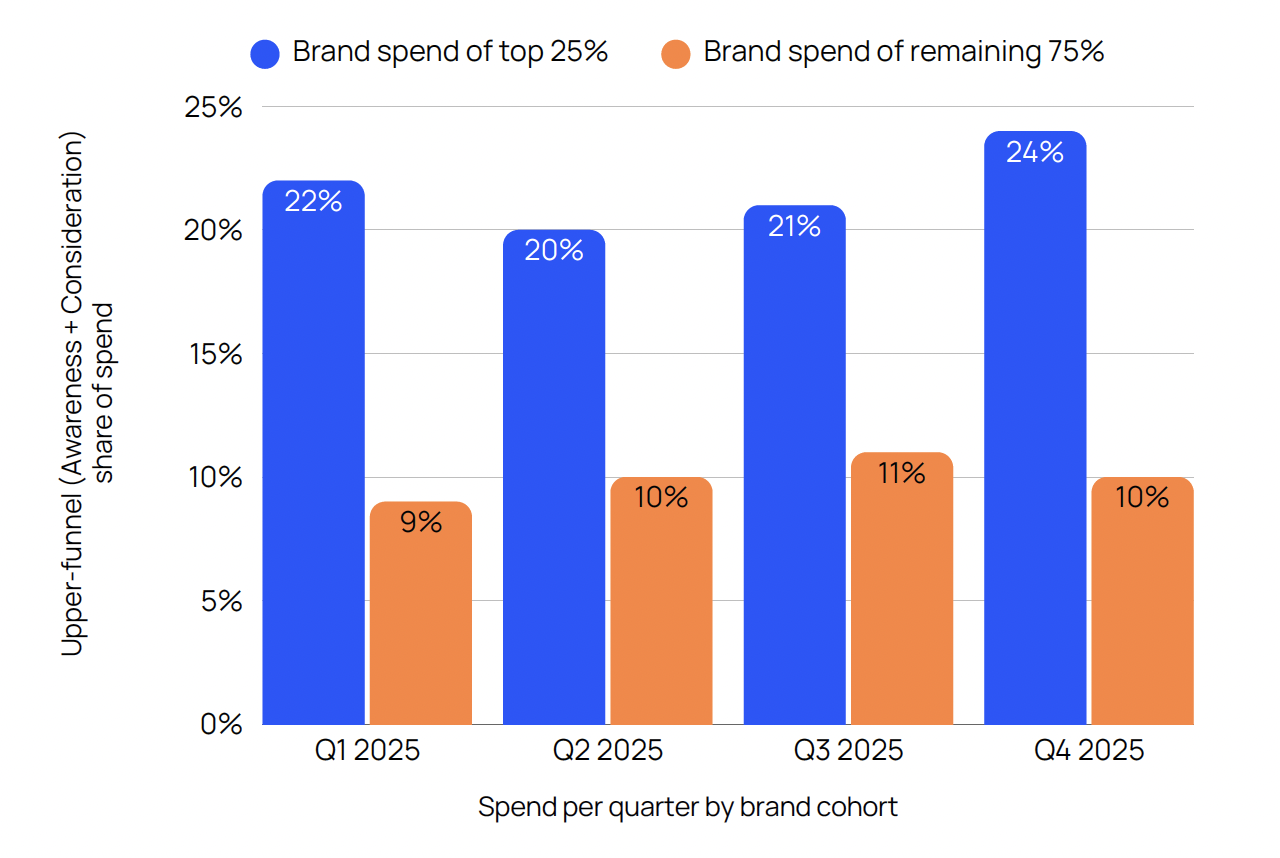
The remaining 75% of brands sat between 9% and 11%, including in Q4. That gap is already present in Q1 and stays roughly consistent through the year in this dataset.
A growing share of peak campaigns now run on AI-driven bidding tools, Meta's Advantage+, Google's Performance Max, and TikTok's Smart+ among them, and these systems typically need a learning phase: a period running on real conversion and audience data before they optimize well.
Starting that learning phase in November means paying peak-period prices while the system is still calibrating. Starting it earlier gives it time to train on lower-cost data before peak demand hits.
Fospha's data offers a directional signal here worth reading carefully: brands that had adopted Advantage+ saw 94% more revenue per brand and a 19% lower cost to acquire than brands that hadn't, on 30% more spend. This compares adopters against non-adopters rather than a controlled test, so factors like brand size or measurement maturity could also be contributing to that gap.
Here's a hypothetical, built from the real percentages above, to make the pattern concrete rather than to predict a guaranteed outcome.
Two DTC (direct-to-consumer) brands each plan to spend $500,000 during Q4. The difference is what they did with their budgets in the months leading up to it. Brand A treated January through September as savings months, holding upper-funnel spend near 10% of that earlier budget, in line with Fospha's bottom-75% cohort, and directing the rest into lower-funnel conversion campaigns. Brand B held upper-funnel spend around 22% of its budget all year, in line with the top-quartile cohort, accepting a less eye-catching ROAS in the quieter months in exchange for a warmer audience and a more trained bidding system by November.
By Q4, Brand A's $500,000 is being asked to introduce the brand to a largely cold audience and convert it, inside the most competitive auction of the year, while its bidding systems are only just entering their learning phase. Brand B's audience has already had months of exposure, and its bidding systems have real data to work from. Brand B's $500,000 is doing comparatively less of the introduction work and more of the conversion work.
Funnel allocation isn't the only variable that would separate these two brands in reality, category, price point, and existing brand equity all matter too, but it's a useful way to see how the same Q4 budget can be asked to do very different jobs depending on what happened earlier in the year.
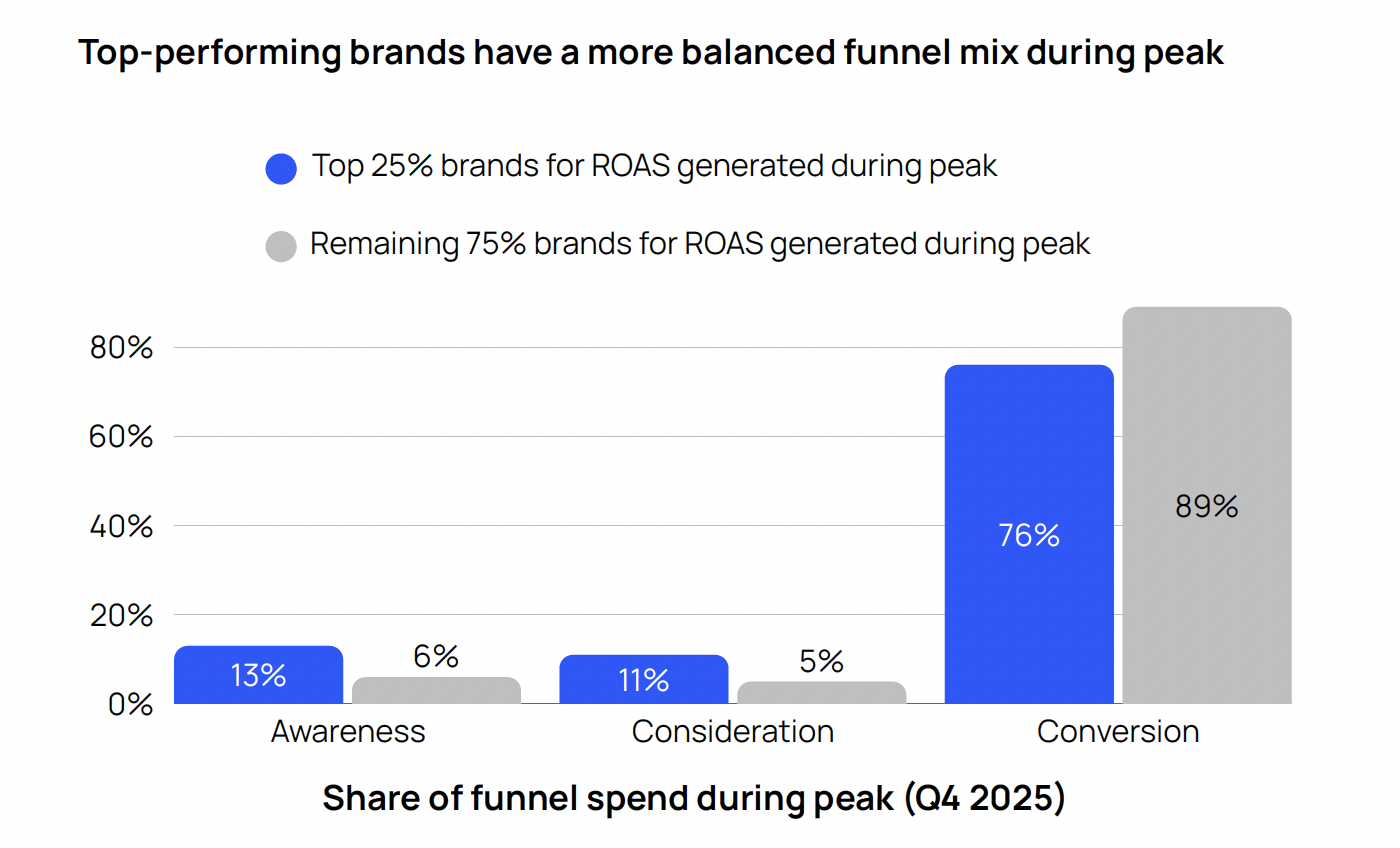
This lines up with Fospha's funnel-mix data: the top performer cohort of brands entered peak with a combined total of 24% of spend in Awareness and Consideration, versus just 11% for the rest of the brands.
It's a similar logic to SEO versus paid search. Paid search buys visibility as soon as you switch it on, and that visibility tends to disappear once you stop paying for it. SEO takes months to build, because search engines need time to trust a site, but it tends to keep paying back well after the initial work. Upper-funnel spend behaves more like SEO in this respect: it's unlikely to show up as revenue in February, but it can compound into more efficient conversions later.
There's an established term for this kind of delayed, compounding effect: ad stock, also called the carryover effect: the idea that an ad's influence on demand decays gradually rather than switching off the moment a campaign stops running.
Doing this work for the first time in Q4 is a bit like trying to rank a brand-new site for a competitive keyword the week before Black Friday. As Niket Shah, Co-founder of Acceler8 Labs, puts it in the playbook: "if your first touchpoint with a customer is a Black Friday ad, you're paying peak prices to introduce yourself."
Your CFO suggests scaling back Awareness and Consideration spend for most of the year and saving the budget for a bigger push at peak. What's your answer?
Two reasons this backfires.
First, cost: the same reach is cheaper to buy outside peak, so pulling that spend now doesn't save money, it just defers the same work to the point in the year it's most expensive.
Second, risk: AI-led bidding systems need months of real conversion data to optimize well, and turning them on cold in November means they're still calibrating right as peak-week competition and prices both spike. Cutting spend to save it for Q4 means paying more, for a less-optimized campaign, at the most expensive time to find that out.
Try saying the core idea in one sentence, out loud, as if you were really in that meeting. A solid version:
"Q4 performance depends heavily on what we did in Q1 through Q3. How much we invested in Awareness and Consideration, and how early we started training our bidding systems. So cutting that spend now doesn't save money, it just moves the same cost to the most expensive week of the year and asks our campaigns to perform without the data they need."
Q4 performance looks, in Fospha’s data, like a lagging indicator of decisions made months earlier. This builds on knowing the basics of the funnel (Awareness, Consideration, Conversion) and understanding that automated bidding tends to need time and data to perform well. From here, a natural next step is working out how to set a Q1 upper-funnel budget floor and which emerging or mid-size channels are worth testing early, before peak demand makes them expensive.
Does this mean Q4 spend doesn't matter? No. Total Q4 spend and revenue both grew year-over-year in Fospha's data. The point is that Q4 spend tends to perform better when it's scaling something already proven rather than starting cold.
What counts as "upper-funnel" spend? Awareness campaigns, which put a brand in front of people with little prior context, and Consideration campaigns, which drive traffic and engagement. Both sit above Conversion campaigns, which are built to close a sale directly.
Is 20% the right number for every brand? It's the benchmark Fospha observed among its own top-quartile clients by Q4 ROAS, not a universal rule. Category, price point, and typical decision time will all shift that number.
Is this proven cause and effect, or just a pattern? It's a pattern, and a fairly consistent one across a large client base, but it's a correlation rather than a controlled experiment. Brands in the top-ROAS cohort might perform better for reasons beyond funnel allocation alone, and this lesson leans on that pattern as a planning input rather than a guarantee.
Where does channel diversification fit in? That's a related but separate decision. Fospha also found top performers directing close to 30% of peak budget into emerging and mid-size channels, tested earlier in the year. That's a question of which channels to invest in, not when to start upper-funnel spend, so it's better handled separately.


.png)
%20and%20how%20does%20modern%20MMM%20work%3F.png)