Why is Black Friday won in Q1, not Q4?
Top-quartile brands don't switch on upper-funnel spend for peak, they hold it above 20% all year round. Here's the client data behind why Q4 is won early.
All
Learn More

Former Nike finance and brand exec Hugo van den Biggelaar argues most marketing plans get built backwards with channels and budgets first, revenue targets as an afterthought. He breaks down why goals, strategy, and budget need to stay separate, why gut-feel planning quietly costs growth, and how balancing your proven revenue base with bold new bets (instead of swinging hard toward either) is what hits the number.

Most marketing plans get written back to front.
They open with what we're going to do, the channels, the campaigns, how we split the budget across all of it. The one thing that should come first, what the business has to earn, is exactly what they leave out.
Let me back up and tell you where I'm coming from. I spent eight and a half years at Nike, the first few years in finance and then insights and brand after that. Same company, two worlds, and half the time they didn't even speak the same language. Finance looked at marketing and saw money walking out the door, while marketing looked at finance and saw the thing standing between them and the good work. I sat on both sides for long enough to learn that this gap quietly costs companies a lot of their growth, and it usually comes down to where the plan begins.
Now, let me be clear that this isn't me preferring spreadsheets over ideas. I spent the second half of my Nike years on the brand side on purpose, because that's where the magic truly happens, and the boldest ideas are usually the ones worth putting real money behind. Starting from the P&L doesn't take any of that away, if anything it protects it, because it keeps the dope work alive and it tells you which brave idea deserves the budget. When a company is struggling, the bold stuff is always the first thing to get cut.
So the fix is easy to say and hard to do: start from the P&L, look at the revenue number your business has to hit, and let the rest of the plan take its shape from there. Let me walk you through what that looks like and why it changes how your whole plan gets built.
Ask your team what the goal is, and you'll usually get one of two answers, either a strategy dressed up as a goal ("we're going to grow brand awareness") or a budget dressed up as a goal ("we've got twelve million to spend this year"). Neither of those is a goal. One is a direction you might travel towards and the other is the fuel someone handed you for the trip, and knowing your direction and your fuel still doesn't tell you where you're meant to arrive.
A goal is the outcome the business promised, whether that's revenue, margin or profit, whatever number someone gets held to in December. The strategy is how you plan to get there, and the budget is what you're allowed to spend along the way. You have to keep those three things apart, because the minute they blur together your plan loses its sharpness and the team starts optimizing the spend instead of chasing the number.
Take the goal that sounds like ambition but is really a strategy in disguise. You probably have heard this one: "This year we're going to connect with Gen Z on TikTok." Everyone in the room agrees, because it sounds logical and looks great on a slide. But nobody in that room can tell you what it's worth, what happens to the business if it works, or how you'll know when you've pulled it off. A year later your team might have real momentum on TikTok and still have no honest way to say whether any of it paid for itself, because there was never a target to check it against.
Setting real, financial goals is the one thing I won't bend on, and it's what people fight me hardest on when I sit down with them. Awareness, brand love, reach, all the things you care about and should care about, only start to mean something once they're tied to a number, and it has to be a financial number specifically. If your goal can't be counted in the currency the business banks, then it isn't your goal at all, just one of the routes you might take to reach it.
And that carries a real cost, ladies and gentlemen, because it puts your team on the hook for more than just activity. You can run a really strong year of work and still come up short if the number never showed up. I don't say that to be hard on marketing, I say it because it's what stops a team reaching December busy and well liked but with nothing to show for it on the P&L.
So separate the goal from the strategy. It's probably the least exciting sentence in this whole piece, but also one of the most important.
Watch what your team does in the back stretch of the fiscal year, when there's still money left in the budget. We all know the scramble, where everyone rushes to spend before it disappears, pulling campaigns forward and feeding whatever channel burns cash the fastest. Nobody says it out loud, but the real job has become getting the budget to zero, because an underspend looks like you asked for too much and next year they hand you less.
I think of it like getting handed a stack of chips at a casino. You sit down expecting to win, because nobody plays to lose, but you don't really know the odds on any table and there's nobody at the door counting what you walk out with. So the only thing that ends up getting measured is whether you put all your chips down. Hand your team a budget as "here's your allocation for the year" with nothing attached about what it should bring back, and that's the exact game you've built for them, where they're playing to win but the scoreboard only tracks what they spent. It doesn't have to work like that.
Put a revenue target on it and the whole thing changes, because now people stop asking whether the budget got spent and start asking what each dollar brought back and where the next one would earn the most. The conversation moves to how much came home once the spend earned its keep, and whether there was a better place to put it, so spending turns into a decision you justify against a return rather than a quota you clear before a deadline.
Underneath all of it is a simple question of what you're holding. Give someone a budget and they'll guard the spending and defend it to the death, because the spending is what's theirs. Give them a number the business has to hit and they end up holding the outcome instead, and they start behaving like someone who owns one. That kind of accountability never comes from a workshop or a values slide on the wall, it comes from putting a real financial goal on the table and making it theirs. The budget is the conversation that comes afterwards, sitting downstream of the target, so it can never be the thing you build the plan around.
Once your goal is clear, you need to know where the revenue comes from today. And I mean where it truly comes from right now, not the version you'd like to be true and not the one the strategy deck likes to tell.
A lot of people get this wrong, and they get it wrong on gut feeling. You talk yourself into a nice story about what your customers want and where the growth is hiding, and then you plan off that belief. The trouble with a gut feeling is that it's usually pretty reasonable, which is exactly what makes it expensive, because it sounds right and so nobody bothers to check it.
The fix is almost boringly simple, which is to look at the evidence. Before you decide where next year's money should go, take a hard look at where this year's money came from, and work off the actual numbers rather than the story the company likes to tell about itself.
I know it's unglamorous work, nothing cool or crazy about it. Map where your revenue comes from and get specific about which products, customers, segments and channels are bringing it in, then rank those sources by what they deliver today rather than what you're hoping they'll deliver one day.
Do this honestly and you'll probably run into the same slightly uncomfortable truth most businesses do, which is that a small handful of sources are carrying almost the whole company, and they're usually not the ones getting airtime in the room. Everyone wants to talk about the new market and the exciting launch, while the quiet workhorse paying the wages and the rent barely gets a mention.
The point of all this isn't to fall in love with what already works and freeze there, it's to see your business clearly before you commit to anything. What you end up with is an honest picture, where some sources are clearly earning their place and others look promising but aren't paying yet. At this stage you still haven't chosen anything, you've simply swapped guessing for knowing what's true.
And this is where that number from the start of the plan turns into something you can act on. The goal tells you what the business has to earn, and knowing your real sources of money tells you where that earning can honestly come from. One without the other just leaves you holding either a wish or a spreadsheet.
This next part sounds like a paradox but isn't one. You have to grow just to stand still, because if you earn the same as or less than last year the business gets weaker even when nothing dramatic looks like it's happening. So growth stops being the ambitious choice and becomes the baseline for staying healthy, which means the real question was never whether to grow, but how to grow without breaking the thing that's already working.
This is exactly where good, ambitious teams tend to hurt themselves, because the instinct is to grow by swinging hard. The whole pendulum swings over to the new thing, the new market, the new channel, the new concept a competitor just made look easy, and it gets the most attention, the budget and the best people. Meanwhile the proven part of the business, the part paying everyone's wages, gets assumed to be fine and left running on its own, until the base weakens, someone finally notices, and the pendulum swings all the way back. Neither end of that swing is a plan, it's just the business lurching back and forth.
The math makes it obvious. You can take a small bet and grow it 200% and still miss your number, because 200% of almost nothing is still almost nothing, while a 5% slip on the thing that carries you can cost more than that shiny new bet will make all year. The people I work with feel this pull constantly, where all the energy wants to go to the second location or the new concept while the business funding the whole dream is the one that already works and is quietly getting ignored.
The way out of all that swinging is balance, and by balance I don't mean caution or standing still. You strengthen what already works first, because that's where most of next year's number is coming from anyway, and then you fund the bold bets out of what's left and scale them up as they start to earn, instead of betting the house before they've proven anything. New bets are how a business grows up, and trust me, I'm the last guy who'll ever talk you out of a bold one. I'm a born optimist, so I'm always up for something off the beaten track. The trick is adding the new without abandoning the old, so the pendulum never has to swing in the first place.
And none of this is an argument for playing small or being too humble. The bold, unconventional, brand-building bets are exactly what a healthy base is for and backing them is the whole reason you built the plan in the first place. What already earns is what buys you the right to take those bets, and it all points back to the number you started with. You protect the base because the base is most of the promise, and you take the bold bets because the promise won't grow on the base alone. Balance here isn't a personality trait or a nice-sounding value, it's simply what hitting the number takes, this year, next year and all the years after.
This last piece is the one almost everyone skips, and it decides whether any of the rest was worth doing.
Your plan isn't a document you write once and reopen a year later to see how you did, because that's just a prediction, and predictions are for entertainment. A plan is only as good as the rhythm that keeps it honest, where you forecast, then compare that forecast against what happened, then decide, and then check again. It doesn't need a clever tool so much as it needs to happen on a regular beat, with someone in the room who can make real-time decisions when reality and the plan start to disagree.
The gap you're always fighting is the one between insight and action, because most companies are drowning in insight and starving for action. The data is already there, sitting in the deck, and the deck gets presented, everyone agrees it's interesting, nothing moves, and next month someone builds a fresh one. Good information dies in slides every single day, and not because it was wrong, but because nobody turned it into a decision fast enough for that decision to still matter.
So build your dashboard to produce decisions rather than admiration. Every time you hold the plan up against reality, that meeting should end on a choice instead of a status update, where you ask whether you're on the number or not, and if you're not, what moves and where the money goes instead. That's what steering looks like, and everything else is just watching the road slide past and describing it nicely.
Which is the whole reason you started from the P&L in the first place, and not for the sake of tidiness. You did it so that when you sit down to steer there's a real number to steer toward, a real gap to close, and a real reason to pull a dollar off the thing that's drifting and put it on the thing that's working. Without that number you're not steering at all, you're just reporting, and reporting on its own has never once hit a target.
Therefore, if there's one thing I want you to hold onto, it's the order. Start from the money the business has to make, keep the goal and the strategy separate so the budget never gets to pretend it's either one, find the sources that are actually earning and protect them before you go chasing the ones that only might, and then keep a rhythm tight enough that you can change your mind while it still counts.
None of this is a growth hack, and honestly, I don't think one exists. It's mostly just refusing to plan in the wrong order for the wrong reasons, which turns out to be most of the job.
And done right, none of this diminishes your creative work, it does the exact opposite. The clearer you are about your revenue goals, the braver you can afford to be with the ideas, because you know exactly what you're protecting and exactly what you're free to risk. The plan was never there to make marketing smaller, but to let your best and boldest work survive contact with reality and make a real impact.
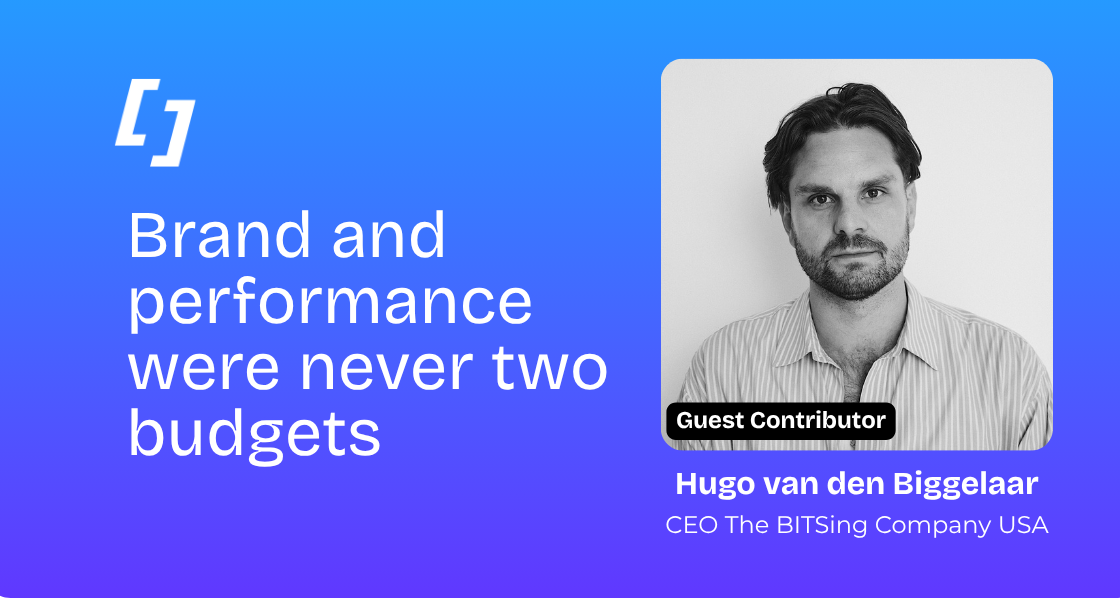
Fospha Academy’s Founding Guest Contributor: Hugo van den Biggelaar
Hugo spent 8.5 years at Nike across finance, insights and brand. He now runs BITSing in the US, a growth methodology built over thirty years and used in more than a thousand organizations. He also runs Think Biggie, a Brooklyn-based creative studio, and is a founding contributor to the Fospha Academy.


%20and%20how%20does%20modern%20MMM%20work%3F.png)