Why is Black Friday won in Q1, not Q4?
Top-quartile brands don't switch on upper-funnel spend for peak, they hold it above 20% all year round. Here's the client data behind why Q4 is won early.
All
Learn More

A Black Friday ad isn't a cheap way to test a channel, it's an expensive way to meet a stranger. Here's when top brands run the test.
Yes, but only if you’ve already tested it somewhere else first. Peak isn’t the time to find out whether a channel works, it’s the time to scale what you already know does. The safest window for testing is Q1 through Q3, when reach is cheap and there’s no deadline pressure yet. With peak just around the corner as you’re reading this, there’s still time for one focused test on a channel that genuinely fits your audience, just not enough time to gamble real peak budget on something completely unproven.
We’ve sat in enough of these planning meetings to recognize the pattern. Someone suggests trying Reddit, or RTB House, or Google Demand Gen, and everyone agrees it sounds promising, right up until someone asks when. Nobody wants to be the one gambling on something unproven for their brand with real peak dollars attached, so the idea gets parked until “after peak.” Then peak ends, budgets reset, and the same conversation happens again in Q4 next year. The channel never really gets tested. It just gets discussed.
The instinct to hold off makes sense on the surface. Nobody wants to risk peak budget on something unproven. But that’s not the choice in front of you. Testing a channel in November isn’t risky because the channel might not work, it’s risky because of what it costs to meet someone for the first time at the most expensive moment of the year.
Niket Shah at Acceler8 Labs puts it plainly: if your first touchpoint with a customer is a Black Friday ad, you’re paying peak prices to introduce yourself. An introduction is expensive in November and cheap in August, and that difference has nothing to do with whether the channel works. It’s just what happens to reach and attention once everyone else shows up at the same time.
By November, most brands aren’t testing anything, they’re converting demand that already exists. Fospha’s own data points to the window that consistently gets missed: brands who win peak build their consideration pool earlier, roughly August through October, while mid-size and emerging channels still offer efficient reach before the rest of the market crowds in and pushes costs up everywhere. This isn’t specific to any one year, it shows up in the data every peak cycle, it’s just the window brands talk themselves out of using.
If the awareness window has already passed you by this year, the answer isn’t to abandon testing, it’s to shrink it. A five or six week test on one channel, run now, still tells you more than walking into Q4 with no data at all. It won’t put you in the same position as a brand that started in January, but it beats finding out in November that you guessed wrong.
The number worth knowing: the top 25% of Fospha brands by ROAS generated in Q4 2025 now direct ~30% of their peak budget to emerging and mid-size channels, compared with about 21% for everyone else. Channels like Reddit, RTB House, and Google Demand Gen each more than doubled in peak spend among that group. None of that spend showed up cold in Q4. It scaled a position that had already been tested and proven months earlier, which is the part that gets missed when people quote the 30% figure as if it’s a peak budget decision. It’s a Q1 to Q3 decision that just happens to pay off at peak.
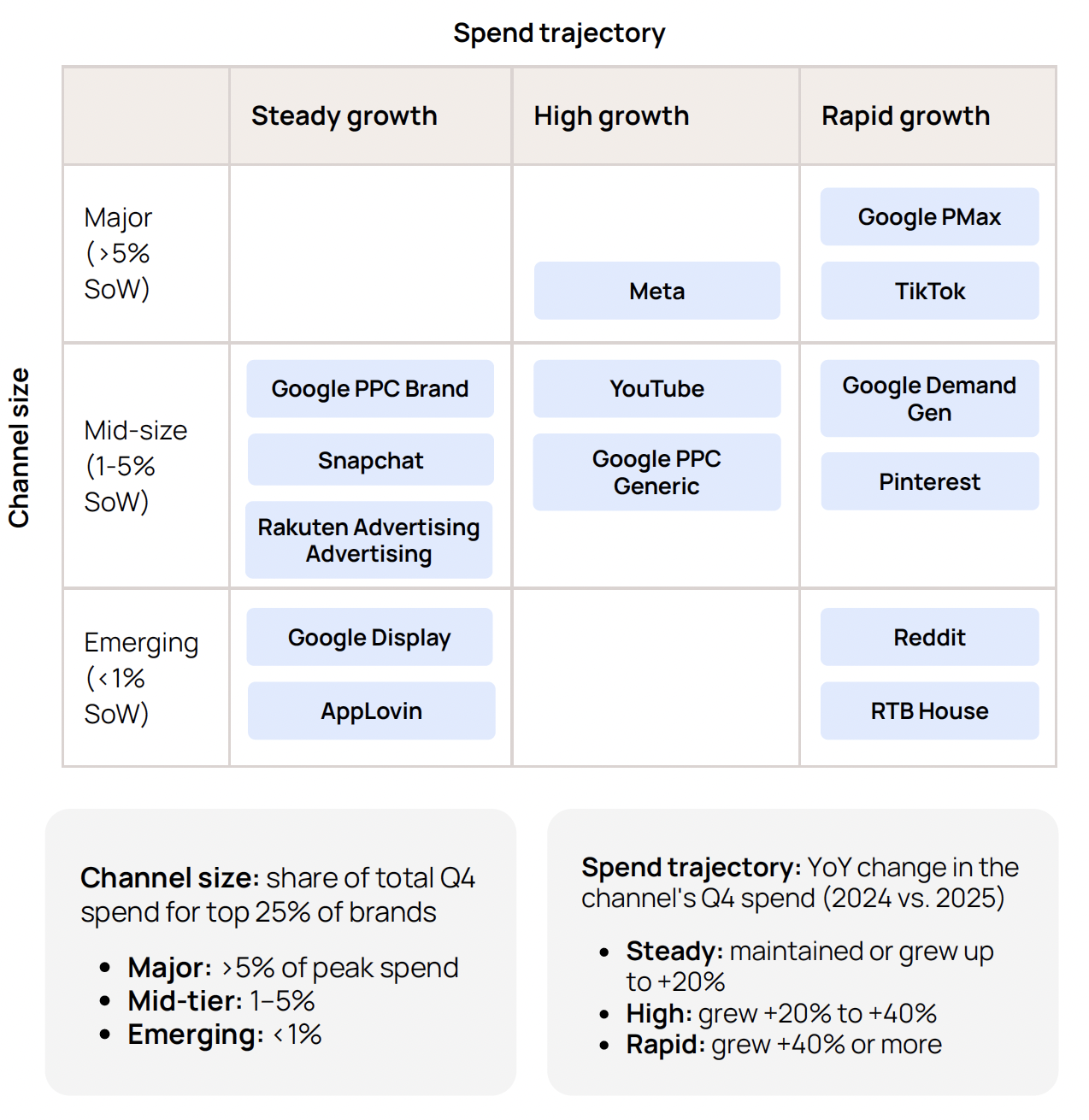
There’s a reason new channels always look weak in Last Click reports, right up until the moment someone commits real budget to them. Last Click only gives credit to wherever generated the final click, so a channel that’s introducing new customers to the brand doesn’t get credit for that, it just makes the channels further down the funnel look unusually efficient. The lift is real, it’s just sitting on somebody else’s line in the report. If you’re judging a new channel purely on its own reported return, you’re judging it on the wrong number.
This follows the same logic behind Fospha’s own Joint Support Programs, a structured way of moving from testing to committed peak spend without guessing. Before Q1 planning locks in, work through this:
If you’re starting later than planned, run the same shortlist in miniature: one channel, five to six weeks, one clear number you’re testing against, rather than skipping the exercise altogether.
The real lesson isn’t the percentage, it’s the sequencing. Brands that test small and early, while attention is still cheap, get to spend on new channels at peak with evidence behind every dollar. Brands that wait end up guessing in November regardless of how much or how little they commit. If you’ve already got that evidence, keep feeding it. If you don’t yet, there’s still a window to get some, and it’s better used now than lost to another year of “maybe next peak.”
How much of your peak marketing budget should go to untested channels?
None. A channel that hasn’t been tested shouldn’t receive real peak budget, it should be validated earlier with a separate, smaller test budget before Q4 planning begins.
When should brands start testing new marketing channels before peak?
Ideally in Q1, with testing running through Q3, so there’s enough time and data to decide whether a channel earns a place in the Q4 budget.
What percentage of peak budget do top brands spend on emerging channels?
Fospha’s data shows top-quartile brands by Q4 2025 ROAS direct close to 30% of their peak budget to emerging and mid-size channels, compared with about 21% for the remaining majority.
Why do new marketing channels look like they’re underperforming in reports?
Last-click attribution only credits the final touchpoint before a sale, so a new channel’s early influence on the rest of the funnel, sometimes called the halo effect, doesn’t get counted, making it look weaker than it actually is.
Which channels are top brands testing ahead of peak?
Fospha’s data points to Reddit, RTB House, and Google Demand Gen as standout movers, each more than doubling in peak spend among top-performing brands after being tested earlier in the year.
Why is Black Friday won in Q1, not Q4?



%20and%20how%20does%20modern%20MMM%20work%3F.png)