Why is Black Friday won in Q1, not Q4?
Top-quartile brands don't switch on upper-funnel spend for peak, they hold it above 20% all year round. Here's the client data behind why Q4 is won early.
All
Learn More

Diversifying your Google mix beyond PMax and Search drives up to 37% higher ROAS. See Q4 2025 data from 25 retail eCommerce brands and a real case study.
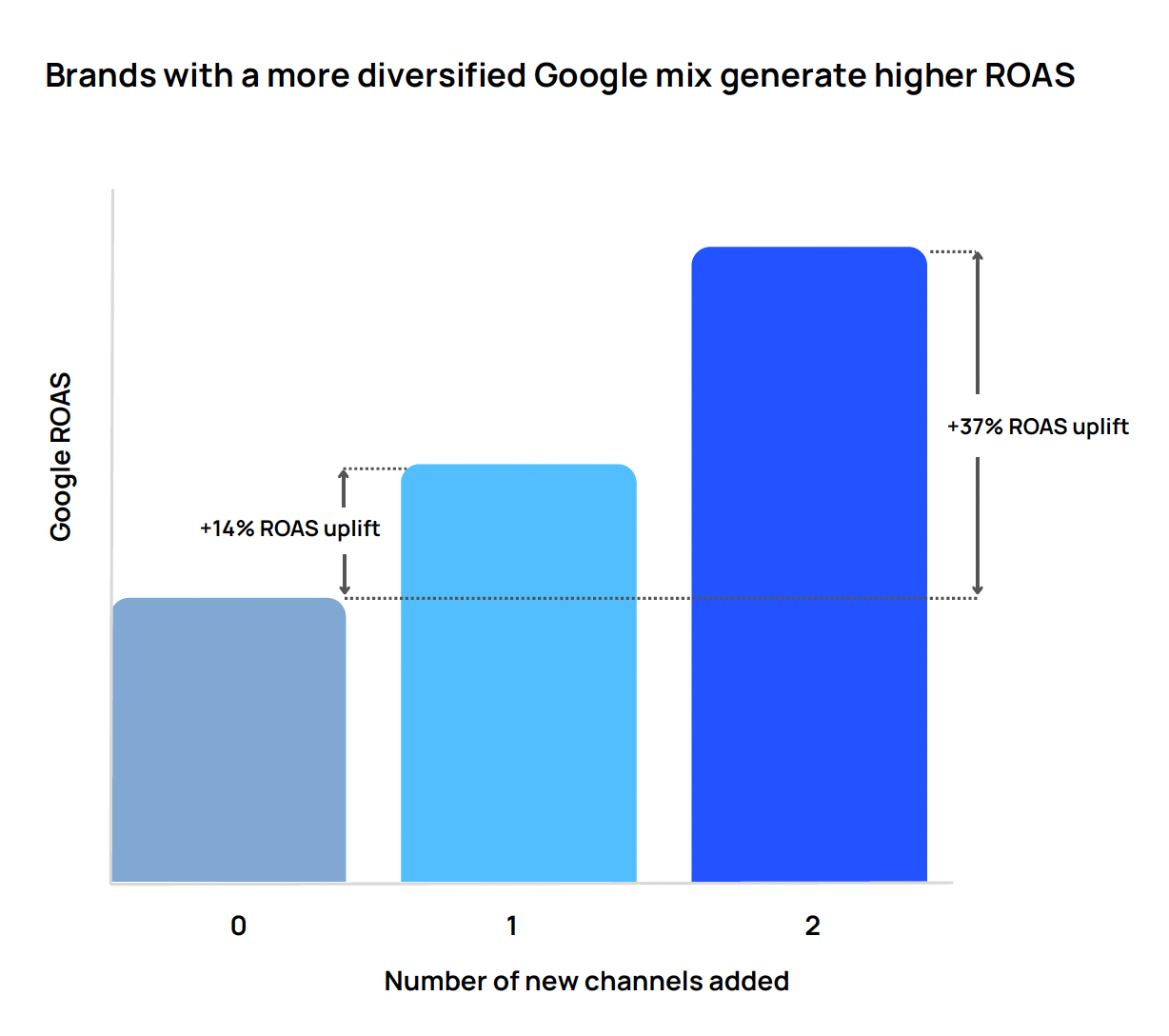
Spending across a broader mix of Google channels maximizes account performance. Data from Fospha's Full-Funnel Google Report (Q4 2025 program) covering 25 retail eCommerce brands found that brands who added one additional channel to an existing Google mix saw 14% higher overall Google ROAS than brands that kept their mix unchanged. Brands that added two channels saw a 37% lift over those that did not grow their channel count. More channels means a broader mix which gives Google's optimization systems more signal, and creates more touchpoints across the same customer journey.
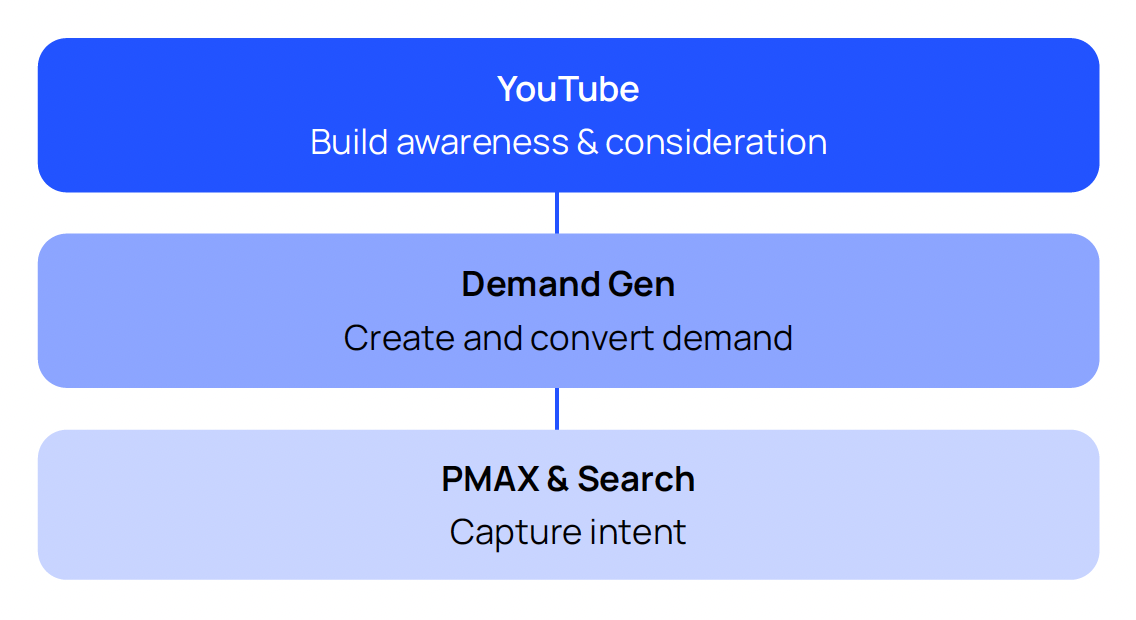
Most brands default to running Google as Performance Max (PMax) plus Brand Search, because those two channels convert existing demand efficiently and are easy to justify on a last-click basis. Last-click credits whichever channel someone clicked right before converting, which structurally favors channels further down the funnel like PMax and Brand Search, and just as structurally undercounts what mid- and upper-funnel channels like Demand Gen and YouTube contributed earlier in that same customer journey.
The problem is that this setup only captures demand - it does nothing to create it. When a marketer is asked to defend a flat or declining Google budget, or make the case for reallocating spend into a new channel, "we've maximized what PMax and Search can do" is often the honest answer but the wrong conclusion. The ceiling isn't PMax and Search's efficiency; it's whether channels further up the funnel are creating enough demand for them to capture.
The Q4 2025 program data backs this up directly: brands that increased Demand Gen spend by 367% and YouTube spend by 118% year over year saw PMax ROAS rise 8% and Brand Search ROAS rise 9%, with CAC falling in both channels. A comparable group that cut YouTube spend by 57% saw the opposite - Brand Search ROAS fell 17% and CAC rose 33% over the same period.
Diversifying doesn't mean spreading budget thin across every format Google offers.
It means adding channels that operate at a different stage of the funnel than what you're already running. Typically:
- YouTube (upper-funnel, builds awareness and consideration at scale), or
- Demand Gen (mid-funnel, creates and converts demand across Discover, Gmail, and YouTube Shorts)
If your account only runs PMax and Brand Search, both are demand-capture channels. Adding either Demand Gen or YouTube introduces demand-creation, which is what expands the pool of people PMax and Search can eventually convert.
The common assumption: add a new line item to a media budget, and overall efficiency dips while the new channel finds its footing. That short-term dip is realistic, and brands should expect one - but the program data shows it doesn't cancel out the medium- and longer-term gain from diversifying.
Two things explain why the net result comes out ahead.
1. First, a broader mix gives Google's systems more signal and more touchpoints across the customer journey to work with.
2. Second, and more importantly, upper- and mid-funnel channels build audience familiarity before someone ever searches or gets shown a PMax ad. By the time that person reaches a conversion-focused campaign, they convert at a lower cost because they're already warm.
This is why brands in the program that added channels didn't do so at the expense of their existing PMax and Search spend - they grew every channel together. Diversification and lower-funnel efficiency reinforce each other rather than compete for the same budget.
This is one of three core learnings in the Full-Funnel Google Report, alongside case studies from four retail eCommerce brands across fashion, beauty, and consumer goods. Download the full report to learn best practices from brands that improved their Q4 2025 performance with full-funnel Google investment to apply within your own strategy.
Corston had already seen strong Demand Gen performance in its UK market, but its French market was still running Google as PMax and Search only. Without a structured plan for scaling a new channel, the team had been reluctant to introduce Demand Gen there - the risk of an unproven channel underperforming felt higher than the upside.
Through the program, Corston launched Demand Gen in France with an incremental spend plan and Google's campaign setup guidance, scaling gradually as results came in rather than launching at full budget on day one.
The result: after introducing Demand Gen, Corston's Google mix drove 61% more new conversions at a 13% improved cost of acquiring a new customer (CAC), year over year. Across the market overall, Q4 performance improved by 47% more revenue, 69% more new conversions, and a 24% better CAC.
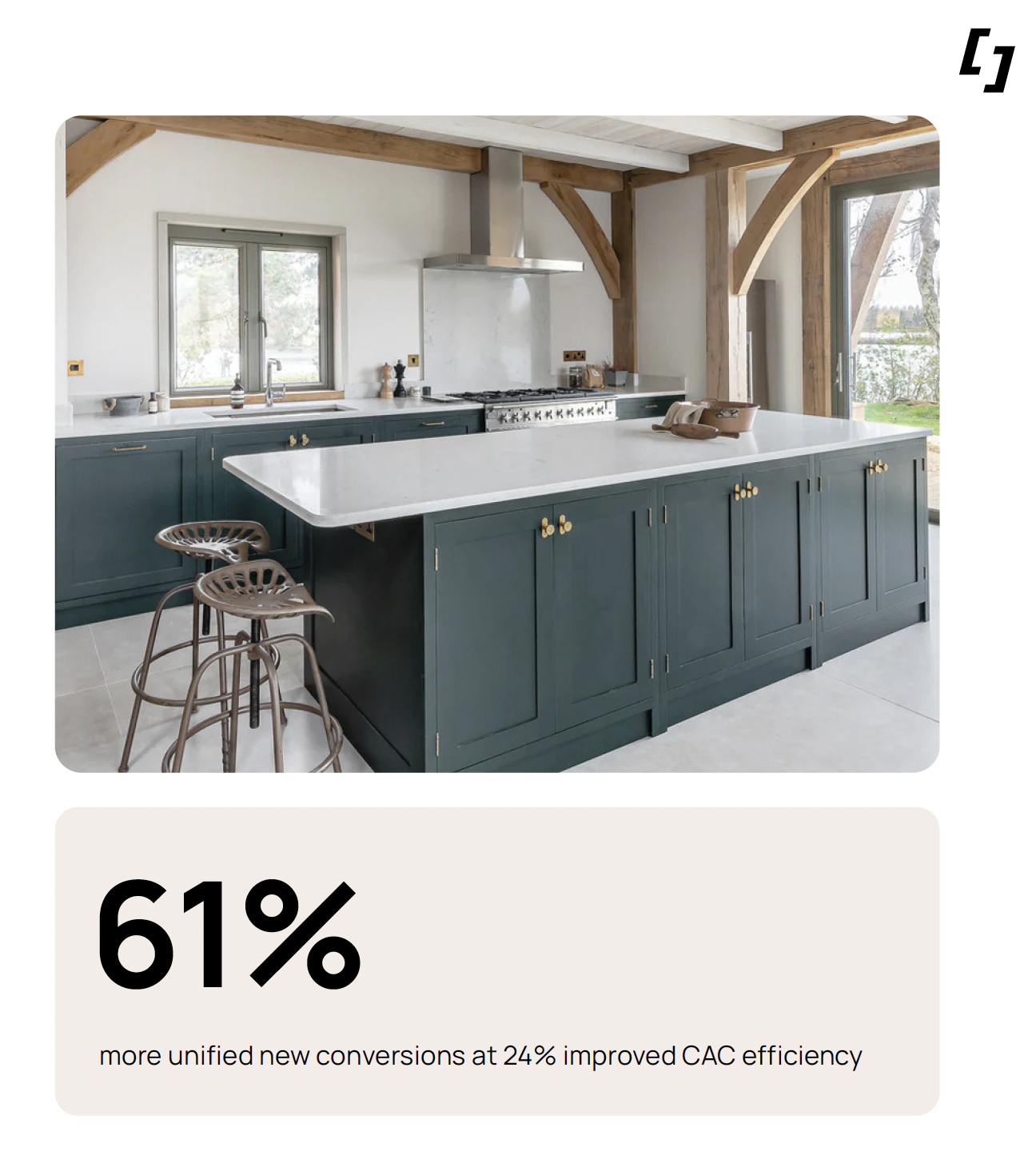
This shows that the improvement landed in the metrics that matter for new customer acquisition (new conversions, CAC) not just in Demand Gen's own reported numbers. That's the signal the new channel was expanding the addressable audience, not cannibalizing existing traffic.
If your account currently runs only PMax and Brand Search, the practical first move is not to guess which channel is 'best' - it's to add one that fills the funnel stage you're missing.
For most brands with no upper-funnel presence, Demand Gen is the more natural starting point - it already runs across multiple upper- and mid-funnel surfaces (Discover, Gmail, YouTube Shorts) in one campaign, and rewards a similar creative approach if you're already comfortable running paid social. YouTube on its own, via dedicated VRC or VVC campaigns, tends to suit brands that already have conviction that video specifically is driving results and want to concentrate spend there rather than spreading across formats.
Whichever you choose, plan for an incremental ramp rather than a full-budget launch - Corston's gradual scaling approach reflects how the algorithm needs time and consistent signal to exit its learning phase.
One way this data gets misread: add a channel, then fund it by cutting PMax or Search budget. That's not what the program's brands did. They grew Demand Gen or YouTube spend alongside their existing channels - the two reinforced each other rather than trading off. Reallocate away from PMax and Search to fund a new channel, and you're not running the strategy this data supports.
Running PMax and Search alone isn't just capped by the audience you're not reaching - it's also a slow-moving risk. Keep showing the same ads to the same finite pool of people, and efficiency typically erodes over time: CAC creeps up as that pool gets smaller and colder.
Diversifying isn't only about upside - it's a hedge against that saturation, spreading demand-creation across more surfaces before PMax and Search run out of new audience to work with.
The program data showed a 14% ROAS lift from one additional channel and 37% from two, and Corston's case study shows what that looks like at the level of new conversions and CAC in a single market.
The next question is how much to invest in that new channel once you've added it - which is where Demand Gen's budget-allocation data comes in.
Do I need to add both Demand Gen and YouTube to see a ROAS improvement?
No - the program data shows a meaningful lift from adding just one channel (14%), with a larger lift from two (37%). Which one to start with depends on your situation - see the guidance above on choosing between Demand Gen and YouTube.
Won't a new channel just cannibalize what's already working in PMax or Search?
The program data suggests the opposite over time, but expect a learning period for the new channel itself. Budget for incremental scaling rather than judging it on week-one results.
Is this specific to retail eCommerce brands?
The program's cohort was retail eCommerce brands (fashion, beauty, consumer goods) across 28 market deployments, so the figures cited are directional for that vertical specifically - the underlying mechanism (audience warming ahead of conversion campaigns) is not retail-specific, but the exact percentages shouldn't be assumed to transfer to other verticals.


.png)

%20and%20how%20does%20modern%20MMM%20work%3F.png)