Why is Black Friday won in Q1, not Q4?
Top-quartile brands don't switch on upper-funnel spend for peak, they hold it above 20% all year round. Here's the client data behind why Q4 is won early.
All
Learn More

Mixed-format YouTube campaigns drive 40% higher ROAS than In-Stream alone. Learn why full-funnel measurement is key to proving YouTube's top-of-funnel impact.
AI-powered YouTube campaigns that mix In-Stream, In-Feed, and Shorts placements deliver 40% higher ROAS than running In-Stream alone, according to Google's performance data cited in Fospha's Full-Funnel Google Report. Most brands still run YouTube as a single-format channel, leaving a meaningful chunk of that performance on the table.
YouTube sits at the very top of Google's funnel - the channel responsible for making people aware a brand exists, before they've searched for it or shown any buying signal at all. With over 2.7 billion monthly active users and more than a billion hours of video watched daily, YouTube reaches a vast, highly engaged audience.
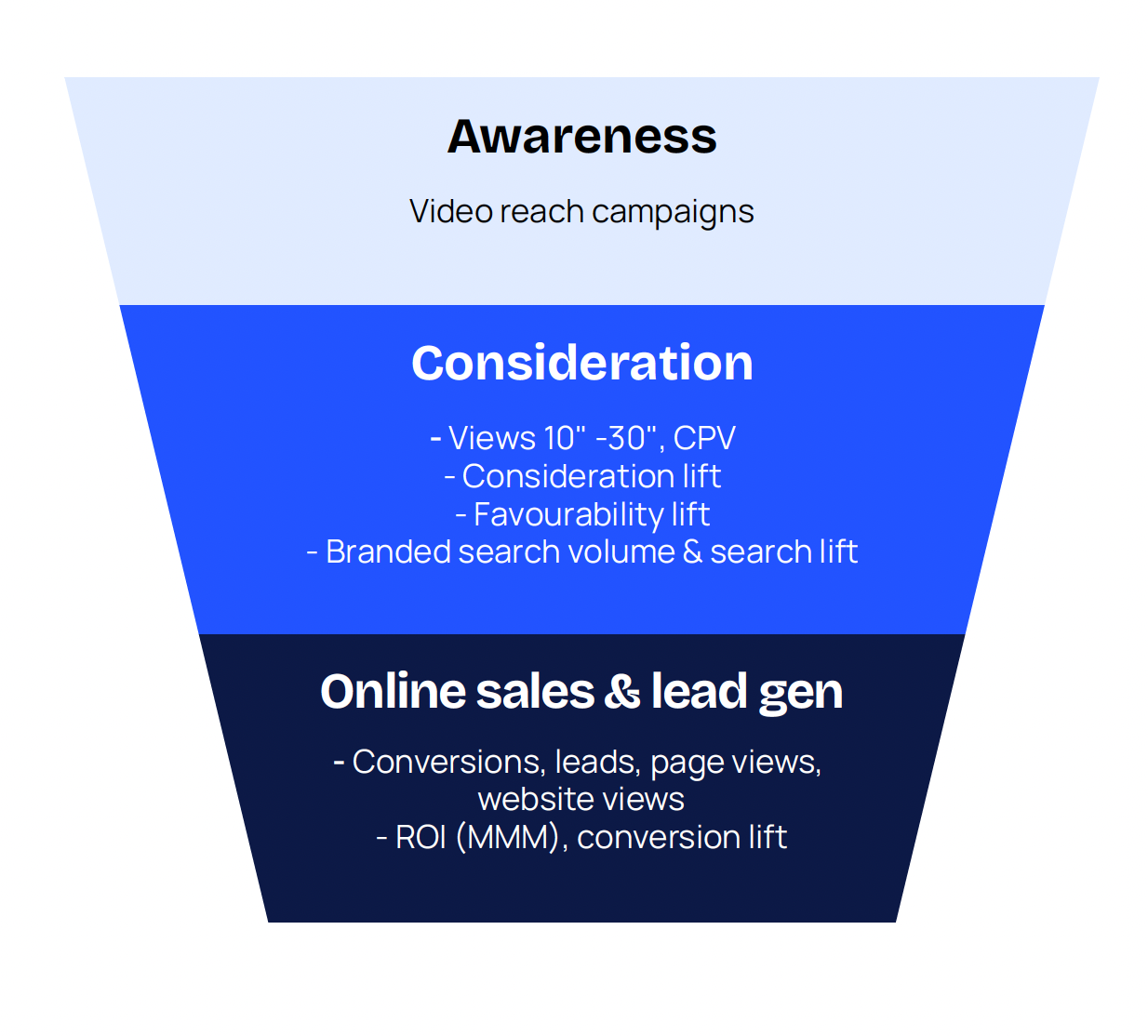
What that awareness really looks like moves through stages: a video reach campaign builds initial recognition, and consideration shows up afterward as watch-through views, rising favorability, and increased branded search volume - concrete, measurable signals that someone is starting to recognize and warm to a brand before they've converted on anything. That consideration is what feeds Demand Gen, which turns it into active interest across Discover, Gmail, and YouTube Shorts, before PMax and Brand Search do most of the work converting that intent (though both can pick up some incremental demand along the way too). None of this shows up as a direct sale, which is exactly why YouTube is also the channel most often treated as optional, or cut first when budgets tighten.
YouTube's impact is impression-driven, not click-driven - someone sees an ad, doesn't click, and converts through Search two weeks later. Click-based attribution has no way to connect those two events, so it systematically understates YouTube's actual contribution. Full-funnel measurement, which tracks a person's full journey rather than just their last touchpoint, is what makes that contribution visible - without it, a genuinely effective channel can look weak simply because click-based attribution isn't built to see impression-driven impact.
Brands investing in both YouTube and Demand Gen saw 32% stronger blended revenue growth year over year than brands that didn't scale these channels, according to Fospha's cross-client analysis from 2025 - and the most aggressive scalers, increasing spend by 400% or more, saw 145% stronger growth. This is a separate study (not the Q4 2025 Deep Dive program) with a global sample of 127 retail brands.
This cross-client stat only scratches the surface. The Full-Funnel Google Report covers the full Q4 2025 program - channel diversification, Demand Gen budget benchmarks, and the upper-funnel halo effect on PMax and Brand Search - all benchmarked against a matched control group. Download the report and see where your own account stacks up.
Treat it as always-on
Match campaign type to objective
Embrace AI-powered mixed formats
Follow creative and audience recommendations
YouTube's job is to build awareness at a scale no other Google channel can match, and its return compounds with consistent, always-on investment rather than sporadic bursts. That return is easy to miss as click-based measurement wasn't built to see impression-driven impact, which is why full-funnel measurement matters most for this specific channel.
Related reading: Why Diversifying Your Google Mix Improves ROAS | How Much of Your Google Budget Should Go to Demand Gen | Why Upper-Funnel Spend Makes PMax and Brand Search Work Harder
Do I need to invest in YouTube and Demand Gen together, or can I start with just one?
The 32% / 145% growth figures are for brands scaling both together, so the data doesn't isolate YouTube's standalone contribution. If you're choosing a starting point, YouTube suits brands with the weakest awareness, while Demand Gen suits brands where some awareness already exists but isn't converting.
Is there a recommended minimum YouTube budget, the way there is for Demand Gen?
The report doesn't specify one for YouTube the way it does for Demand Gen's $130/day campaign minimum - the strongest guidance here is about consistency of spend over time, not a specific floor.
Do I need professional video production to get started?
The data doesn't speak to production quality directly. What it does support is format variety (horizontal and vertical assets, all three placement types) over investing everything in a single polished asset.
How would I know if YouTube is working, given last-click understates it?
Track Brand Search and PMax CAC or ROAS trends against YouTube spend changes over time, or use measurement that credits assists rather than only final clicks.



.png)


%20and%20how%20does%20modern%20MMM%20work%3F.png)