Why is Black Friday won in Q1, not Q4?
Top-quartile brands don't switch on upper-funnel spend for peak, they hold it above 20% all year round. Here's the client data behind why Q4 is won early.
All
Learn More

Most brands treat Demand Gen as a token test budget. Fospha's Full-Funnel Google Report shows scaling it to 10–20% of Google wallet doubles account-wide ROAS.

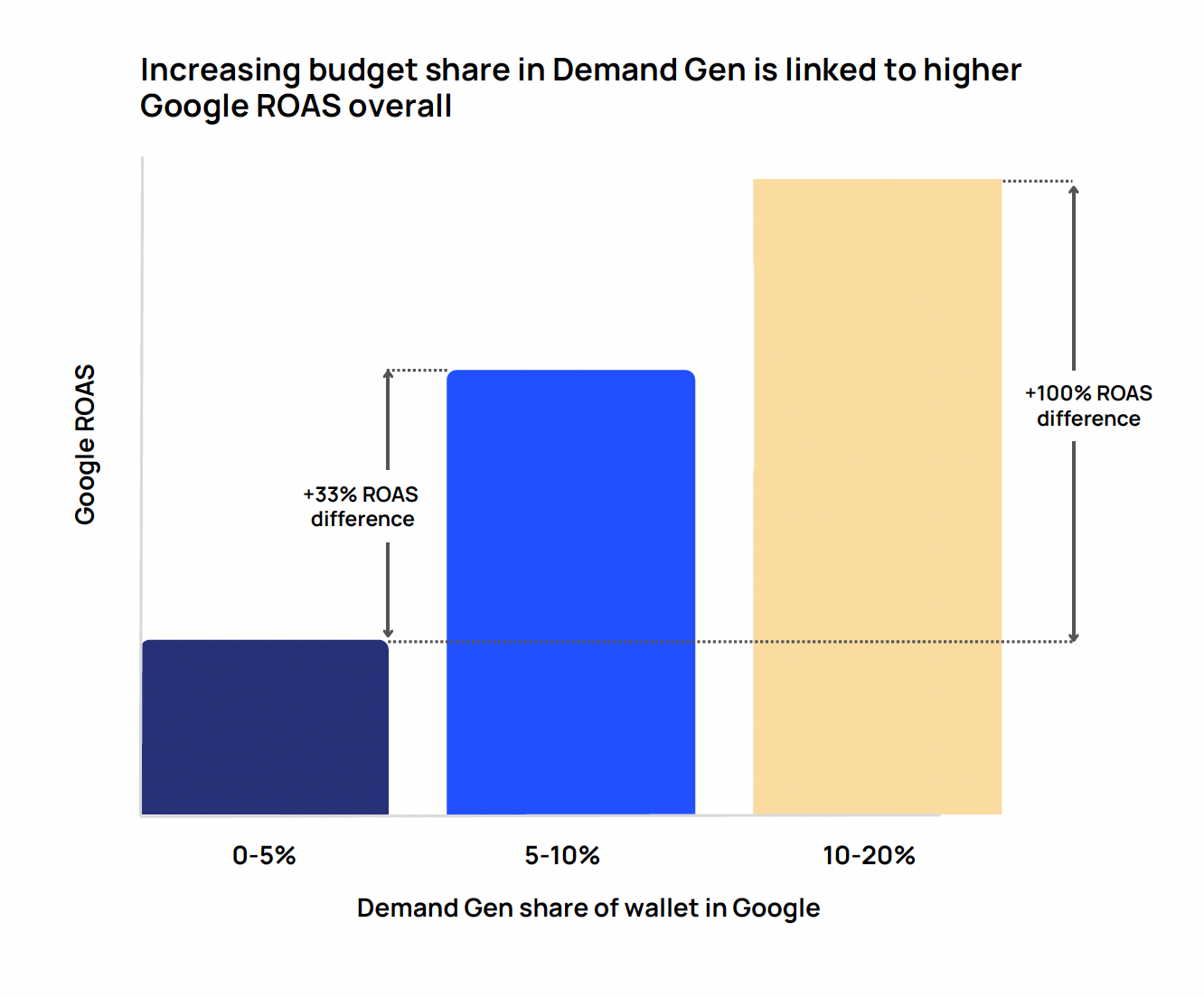
Google gives brands a full-funnel ad ecosystem in one platform - awareness, interest, and intent, all under one roof. Scaling Demand Gen investment is how you get more out of that system, and the strongest results come from funding it with incremental investment rather than reallocating from PMax or Search. Data from Fospha's Full-Funnel Google Report (Q4 2025 program) covering 25 retail eCommerce brands found that brands allocating 10–20% of their Google budget to Demand Gen saw 100% higher Google ROAS vs brands allocating 0–5%. That single data point points to a specific, actionable number for anyone currently running or planning to invest in Demand Gen.
Demand Gen is Google's AI-driven campaign type that runs across Discover, Gmail, and YouTube - the visual, scroll-based surfaces where people aren't actively searching for anything, but are still open to noticing a brand. It sits in the middle of a three-stage system: YouTube builds awareness at scale, Demand Gen turns that awareness into active interest, and Performance Max (PMax) and Brand Search capture the intent both create.
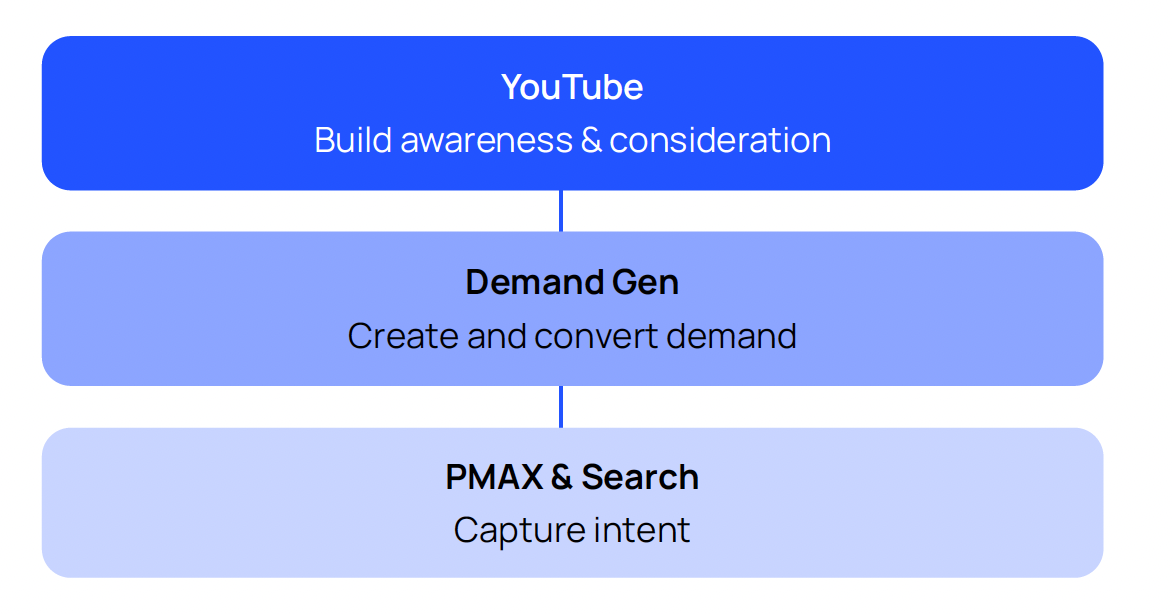
That system only works if each stage gets enough investment to do its job.
PMax and Brand Search are typically the last touchpoint before a conversion - strong demand-capture channels, converting people who are already searching or who already recognize your brand. That's where most of their return comes from, though both can pick up some incremental demand along the way too.
Demand Gen and YouTube are what expand the pool of people PMax and Search have to work with in the first place. PMax and Search win auctions off existing intent signals (a branded search query, a remarketing list, a customer-match audience) so the more upstream activity is creating new awareness, the larger that pool grows. Well-funded Demand Gen and YouTube keep feeding PMax and Search a steady stream of people who already know your brand, which is what keeps cost per conversion efficient even as audiences naturally churn over time.
Brands that scaled Demand Gen and YouTube together saw PMax and Brand Search CAC fall. A comparable group that scaled Demand Gen more modestly and cut YouTube spend saw CAC rise in those same channels instead. The lower-funnel numbers move in direct response to what happens upstream - which is why cutting upper-funnel spend to "protect efficiency" usually does the opposite.
Most brands that add Demand Gen to their Google mix treat it as a small test budget - just enough to say they're "doing full-funnel" without giving it the weight to really do that job. That pattern leaves real room to scale: the data shows the clearest returns start at 10–20% of Google wallet, a threshold most test-budget allocations never reach.
Within the program's Deep Dive cohort, Demand Gen's share of Google wallet tracked closely with overall account ROAS. Brands at 5–10% of wallet already outperformed those at 0–5% - a 33% difference in Google ROAS. Push further, to 10–20% of budget, and that gap widens to 100% - the number behind the headline stat above. The report doesn't test budget shares beyond 20%, so the data supports scaling toward that range, not a claim that more is unconditionally better past it.
None of this shows up in last-click reporting, the default view most Google accounts are measured against. Last-click correctly credits whichever channel closes a conversion, but it wasn't built to see the audience Demand Gen warms up earlier in the journey for Brand Search and PMax to close later.
It seems like putting more budget into one channel, especially one still building its own efficiency, would drag down your blended Google ROAS - and in the short term, some dip is realistic while that channel exits its learning phase, the same as any new campaign finding its footing. But that early dip doesn't cancel out the medium-term gain: once Demand Gen matures, blended ROAS moves the opposite way.
Demand Gen does two jobs inside a single campaign type. Lower-funnel placements, such as a product ad surfacing in Gmail, drive direct response on their own. Higher-funnel placements, like an in-feed YouTube video ad, build the awareness that PMax and Brand Search later convert.
That dual role shows up in the account's overall ROAS, not just Demand Gen's own number. Demand Gen drives ROAS directly through its own conversions, and lifts ROAS further down the funnel by creating warmer audiences that PMax and Brand Search convert with more cost efficiency. Demand Gen's own last-click reporting never gets credit for that second effect, which is why blended ROAS is the number to watch, not any one channel in isolation.
This budget threshold is one of three core findings in the Full-Funnel Google Report - alongside the diversification and upper-funnel findings, YouTube-specific benchmarks, and detailed brand case studies including Corston and Derek Rose. Download the full report to see exactly how each one plays out.
Finisterre had historically leaned on lower-funnel Google activity to drive efficiency during peak periods.
That approach converted well, but did little to expand who saw the brand in the first place - performance was capped by how many people were already searching for it.
Through the program, Finisterre and its agency, Push, made Demand Gen the primary upper-funnel lever heading into Q4, tracking not just Demand Gen's own returns but its downstream effect on Brand Search. Over the program window (29 October–16 December 2025), Finisterre increased Demand Gen daily spend by 5.7x.
The results:
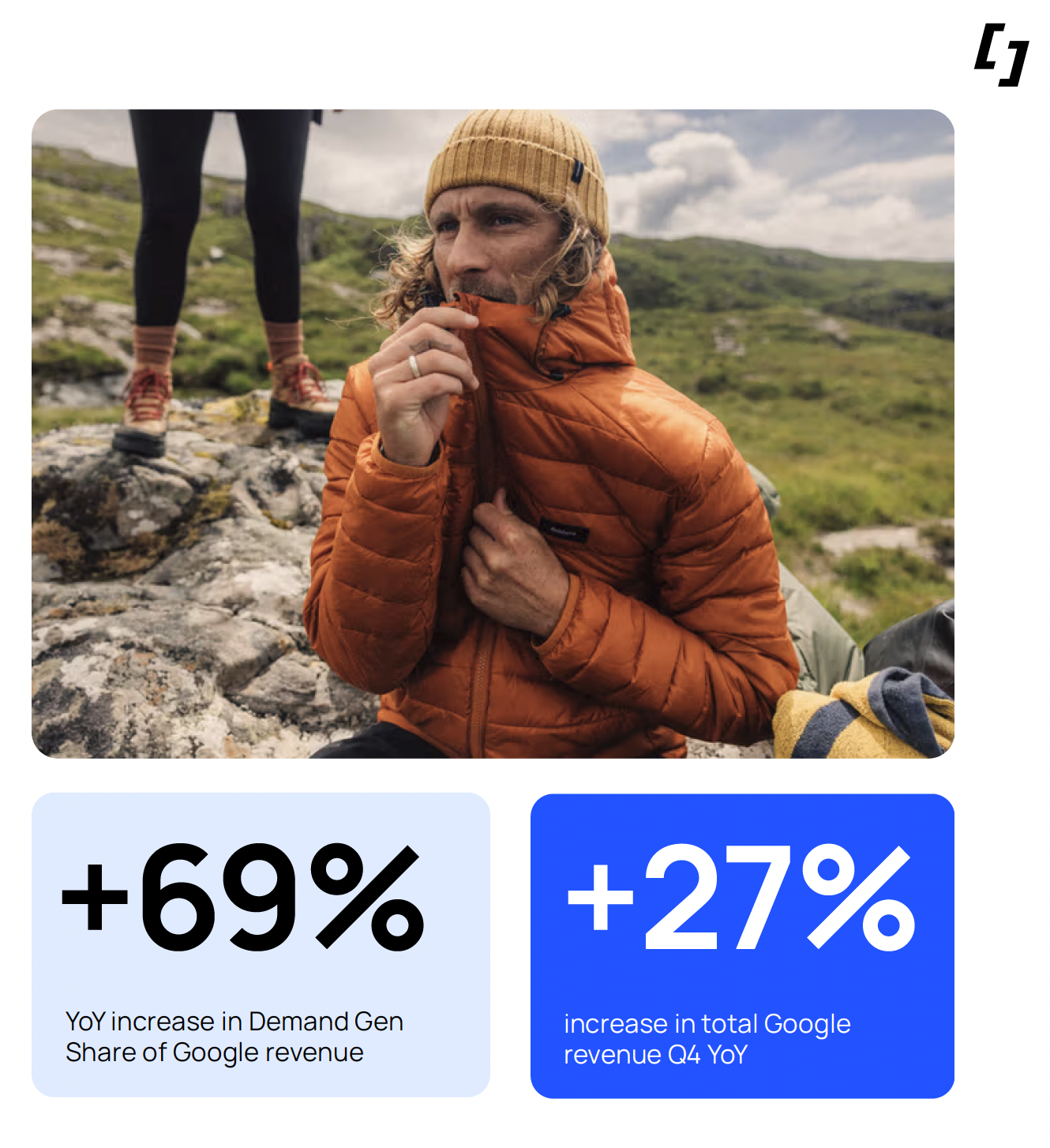
Brand Search CAC fell 73% over the same Q4 period, and total Google revenue grew 27% year over year - a more balanced full-funnel approach paying off in the metrics that matter most. Demand Gen's own share of Google revenue rose 69% year over year, becoming the brand's single biggest driver of incremental revenue across the account.
Two things commonly undercut Demand Gen results: pulling budget before the algorithm has had time to learn, and moving bid targets too aggressively once it's running.
Both mistakes come from judging a channel that's still building signal by the same standards as one that's already optimized - cutting spend at week two because results look thin usually kills a channel that was about to start working, and swinging bids to chase a bad day resets progress that took weeks to build.
A third mistake is funding Demand Gen by cutting PMax or Search's budget rather than adding to it. Brands that scaled Demand Gen and YouTube didn't reduce their PMax and Search investment - they grew it, treating the Google mix as one connected system rather than a fixed budget to redivide.
The checklist below has the specific thresholds to plan around.
If Demand Gen currently sits below 5% of your Google wallet, the data suggests there's real headroom to grow toward the 10–20% range. The program's data points to these specific thresholds:
Set your benchmarks
- Starting budget: ~$130/day minimum per campaign
- Bid strategy: Maximize Conversions is the dominant choice - used by 68% of the Deep Dive cohort and 55% of top Fospha Demand Gen advertisers at launch
- Primary goal: Purchases, used by 61% of advertisers
Prioritize high-performing creative
- Pull from existing social channels over building net-new
- Minimum 9 assets (3 horizontal videos, 3 vertical, 3 square)
- Design each around Attract, Brand, Connect, or Direct to match how people engage across YouTube Shorts, Discover, and Gmail
Adopt an "always-on" strategy
- Budget for 50+ conversions within 30 days before judging results
- Stay within ±15% bid changes once live to avoid resetting the algorithm
- Drop to a maintenance budget in slow periods rather than pausing outright
- Scale gradually - Finisterre's 5.7x increase was ramped over the roughly seven-week program window
Leverage campaign segmentation
- Start with one campaign, split into Prospecting and Retargeting at the ad group level
- Keep it lean - Deep Dive brands ran an average of 2.2 active campaigns per client-market combination; 43% ran just one
- Use Customer Match lists to build lookalike segments, and enable optimized targeting to find high-value users beyond your manually selected audiences
Demand Gen's return doesn't scale in a straight line with spend - it scales in bands, and 10–20% of Google wallet is where the program's data shows the clearest step up in account-wide ROAS.
Getting there takes patience through the learning phase and disciplined bid management, but Finisterre's result shows what's possible once a brand commits to Demand Gen as more than a test line item.
Critically, this isn't a trade-off between channels: the report's own evidence shows brands who scaled Demand Gen and YouTube didn't reduce their PMax and Search investment - they grew it, with every part of the Google mix expanding together.
Related reading: Why Diversifying Your Google Mix Improves ROAS
Does the extra Demand Gen budget need to come from PMax or Search?
No - the program's brands grew Demand Gen spend alongside their existing channels rather than reallocating away from them. Cutting PMax or Search to fund Demand Gen isn't the strategy this data supports.
What if I can't get budget approval for 10%+ right away?
Start where you can. The data shows 5–10% already outperforms 0–5%, so a smaller allocation is still worth making - it just won't show the same step-change in ROAS that the 10–20% bracket does.
Is there a point where more Demand Gen budget stops helping?
The report doesn't test allocations above 20% of Google wallet, so there's no data here on where returns might flatten. Treat 10–20% as the range with evidence behind it, not a ceiling to push past by default.
How long before I'll see results?
Budget for at least 30 days before judging performance - that's the window the report ties to exiting the algorithm's learning phase, and judging results earlier risks writing off a channel that hasn't had time to prove itself.


.png)

%20and%20how%20does%20modern%20MMM%20work%3F.png)