Why is Black Friday won in Q1, not Q4?
Top-quartile brands don't switch on upper-funnel spend for peak, they hold it above 20% all year round. Here's the client data behind why Q4 is won early.
All
Learn More

New Fospha data: cutting YouTube spend by 57% dropped Brand Search ROAS 17% and raised CAC 33%, even with PMax and Search strategy unchanged.
Google's arsenal extends far beyond Search and brands that invest across Google's full funnel see better efficiency at every stage. Brands that scaled Demand Gen and YouTube together saw Performance Max (PMax) ROAS rise 8% and Brand Search ROAS rise 9% year over year, with CAC falling in both channels - while a comparable group that cut YouTube spend saw Brand Search ROAS fall 17% and CAC rise 33% over the same period, according to Fospha's Full-Funnel Google Report (Q4 2025 program). Same platform, same lower-funnel channels, opposite outcomes - the difference was what each group did upstream.
PMax and Brand Search aren't lesser channels waiting to be replaced by Demand Gen and YouTube - they're still where the intent they've built gets captured and converted. The strongest brands in the program treated all four as one connected system rather than separate budgets competing for the same pool of spend, and that's the mindset shift this data supports.
When PMax or Brand Search efficiency stalls, the instinct is to fix it from inside those channels: adjust bids, rework the feed, tighten targeting. Those levers matter, but they all assume the ceiling on performance is something PMax and Search control. The program's data points somewhere else - toward how warm the audience already is by the time it reaches those campaigns, which is a function of what's happening in Demand Gen and YouTube, not PMax's own settings.
PMax and Search are built primarily to capture existing interest, though PMax's automated targeting can also surface some incremental demand - someone searches, or fits a targeting signal, and the campaign converts them if it can. That's exactly the job they're built for: without a channel doing this well, upstream demand never turns into revenue. How much of that job they get to do, though, is shaped by how much warm demand Demand Gen and YouTube are sending their way.
YouTube builds that initial awareness at scale, Demand Gen turns it into active interest across Discover, Gmail, and YouTube, and by the time someone reaches a PMax or Search ad, they're easier and cheaper to close than someone arriving cold.
PMax's own settings haven't changed here - the audience arriving at it has, and that's the real driver of the gains.
The program compared a cohort of 25 eCommerce brands who took part in Fospha and Google's Q4 2025 program, against a matched control group of similar advertisers who didn't take part. The two groups made different bets on upper-funnel spend, and the results diverged sharply:
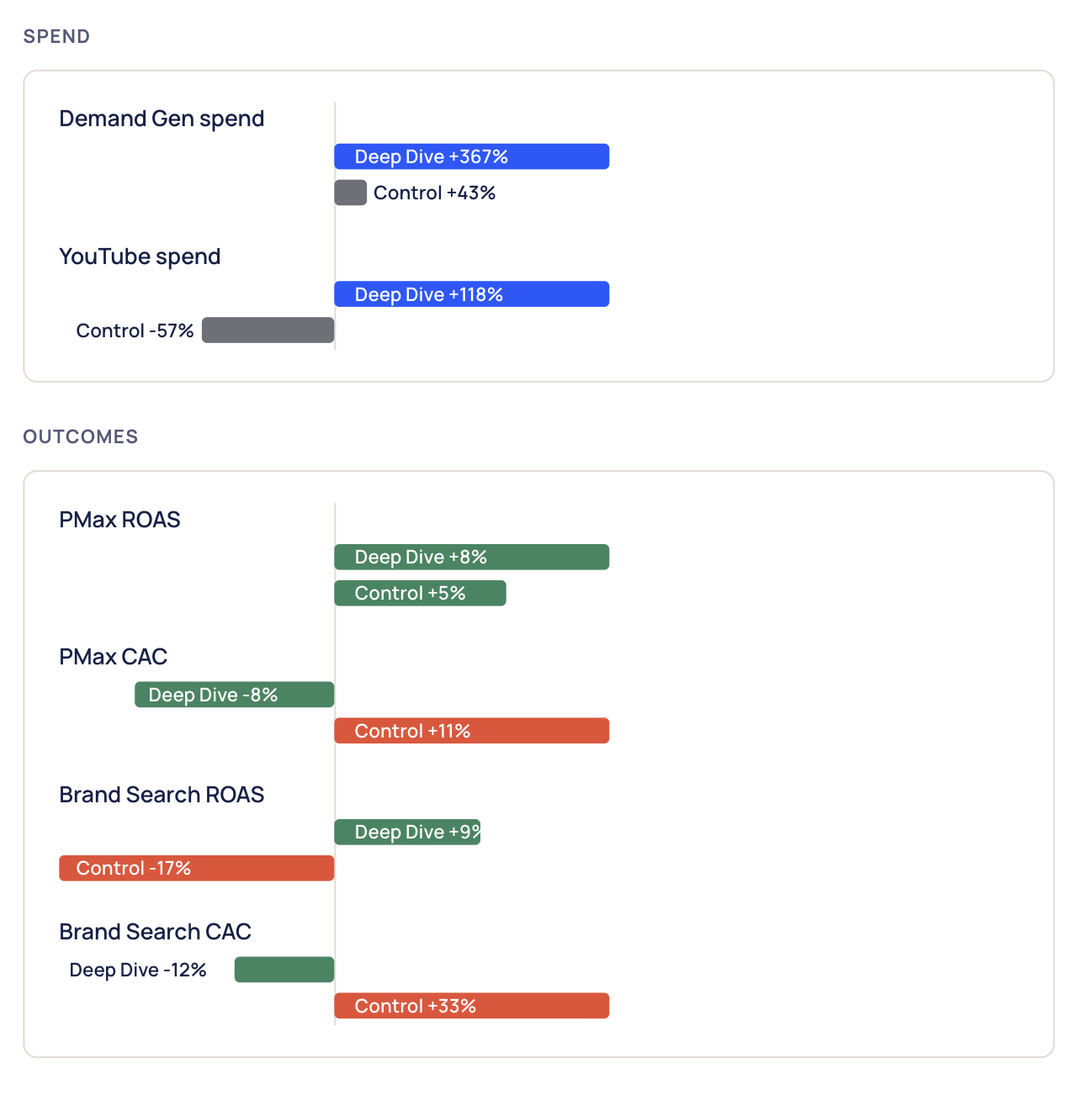
The Support Program group scaled Demand Gen aggressively and kept growing YouTube. The control group grew Demand Gen only modestly and cut YouTube spend by more than half. Both groups kept running PMax and Brand Search the same way - the only meaningful difference was what happened upstream, and that's what tracked with the gap in results.
If you're judging PMax and Brand Search purely on their own last-click numbers, this pattern is invisible. Last-click credits whichever campaign someone clicked right before converting - it has no way to trace that conversion back to a YouTube ad they saw three weeks earlier, or a Demand Gen impression that made the brand name familiar. A team optimizing PMax and Search in isolation would see the ROAS change but never connect it to a decision made in a completely different part of the account. Seeing this pattern at all requires measurement that tracks a person's full path, not just their last touchpoint - which is exactly the gap full-funnel measurement is built to close.
This comparison is one of three core findings in the Full-Funnel Google Report, alongside channel diversification guidance and Demand Gen budget benchmarks. Download the full report for the full methodology.
None of the pattern above shows up without measurement built to see it. Last-click attribution, by design, credits only the final touchpoint - which means it structurally overvalues channels that capture demand and undervalues the ones that create it - which is exactly why PMax and Brand Search look self-sufficient on a standard dashboard, even while their efficiency is being shaped by decisions made somewhere else in the account. Full-funnel measurement is what makes that connection visible - and once it is, the case for investing across the full funnel, not just the channels a dashboard already rewards, gets easier to make with confidence.
The control group's YouTube spend fell 57% year over year - the single biggest difference between the two groups' strategies, and it lines up with Brand Search being the metric that moved the most in the wrong direction (ROAS down 17%, CAC up 33%).
Part of the reason a YouTube cut does more damage than it looks like it should: YouTube's algorithm needs consistent, always-on spend to stay out of its learning phase. Turning it down or off resets the targeting and bidding progress that's already been built up, a cost that shows up somewhere else in the account.
- Don't treat YouTube as flexible budget. It's usually the first channel cut when budgets tighten, but the control group's results suggest that's exactly backward - cutting it can quietly cost you efficiency in channels you're not touching at all. Fund the increase with incremental budget rather than pulling from PMax or Search - the gains in this data came from growing both ends of the funnel together, not reallocating between them.
- Keep YouTube spend consistent rather than pausing and restarting. Switching it on and off prevents the algorithm from exiting its learning phase, undoing progress that took time to build.
- Track PMax and Brand Search CAC alongside upper-funnel spend changes, not in isolation. If CAC moves after a Demand Gen or YouTube budget change, that's a signal worth investigating especially if nothing changed inside PMax or Search itself.
- Use measurement that can see beyond last-click before concluding an upper-funnel channel "isn't working." Its own last-click ROAS was never designed to capture this effect.
- If budget is tight, build upper-funnel investment ahead of peak trading rather than spreading it flat across the year.
PMax and Brand Search's efficiency ceiling is set by how warm their audience already is when it arrives - which depends on what's happening in Demand Gen and YouTube, not on anything inside PMax or Search itself. The program's Support Program group and control groups ran identical lower-funnel strategies and got opposite results, and the only real difference was upstream investment. This creates a virtuous cycle, not a trade-off: better lower-funnel performance is what builds the business case to invest more in Demand Gen and YouTube, which in turn makes PMax and Brand Search work harder still. Crucially, this works because upper-funnel investment is funded incrementally, not carved out of PMax and Search - the Support Program brands grew both ends of the funnel together, rather than shifting budget from one to the other.
Related reading: Why Diversifying Your Google Mix Improves ROAS | How Much of Your Google Budget Should Go to Demand Gen
Should I cut PMax or Search budget to fund more upper-funnel spend?
No - the Support Program group grew Demand Gen and YouTube while maintaining their PMax and Search investment, not by taking budget from it. Reallocating away from lower-funnel channels isn't the strategy this data supports.
Was this Demand Gen's effect, YouTube's, or both?
The report doesn't isolate the two - the Support Program group scaled both together (+367% Demand Gen, +118% YouTube), so this is evidence for upper-funnel investment broadly rather than a case for either channel in isolation.
How would I know if this is happening in my own account?
Last-click reporting won't show it. You'd need to track PMax and Brand Search CAC or ROAS trends against upper-funnel spend changes over time, or use attribution that credits assists, not just final clicks.
What if I can only afford to invest in one of Demand Gen or YouTube?
The report doesn't test that scenario directly - the Support Program cohort scaled both together, so there's no data here on which one to prioritize alone. As a starting point, YouTube tends to matter more when awareness is the gap; Demand Gen tends to matter more when people already know the brand but aren't yet converting.



%20and%20how%20does%20modern%20MMM%20work%3F.png)