Why is Black Friday won in Q1, not Q4?
Top-quartile brands don't switch on upper-funnel spend for peak, they hold it above 20% all year round. Here's the client data behind why Q4 is won early.
All
Learn More

Most brands build peak budgets around last year's channel split. This lesson breaks down what the top 25% of brands do differently - testing hard during BAU, then scaling only what's already proven once peak arrives.
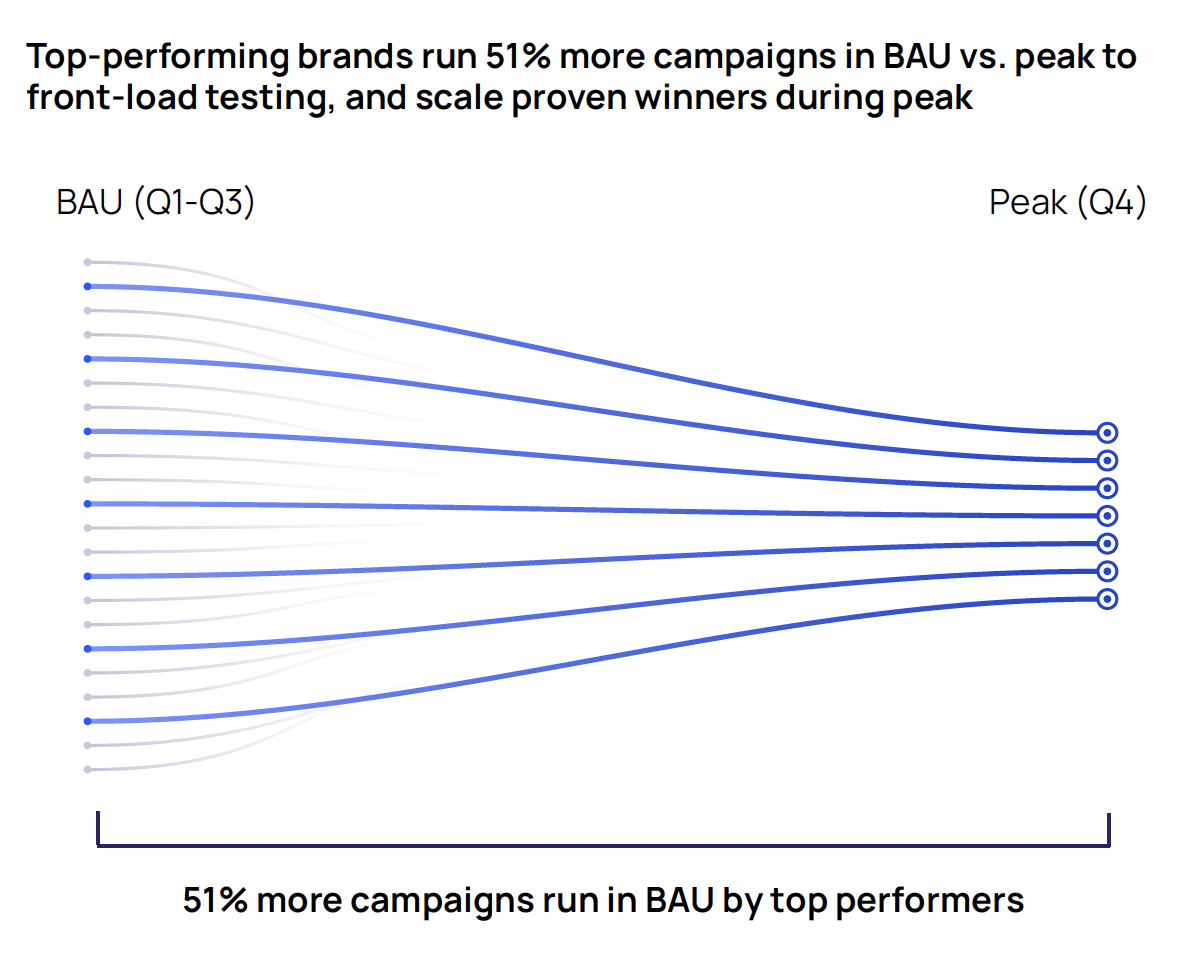
Test-and-scale is the practice of running a wide spread of small campaign tests during BAU, the January-through-September stretch, then narrowing that spread into fewer, larger campaigns once peak begins. Data from Fospha’s top-performing brands during peak confirms this: brands who generated the most ROAS during peak (Q4) ran 51% more campaigns during BAU than during peak, then increased spend per campaign by 48% year over year once peak arrived. By the time November arrived, they already knew what worked, because they'd spent the months before peak testing and validating it.
Most peak media plans get built one of two ways. Some take last year's channel split and add more budget. Others wait until a channel looks obviously good before committing real money to it, which usually means committing once peak is already underway, the most expensive, most competitive point of the year, with much of the market bidding for the same demand at the same time.
The top-performing brands in this data do neither. They treat the months before peak as a proving ground, cheap to be wrong in, and bring that evidence into peak as a scaling decision instead of a guess.
The shift worth internalizing: brands that scale well plan peak in advance rather than reacting to it once it's underway.
There are two different jobs happening across the year, and each calls for a different kind of budget. BAU months are for running more campaign variants, formats, audiences, creative angles, than you'd ever risk keeping, just to see which ones hold up. Peak is for pulling money out of the ones that didn't and concentrating it behind the ones that did.
Brands that scale well during peak made that call months earlier, using data they'd already collected, while most teams are still working off last year's split.
The instinct is to wait until a channel proves itself before committing real money to it, using whatever reporting you already trust. That's sensible on the surface, and it runs into two problems.
1. Measurement: Last Click tends to undercount newer or upper-funnel channels, because it only credits the final touchpoint. A channel driving real incremental sales through a halo effect into search or direct traffic can look like it's underperforming, right up until it's tested with an incrementality approach.
2. Timing: If you wait for a channel to look obviously good under a lens with a known blind spot, you're often waiting until it's already crowded and expensive. The brands who moved into emerging channels early captured the cheapest reach before the rest of the market caught up.
The top-performing brands in this dataset aren't treating Reddit, RTB House, and Pinterest as afterthoughts. They're putting close to 30% of peak budget behind emerging and mid-size channels like these, compared with 21% for the rest of the market.
That gap shows up clearly in the results. Several channels and automated formats told a similar story:
- RTB House: a 105% year-over-year ROAS increase, alongside a 19.6x revenue multiple
- Reddit: cost per purchase down 70%, alongside a 4.2x revenue multiple
- Pinterest Performance+: ad spend up 124% year over year, winning roughly 80% of head-to-head tests against manually built campaigns
- Google Demand Gen: brands allocating 10 to 20% of wallet share saw close to double the ROAS of brands allocating under 5%
- Meta Advantage+: 94% more revenue and 19% lower customer acquisition cost, on 30% more spend
- TikTok Smart+: adoption roughly tripled year over year, from 16% to 50% of brands, with spend scaling 14 times over
For Reddit, RTB House, and Pinterest, that payoff traces back to timing: brands moved in before the rest of the market caught up, while reach was still cheap.
Acceler8 Labs, a growth agency that works exclusively with scaling DTC and retail brands, sees the same thing across its own client base. Brands that wait for a channel to look "proven" usually end up testing it for the first time in the exact months it's most expensive to test. As Acceler8 co-founder Niket Shah puts it: "If your first touchpoint with a customer is a Black Friday ad, you're paying peak prices to introduce yourself.
Demand Gen and the AI-led automation formats tell a related but separate story, spend allocated toward them is outperforming spend that isn't, regardless of when a brand adopted them. Within Google's own stack specifically, Demand Gen is increasingly run alongside Search, Performance Max, and YouTube rather than in isolation.
Scaling decisions aren't only about which channels have earned more budget. They're also about whether your funnel is balanced enough to support scaling at all.
In this same Q4 2025 client data, the top 25% of brands by ROAS held 24% of their funnel spend in Awareness and Consideration, compared with 10% for the bottom 75%, a gap of nearly 1.7x. That's not just a peak number either. Top performers kept upper-funnel spend above a 20% floor in every quarter of the year, while the bottom 75% stayed around 9 to 11% year-round.

This matters for scaling because upper-funnel spend is usually the first thing cut when budgets tighten, and it's the most expensive thing to rebuild once it's gone. A brand that's let its Awareness and Consideration spend drift down going into peak is scaling from a weaker base, even if its lower-funnel numbers look fine.
A strong campaign can still be structurally unready to scale. Acceler8 Labs flags a common mistake: brands carry eight to twelve fragmented test campaigns into peak instead of consolidating them into fewer, cleaner ones with stronger signal.
The playbook's guidance is to consolidate six to eight weeks out from peak, not during it. Some splits are worth keeping, new customers versus returning, top sellers versus the wider catalog, because they serve a real purpose. Others are just leftover structure that should have been merged earlier.
There's a timing cost to changing that structure too. AI-led formats like Advantage+ and Performance Max need roughly one to two conversion cycles to exit their learning phase, and that reset is far cheaper in September than in November.
Niket Shah, puts it well. "Every restructure has a tax. Pay it in September when CPMs are cheap, not in November when they're not."
Deciding what to scale gets harder to do well if you're relying on a reporting model that leaves a structural gap in how it credits certain channels. This is where incrementality testing earns its place in the pre-peak calendar.
Running lift or geo tests on channels with headroom, before you've committed serious budget, gives you a clearer read on incremental impact, filling in what a last-click view tends to miss for upper-funnel channels. A simple budget-simulation exercise, modelling a few different splits before you commit, does the same job by replacing a guess with a forecast.
ONE/SIZE, working with Acceler8 Labs and Fospha, is a useful example of this playing out.
Instead of running Meta as a wide spread of smaller campaigns, they consolidated spend into fewer, larger campaigns built around their hero SKUs. At the same time, they took TikTok's GMV Max from a small test line to 42% of total media budget, a move backed by attribution data showing the channel's halo effect into direct traffic, organic social, and paid search.
Blended revenue ended up 35% year over year, Meta ROAS rose 164%, TikTok ROAS rose 421%, CPMs dropped 23%, and CTR climbed 53%. The total budget stayed flat. What moved was where it went, toward what the data had already shown was working, with a cleaner structure behind it. Results like this aren't guaranteed for every brand, but the approach behind them, consolidate structure, follow the evidence, is repeatable.
It's a bit like a product team prototyping before a full production run. You wouldn't commit a full manufacturing run to an unproven design. You'd test a handful of cheap prototypes first, then scale up whichever one performs. Test-and-scale applies the same logic to campaign budgets. Cheap tests first, real money once something's validated, and a cleaner structure behind it before it goes into peak.
Your CFO asks why you want to put real budget behind channels that don't have much of a track record yet. What's your answer?
Two things worth saying.
First, the channels putting up the biggest gains in this data, Reddit and RTB House among them, were tested and validated months before peak, not discovered during it.
Second, waiting for a channel to look obviously good under last-click reporting usually means waiting until it's already crowded and expensive to enter.
One version worth trying out loud goes something like this. "We tested these channels for months before peak, and we're moving budget toward the ones that validated well, before they get more expensive to enter."
[ ] Has this been tested during BAU with enough spend behind it to trust the result?
[ ] Does it still have headroom relative to the big, already-crowded channels?
[ ] If it's automated, has it had clean, full-funnel signal to learn from, not just platform-reported numbers?
[ ] Does scaling it protect your upper-funnel balance instead of eroding it?
Clear all four, and it's a strong candidate for a bigger peak budget. Miss one, and it's probably worth another cycle in test mode.
Deciding what to scale is the output of testing done months earlier, backed by measurement that credits what's working, a funnel that's kept its upper-funnel balance intact, and campaigns that have already been cleaned up structurally so they're ready to carry more budget.
This builds on the idea that Q4 performance depends on what got funded in Q1 through Q3. From here, a natural next step is working out how much of your budget should sit in channels you haven't tested yet, and what upper-funnel investment needs to look like to support all of it.
1. Does this mean every brand should put 30% of peak budget into emerging channels? No. That's the average among the top-performing cohort in this data, not a universal target. The right number depends on which channels you've already tested and how much headroom they still have.
2. What counts as an emerging or mid-size channel? In this data, it covers platforms like Reddit, RTB House, Pinterest, and Google's Demand Gen, channels with real scale but far less budget competition than the biggest platforms. Demand Gen sits in the same mid-size, rapid-growth bracket as Pinterest, and it's also part of Google's own Search, Performance Max, YouTube, and Demand Gen mix, so it's worth tracking on both counts.
3. Should you make structural changes to campaigns during peak week? Generally no. Changing audiences, budgets, or campaign architecture resets an AI-led campaign's learning phase at the exact moment consistency matters most.
4. Is this cause and effect, or just a pattern? It's a strong pattern across this client base, not a controlled experiment. Brands that test and scale well may also be doing other things right, like stronger creative or better inventory planning, so treat this as a planning input rather than a guarantee.
5. What's the halo effect, in plain terms? It's the lift a channel drives in other parts of your funnel, like direct traffic or paid search, that last-click reporting won't credit back to the original channel. It's a big part of why some channels look weaker than they actually are.
6. What if my upper-funnel spend is already below that benchmark going into peak? Treat it as something to close before you scale anything else. Upper-funnel investment builds the demand that your lower-funnel and peak campaigns convert, so scaling on top of a weak base tends to just pull forward demand rather than create new demand.
Why is Black Friday won in Q1, not Q4?


.png)
%20and%20how%20does%20modern%20MMM%20work%3F.png)