Why is Black Friday won in Q1, not Q4?
Top-quartile brands don't switch on upper-funnel spend for peak, they hold it above 20% all year round. Here's the client data behind why Q4 is won early.
All
Learn More

AI adoption in marketing measurement runs in three stages: analyze, act and automate. Here is what each stage involves and when a marketing team is ready to move up.
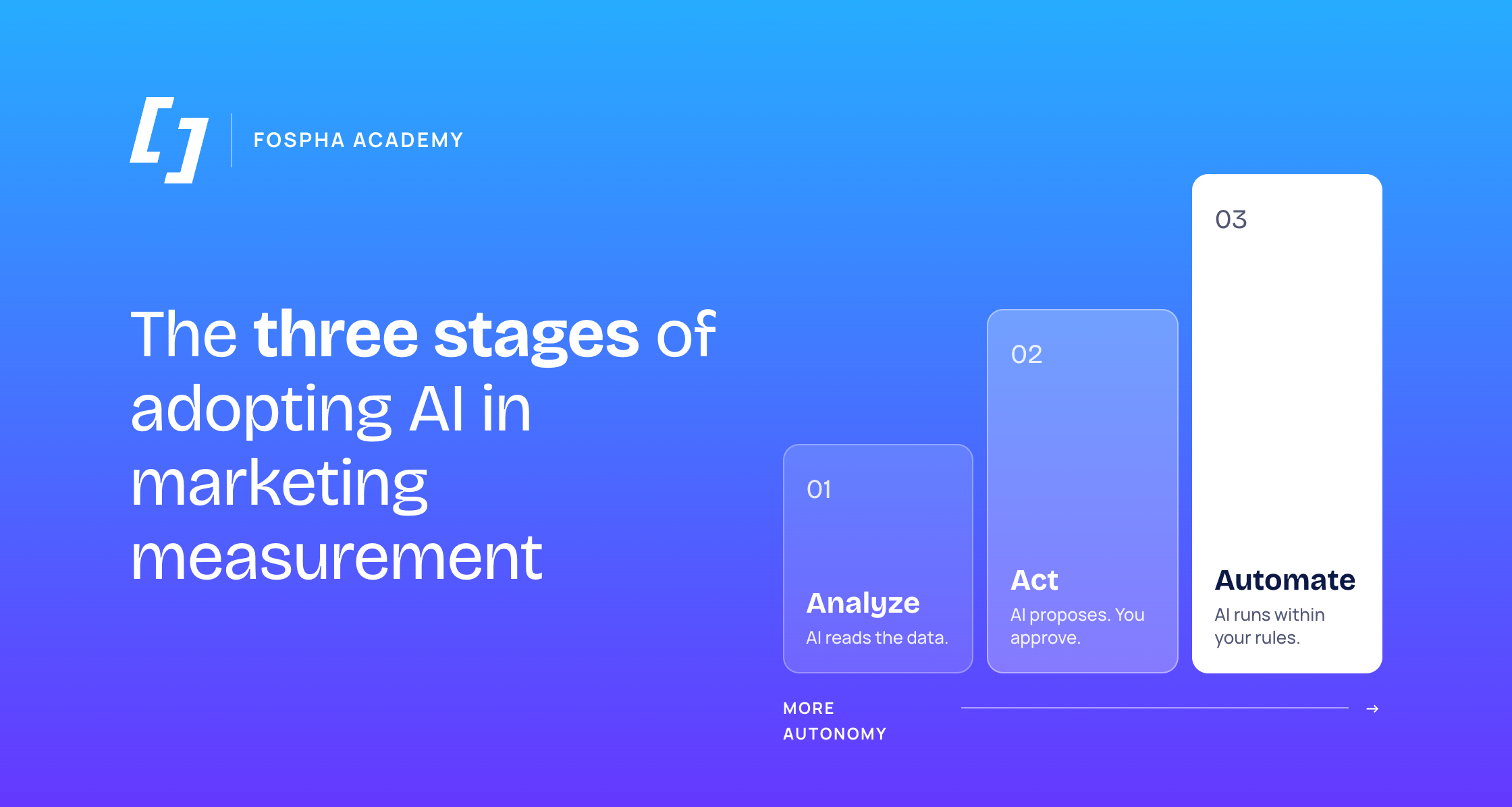
Marketers adopt artificial intelligence (AI) in measurement in three stages. First, it analyzes data. Then it proposes actions a person approves. Finally, it automates, running recurring decisions inside rules the team sets and, once the number is trusted, steering the ad platforms’ own bidding. Each stage gives the machine more work, so each depends more on a number the team trusts.
Most teams ask whether they should automate. A more useful question is which decisions to hand over, in what order, and on whose number.
The pressure to move is real. Adobe’s 2026 State of Marketing report found that more than 8 in 10 marketing teams missed at least one opportunity last quarter because their workflow couldn’t respond in time. Readiness is the harder part. A Gartner survey of data management leaders found that 63% of organizations either lack, or aren’t sure they have, the data practices AI needs.
The space between the pressure to use AI and the readiness for it is where budget gets wasted. Automation executes faster on whatever it’s fed. Give it an incomplete or untrusted number and it makes the same bad calls, only more of them and sooner. So the three stages work as a trust ladder. You climb one rung when the rung below has earned it.
In the first stage, AI reads your measurement and answers questions, and a person does everything else.
In practice this takes two forms. Some measurement platforms now have a chat assistant built in. Others connect their data to the AI tools teams already use, such as ChatGPT or Claude, through a standard connection called the Model Context Protocol (MCP). Either way, you ask a question and get an answer in any format you need, using your metric names, your attribution windows and your market cuts.
Because it only reads data and never touches an ad account, this is the safest place to start. It also changes who can use the numbers. Insight no longer sits behind a dashboard login or an analyst’s queue. A channel manager, a finance partner or a chief marketing officer can ask the question in the tool they already have open.
The test is simple. Ask for a summary of last week’s performance and check it against what you already know. If it matches your instincts where it should, and surprises you where something really changed, you have a number worth building on. Teams usually get two things here: hours back from data pulls, and answers that reach people who used to wait on an analyst.
In the second stage, AI proposes a change and a person decides whether it happens.
A proposal arrives with its reasoning and the result it expects, such as raising a channel’s daily budget. The team approves, adjusts or declines. Approved changes are pushed directly into ad platforms, stay traceable to the recommendation, and can be reversed.
The adjust option matters more than it looks. A study in Management Science by Dietvorst, Simmons and Massey found people were considerably more likely to use an imperfect algorithm when they could modify its output, even slightly. Finance leaders come at it from another angle. They want to know why money moved before they let anything move it unattended.
Watch for approval fatigue. If a team is rubber-stamping dozens of small changes a day, that decision is ready for the next stage. Start to note down how much extra time is saved from doing this, and what you’re now using that time to accomplish, as a way to build a case to expand AI capabilities.
In the third stage, the team sets the rules once and AI agents run the recurring decisions inside them. The same measurement can also steer the ad platforms’ own bidding.
Rules usually cover what the agent can touch, how much it can move in a day, a spend ceiling, and the conditions that make it pause. Before anything goes live, a dry run lists every action the agent would take. After that, each run is logged, and the team can pause, edit or stop it at any time.
The job changes here. People stop approving individual moves and start supervising rules, which is a different skill. Someone owns the guardrails, someone reads the log, and someone decides when the rules need to change. Start using it for one month, then measure whether next month’s results have improved for the channels you tested it on. If they have, that is your evidence to extend the rules to more channels, or into bidding.
Bidding is where automation reaches furthest. Platform bidding systems optimize toward the signal they receive. Feed them a fuller one, covering every channel and every place you sell, and they can optimize toward a fuller picture of revenue. The platform keeps its own controls. What changes is the signal it learns from.
That makes this the highest-impact step, and the one where the number underneath matters most.
Take a brand spending $500 a day on TikTok prospecting. These numbers are illustrative.
The decision never changed. What changed is how much of it the team handed over, and how much evidence they had before they did.
Two retail brands show stage 3 in operation, one through automated budget allocation and one through automated bidding.
Gymshark feeds ad-level daily measurement into an AI-powered budget allocation system through Smartly. The brand reports a 13% uplift in cross-channel ROAS. The groundwork came first. Fourteen daily users across marketing leaders, channel managers, agency partners and executives work from the same view, taking more than 30,000 actions a month, and the data feeds their board reports.
.png)
BOOHOOMAN connected daily measurement to automated bidding instead of waiting on manual optimization. It reports 1.9 times more revenue over Black Friday Cyber Monday weekend on Meta, and 13% higher ROAS than non-automated campaigns.
Move up a stage when the team can answer yes to four questions.
Each role needs something slightly different. A chief marketing officer needs a number defensible in the boardroom. A finance director needs the reasoning behind every move. An analyst needs time back. An agency needs one standard across many accounts.
Treat each stage as a small win that earns the next one, and resist skipping ahead because the technology allows it.
AI adoption in measurement runs from analyzing, to acting with approval, to automating, first through recurring workflows and then through bidding. Each step hands over more work and asks for more trust in the number underneath.
MMM, MTA and incrementality: building your measurement system
Do I need to go through all three stages?
No. The stages describe how much autonomy you give a decision, not a grade for your whole team. Many teams run low-risk, high-frequency decisions at stage 3 while keeping larger bets at stage 2.
Should every decision end up automated?
No. Decisions such as entering a new channel or sizing brand investment usually stay with people, supported by analysis.
What belongs in a guardrail?
The accounts and campaigns an agent can touch, a daily change limit, a spend ceiling, a pause condition, a named owner and a run log.
What data do I need before stage 3?
One agreed source of truth, refreshed often enough to act on, and reconciled to reported revenue so finance can sign off on it.


.png)



%20and%20how%20does%20modern%20MMM%20work%3F.png)