Upstream of Every Decision: Why Measurement Holds Brands Back
Dom looks at what's changed for brands selling across their own site, Amazon, TikTok Shop and retailers, and argues that measurement is a generation behind: brands now sell everywhere, with agentic shopping starting to arrive, but still set budgets and targets on numbers built for the DTC era, and that's one of the things holding back the organisational changes they know they need to make.
In May 2025 we launched Halo, our daily read of what brands' off-site media was doing for their Amazon sales. We found this measurement innovation shone a light on organisational structures that were past their sell-by date. Brands weren't set up to budget and make decisions efficiently and often had misaligned incentives that damaged holistic growth. Separate .com and Amazon budgets and separate teams with their own KPIs. 18 months on, things are changing but slowly, and I think measurement is a big part of why.
Commerce evolves much faster than measurement, and the gap is growing; to the point where many brands have learned to live with incomplete measurement of how they actually trade.
Partly this is about how brands buy measurement: commerce moves at the speed of the consumer, but measurement moves at the speed of budgeting, contract and adoption cycles. So it takes much longer to notice it’s out of date and longer again to change it, especially when it's embedded operationally. And partly it’s the data: every new channel arrives with its own walled garden, reporting and data availability fun, so measurement has to catch up and mature one channel at a time.
Because of this, in some of the brands I talk to, the measurement source of truth is too often a generation behind the commerce strategy. This is why solving measurement for the shape of your business today is a real competitive advantage.
The brands moving fastest have tackled it from the top of the stream: leadership understood the imperative to see the whole picture, and the decisions further down changed with it. When The Ordinary looked across everywhere they sell, 62% of their revenue wasn’t visible to last click, the majority driven by paid social and video and landing on marketplaces. They dropped the separate Amazon and DTC budgets for one budget across the whole journey, and as Vanessa Mac, who runs global media at DECIEM, put it on stage with me at eTail Boston, they went “from defending decisions to actually being able to make decisions”.
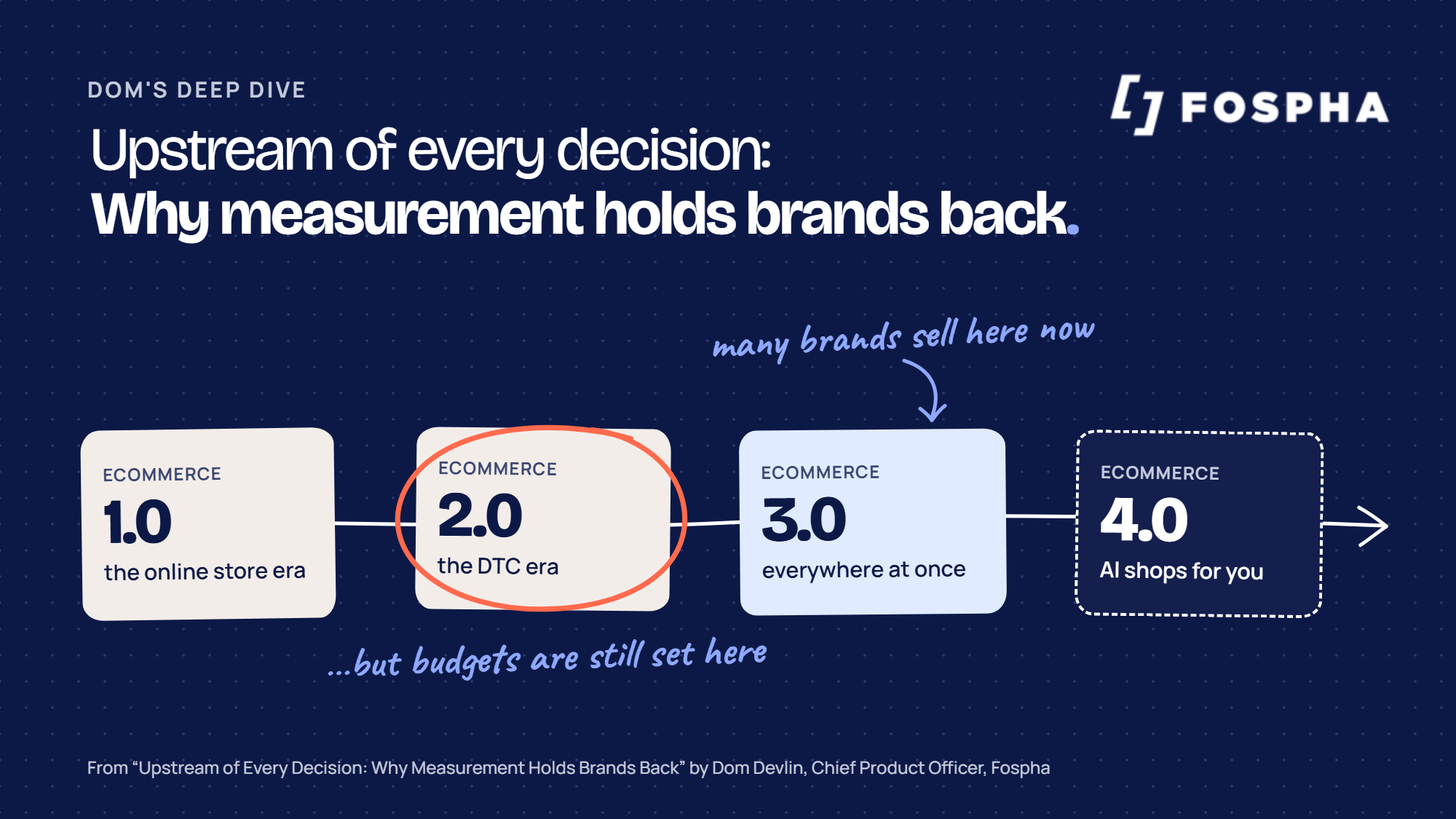
Let's try and delineate some eCommerce epochs that are helpful if imprecise (and vary by category):
1. eCommerce 1.0 was the online store era: retailers and early marketplaces put the shelf online, found shoppers through search, email and affiliates, and measured it with site analytics and last click.
2. eCommerce 2.0 was the DTC era, where a brand sold on its own site and judged its media on what Meta and Google could see there in a relatively closed data loop (broken by ATT, then mitigated with CAPIs)
3. Many brands we work with are now well into 3.0, diversifying into Amazon, TikTok Shop and Retail, with accompanying investment into retail media. This has created far more complexity in the customer journey and media consumption.
4. Things are now moving on towards potential 4.0 with agentic commerce, though the extent to which this will be adopted is contested and the shape is far from clear.

The numbers many still use to target and budget were built for 2.0
A lot of the brands I talk to know they need to reorganise around how their customers actually buy now, with flexible budgets and teams judged on total sales rather than their own channel.
Measurement is one of the things holding it back, because it sits upstream of decision-making. The decisions a brand can take, and the strategies and targets it pursues, are limited by the data it has to hand, and that data is defined by the measurement it uses. It runs the other way too: siloed teams tend to buy siloed measurement, which keeps them siloed, so I think measurement is the part of that loop leadership can change fastest.
It's hard to move money or change a team's KPIs when the numbers you'd use to justify it miss close to half the sales.

A 2.0 view of a 3.0 business
In eCommerce 3.0, .com is still where you go to get a feel for the brand, and it still owns the customer relationship, the first-party data and normally a big chunk of revenue. But for many it's no longer where most of the money is made: for nearly half of the brands we measure that sell on marketplaces, over half of sales land off .com, on Amazon, TikTok Shop and retailers like Sephora.
Pixel-based measurement is constrained by where you can place the pixel, so it's largely constrained to sales on the website which doesn't work in eCommerce 3.0 (and probably even less so in 4.0).
So many brands are still splitting budgets and setting platform targets on a fraction of what their media actually drives, because the sales landing on other channels are simply missing from the pool available to credit demand-generating media. Every dollar of spend gets counted, but only the sales that land on the site get credited against it. Given the scale of Amazon in the US alone, that's a big hole.
Last click doesn't help either - for brands selling on their own site, Amazon and TikTok Shop, it gives the ads that create demand credit for less than one in five of the sales they drive, because it only sees the last click on the site.
What you measure sets the target you chase
Let’s see how this plays out using Meta sales campaigns as an example. A lot of brands run them with a cost per result goal, and that goal is built from purchases on the website because those are the conversions Meta can see.
For the median brand we measure on marketplaces, our model sees about 30% of what those campaigns drive landing off-site, and more than half for brands selling mostly away from their own site.
What a customer is worth hasn’t changed, but the campaign is only being given credit for the share Meta can see. Against the purchases Meta reports, the median brand’s cost per sale looks about 30% higher than our read across everywhere it sells, and for brands selling mostly off-site it’s closer to double. Meta bids more cautiously to stay near the goal, so a campaign can sit right on target and still be held back from customers the business would happily pay for.

I think this is measurement being upstream in practice. Nobody chose a target that was too tight, it fell out of what the measurement could see, and every decision further down - the bid, the budget, whether the channel survives the next round of cuts - inherits the same blind spot. Once a brand can see where its sales actually land, and what each one is worth after fees, the target can be built on what a customer is worth everywhere they buy, and the sales it was missing become growth it can go after.
What a 2.0 view misses
There are a number of off-site halo effects we've observed that a site-only view can't see:
- Social and video into Amazon. Most of us do this ourselves (who doesn't love ordering in the evening for a 3am-6am delivery slot?). The more a channel creates demand, the more of what it drives lands off-site: comparing channels within the same brand, TikTok sends about 1.7 times as much to Amazon as Meta for every dollar of site sales, and video closer to twice as much. Awareness and consideration campaigns carry roughly one and a half to two times the Amazon halo of conversion campaigns. So the channels and campaigns that look weakest on .com are often the ones doing the most for Amazon.
- TikTok Shop ads that sell elsewhere. GMV Max is built to sell on TikTok Shop, but for the brands we measure running it, around half of what it drives lands on the brand's own site or Amazon, so judging it on the Shop alone sees about half of what it does.
- Retailers. Our reads here are earlier, because the integrations are newer and most retailers share sales weekly, but paid media shows up in Sephora sales for each of the beauty brands we've looked at so far, which a .com report can't show.
- Demand driven to retail media. Off-site video builds it, the shopper searches on Amazon and a sponsored listing takes the sale, and I think much of the credit still lands with the retail media ad, so the video that started it looks worse than it is, when the Amazon team has as much reason to want it funded as anyone.
This isn't to say this is all driven by advertising. Understanding the baseline and its composition for a channel such as Amazon is part of 3.0 measurement to not over-estimate the effects of media. The repeat buyer of protein powder isn't likely purchasing because of awareness media.
Operating in 3.0
In 3.0, the brands I see handling this best have built one source of truth: the sales across the site, marketplaces and retail de-duplicated in one total commerce view, with the effects between them modelled with full-funnel attribution that counts each sale once however many channels touched it. Finance, marketing and the channel owners can all plan from that, which is what makes it something a business can actually operationalise.
This is why the daily view is so important. Daily doesn't mean deciding every day, but the read responds to change as it happens, so each decision can be taken at the cadence it needs - creative and bids frequently, budgets between .com and Amazon most weeks once the Amazon read has firmed up, the retail mix monthly - without waiting for the next test result or quarterly MMM.
Tests and MMM still have an important role. A well-run test is the best check that a channel is delivering what you think it is, and MMM is the best way to see the bigger picture, so I see them as guardrails. A test answers for one channel weeks after the fact, marketplaces and retail are hard to test cleanly, and MMM moves too slowly and only at channel level. So I think the daily read has to be the operating view, with tests and MMM keeping it honest.
If I were going into 2027 planning, these are the questions I’d want answered:
1. Are your platform targets and budgets built from what a customer is worth everywhere they buy (net of fees) or from .com sales alone?
2. If the total view says money should move between .com and Amazon, can it move within the quarter, and who signs that off?
3. Who owns the total number, and can they see it as often as they need to make the call?
Data source: Fospha's daily measurement system, November 2025 to October 2026, subset covering 80 brands that sell on their own site and on Amazon or TikTok Shop with a full year of marketplace data, excluding brands that opt out of benchmarking. The Ordinary's figures are as presented at eTail Boston 2026.

Stay ahead with the inside scoop from Fospha.
For over 10 years we've been leading the change in marketing measurement.