
Why we built a measurement system around the Monday meeting
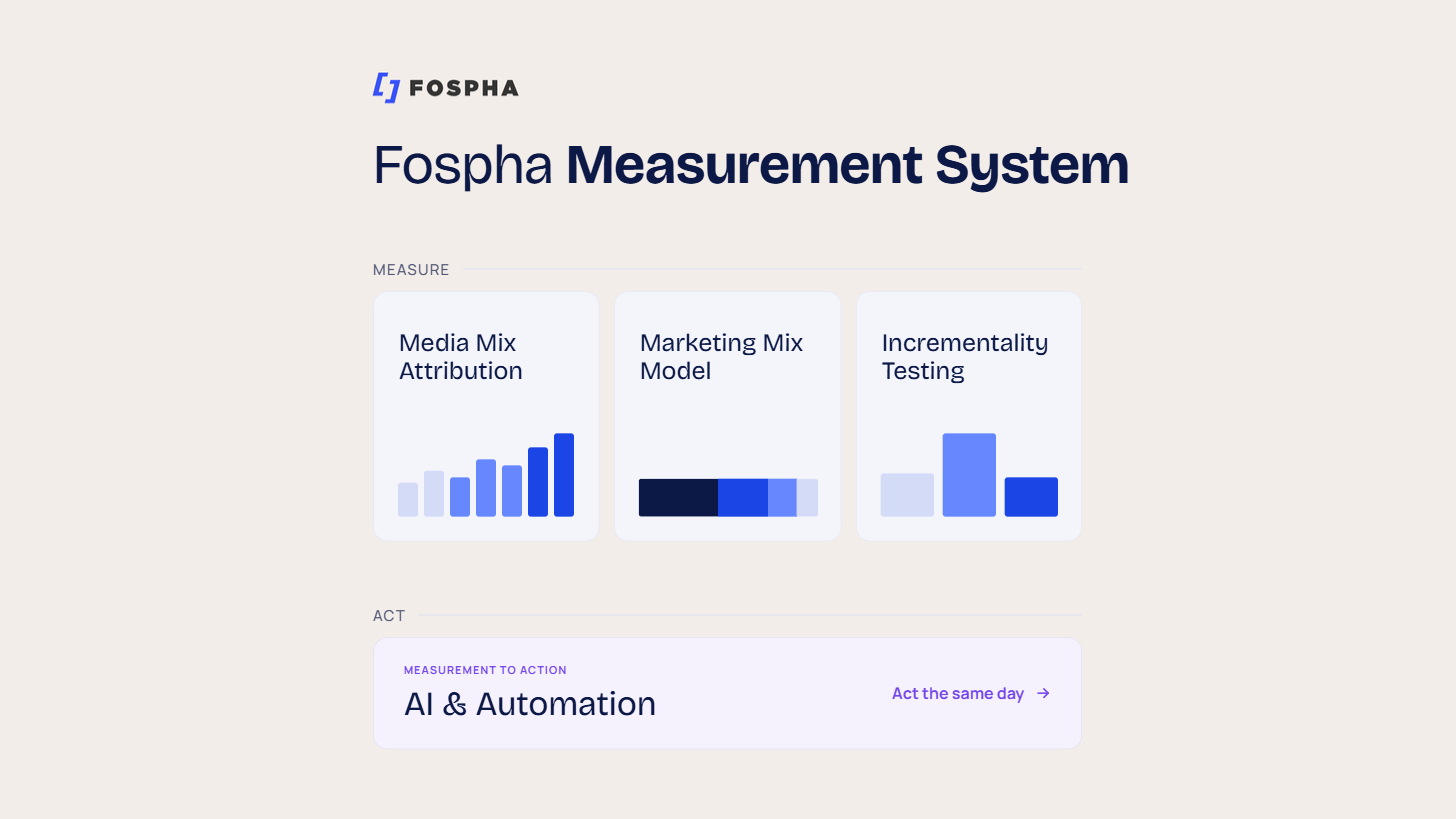
Fospha's complete measurement system from the daily decision upwards, with Media Mix Attribution as the foundation, Incrementality Testing and MMM layered on top, and AI and Automation turning it all into action.
Why we built a measurement system around the Monday meeting
The industry keeps asking which measurement method is "right". That's the wrong question. The right one is: what decisions does your business need to make, how often, and at what level of detail? Start there, and the measurement system follows.
Here's why Fospha built its measurement system from the daily decision upwards, with Media Mix Attribution as the foundation, Incrementality Testing and MMM layered on top, and AI and Automation turning it all into action.
Every Monday, in thousands of retail businesses, the same meeting happens. Each market presents its numbers. Marketing explains last week's spend. Someone asks whether budget should move this week. If you're publicly listed, the same rhythm runs all the way up to the earnings call.
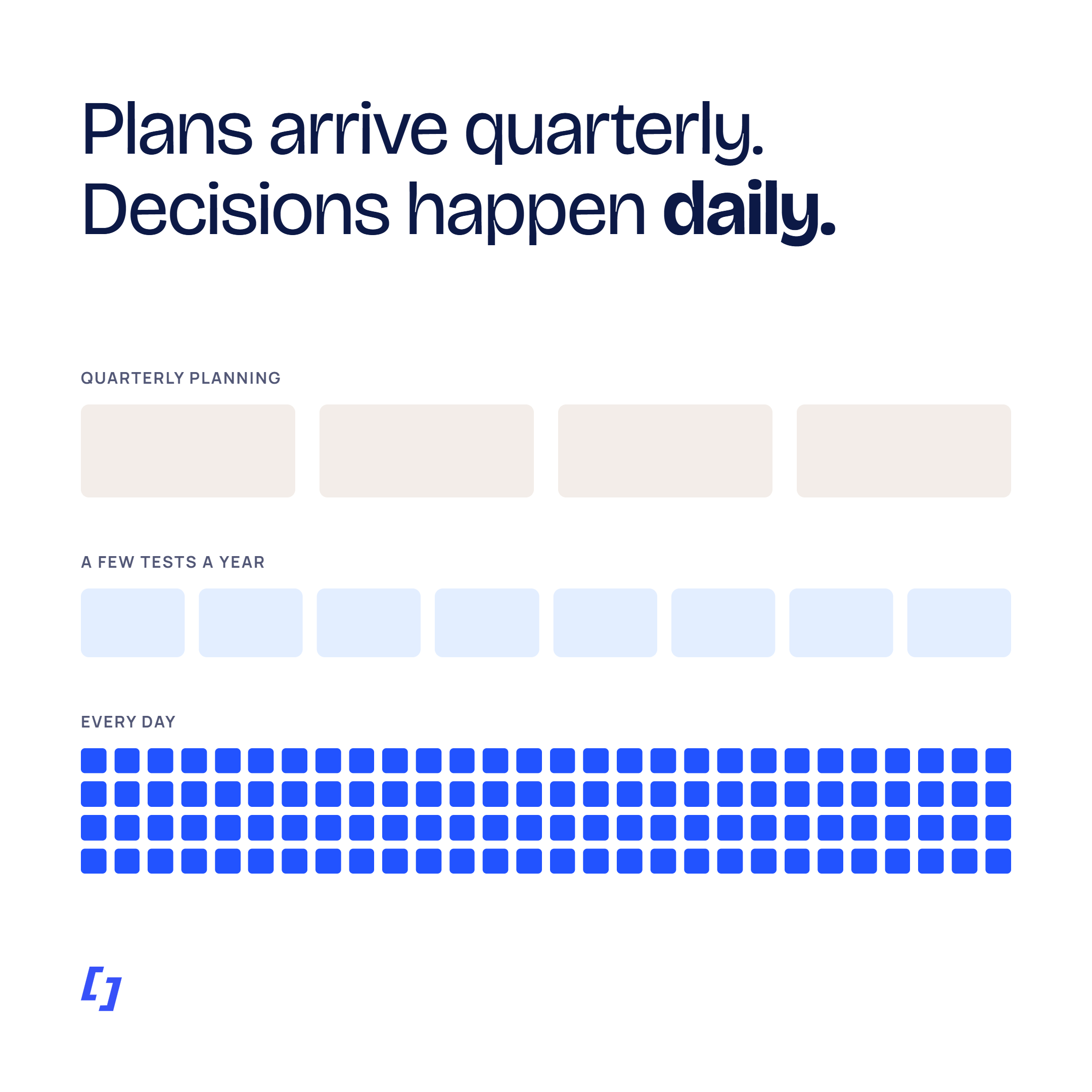
That meeting has existed for fifty years and will exist for the next fifty. It doesn't care which measurement technique is fashionable. It needs an answer this week, at the level of detail where decisions actually get made.
And yet much of today's measurement debate ignores it. Attribution is "dead". MMM is "the answer". Every result must be "causal". Each camp argues for the purest method, and the business is left with a periodic plan and a daily reporting stack that looks nothing like it. So, day to day, teams revert to last-click attribution and ad platform reporting: the views they'd already outgrown for planning.
We think there's a disconnect between measurement purity and business reality. Closing it is why Fospha's system is built the way it is.
Attribution wasn't wrong. The world changed.
Attribution has become an easy target. It's worth remembering why it existed in the first place.
In the early days of digital, a customer had one device and you ran two or three channels. Last click was a perfectly reasonable answer.
What broke it wasn't the logic. It was the environment: multiple devices, cookie loss and wider privacy changes across browsers and operating systems. Journeys fragmented, and even the clicks it relied on became harder to track. At the same time, more of what drives growth moved to places last click was never built to see: video, social and other upper-funnel activity, and marketplaces like Amazon and TikTok Shop.
The industry responded in waves. First came experiments, as brands adopted incrementality testing. Then open-source marketing mix models arrived and MMM went mainstream. Today the question has shifted again. It's no longer which tool you own, but how you connect them into one system you can run the business on.
Attribution didn't fail because the idea was wrong. It failed to keep up, and the answer is to evolve it, not abandon it.
How we evolved attribution, and why it comes first
Evolving attribution is exactly what we've done. Media Mix Attribution (MMA) is the result, and we made it the foundation of our system because it's the layer that matches the rhythm and the granularity of real decisions. Tests and models are essential. But on their own, they can't run Monday.
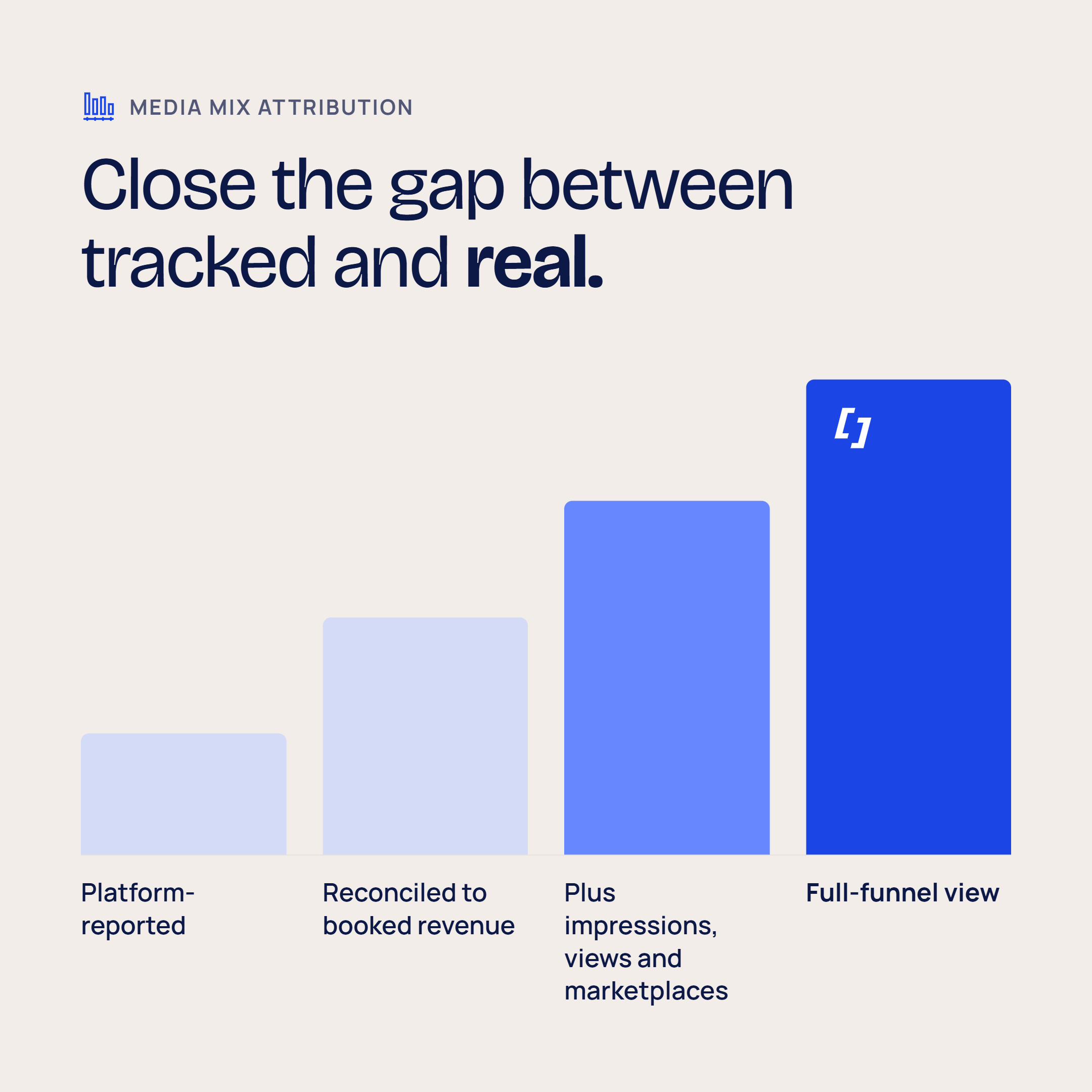
MMA is not last click with a new name. It's a daily, full-funnel model that estimates the contribution of impressions and views alongside clicks, across your website and marketplaces such as Amazon and TikTok Shop, down to the ad. Four things make it the right foundation.
1. It runs at the speed of the business. Budgets move weekly. Campaigns launch daily. A measurement layer that answers in weeks or months shows you the waste after the money's gone.
2. It sits between the two views you already have. Most brands live with two pictures: last click, which undercounts everything above the bottom of the funnel, and an MMM that captures full impact but isn't built for daily, ad-level decisions. MMA gives you a daily view you can compare to both, designed to sit much closer to your MMM than to last click. That matters, because without it the daily habit always pulls you back to the most limited view of your marketing.
3. It's infrastructure, not just a number. Brands often over-invest in debating how credit should be split between a handful of touchpoints. But journeys today are more complex than ever, and far less of them can be tracked. No allocation rule can recover what it can't see, which is why the rule matters less than people think. The real value is a granular, daily layer that carries what tests and models have learned into every channel, campaign and ad.
4. It speaks the platforms' language. Ad platforms optimise on granular signals at the level of the campaign, ad and audience. Aggregated outputs, like a quarterly MMM read or a single geo-test result, are valuable for planning but too coarse to steer an auction. A daily, ad-level model is what connects measurement to how platforms actually buy media.
The unglamorous part that matters most: signal loss
There's one more job MMA does that we've underplayed for years. It reconciles what each platform reports against the revenue you actually booked.
No tracking method captures every conversion. Consent choices, browsers and devices all limit what any single source can see. If a channel's reported conversions are 10% short of reality, its ROAS looks 10% lower, and that's often the difference between moving budget and leaving it.
It also matters for everything else in the system. Your MMM works from total revenue, while attribution and platform lift tests rely on tracked conversions. You can't fairly compare them until you know how much signal the tracked sources are missing. Reconciliation is what makes the layers comparable.
MMM: the strategic layer, with honest limits
Marketing mix modelling is the most established technique in measurement, and it's having a renaissance for good reasons. It's privacy-safe, resilient to signal loss, and can include everything: online and offline, marketing and non-marketing drivers.
Its biggest value is often the conversation it forces. Attribution's stakeholders are mostly marketing operators. MMM's stakeholders are almost everyone: finance, leadership, trade, brand. It answers the bigger questions. How has the top line moved? What can we expect next year? Should we renew the TV deal? And it makes a business agree on its baseline, the sales it would make without marketing, which nobody can observe directly.
But MMM has a structural limit worth being clear about.
MMM works with aggregated data: spend and other drivers by channel, over time. Even with daily or regional data, the model sees channels, not individual campaigns and ads.
Yet brands often ask it for the impact of every channel and every KPI, Black Friday versus always-on, a one-off sponsorship, even what competitors did. There's only so much an aggregated model can tell you, however carefully it's analysed.
What makes an MMM more useful is better and more relevant data, not cleverer arithmetic on the same inputs.
That's why Fospha's MMM isn't built from zero. It draws on the data already flowing through MMA, and on priors from incrementality tests. That means faster set-up, more frequent refreshes, and a model informed by what's happening in the business day to day.
Incrementality testing: the best way to prove causality, but you can't test everything
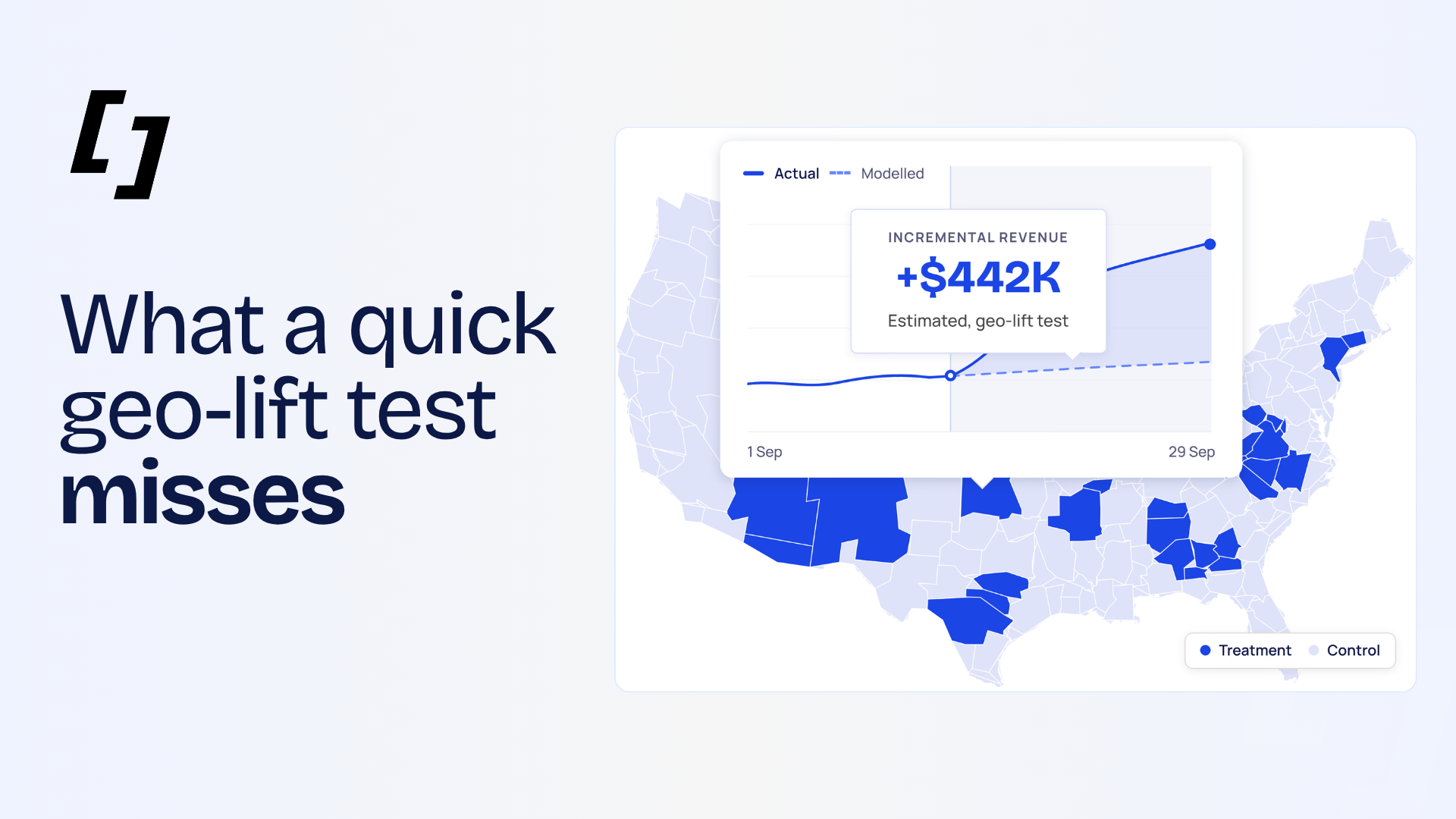
Experiments are the best evidence of cause and effect we have. A well-run geo-lift test, comparing regions that see your ads with similar regions that don't, answers your biggest budget questions with real confidence. We run them, and we use them.
But testing has practical limits:
- Frequency. Even disciplined brands can only run a handful of geo-lifts a year. Each one carries a real opportunity cost in held-out markets.
- Coverage. Testing options vary by platform, campaign type and market, so it's rarely practical to test every channel with the same depth and regularity.
- Relativity. Get to your fourth market and third channel and you start compromising. You end up with excellent reads on some channels and none on others, and lose the ability to compare them fairly.
- Realism. Test too granularly and you create a lab that never exists. Switching off one campaign out of a hundred ignores how the other 99 interact with it.
The brands that test well don't try to test everything. They use a small number of rigorous tests as anchors and check, over time, how those results line up with faster, more granular methods. Tests set the benchmark. Something else has to carry it every day.
How brands bring the layers together
Attribution, tests and MMM measure different things, at different speeds, for different people. The goal isn't to pick a winner. It's to understand what each one is for, line them up carefully, and let each one do the job it does best.
In practice, each layer has a distinct role. Incrementality tests are the reference point. When a test and the daily model disagree, that's a prompt to investigate, and test results inform how both MMA and the MMM read each channel. The MMM sets the strategic frame and the baseline. MMA turns all of that into a daily view, at the campaign and ad level, that teams can act on.
One global nutrition brand shows what this looks like in practice. Its team uses click-based attribution for bottom-of-funnel decisions: Meta conversion campaigns, Performance Max, affiliates. Fospha's impression modelling guides upper-funnel channels like TikTok, Pinterest, Reddit and YouTube. Halo measurement shows whether that activity boosts or drains Amazon sales. And because the brand is omnichannel, MMM ties it together. It's a layered system, with each layer applied to the use case it fits.
Granularity matters most when platforms change fast. When a new format like Google's Demand Gen scales quickly, a daily model can surface early signs of how Performance Max efficiency responds as spend increases, and whether one is building audiences the other converts. A periodic MMM or a handful of tests would struggle to pick that up in time.
From measurement you consult to measurement you run on
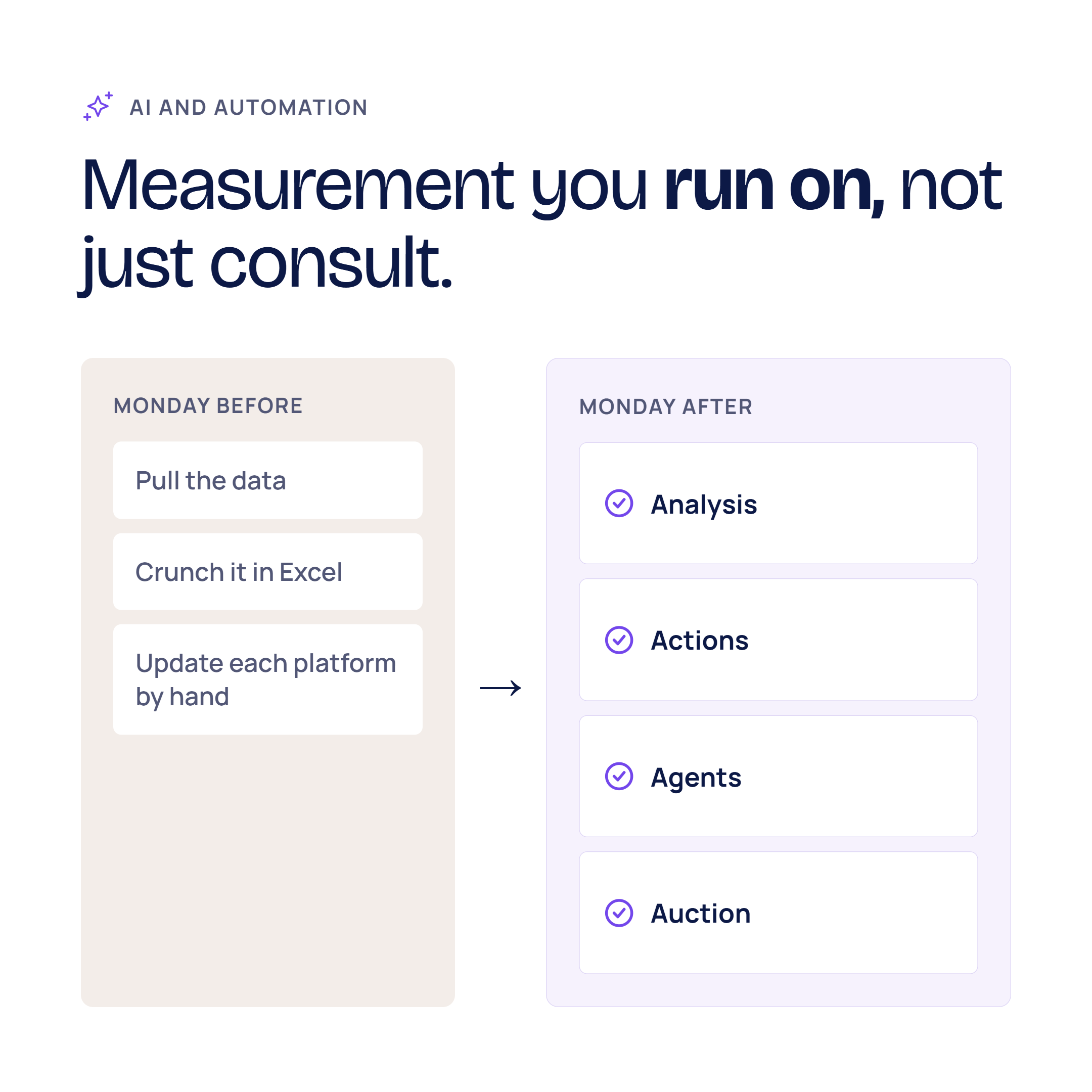
A trusted number only creates value when someone acts on it. That's the final layer: AI and Automation, which turns what you know into what you do. Ask your numbers a question in plain language and get an answer. Or let approved actions, like budget shifts between campaigns, run within rules you set.
This only works because of the foundation underneath it. Automation needs a signal that is daily, granular, and trusted by finance. Even a frequently refreshed MMM doesn't reach the campaign and ad level a bid needs. A test can't steer a campaign on a Tuesday. A reconciled, daily model can.
Nothing is perfect. A system is better.
Every method in measurement has flaws. Attribution can't see everything. Tests can't run everywhere, all the time. MMM can't answer every question at every level of detail. No single method solves measurement on its own.
The honest answer is to understand each method's imperfections, apply each one where it's strongest, and let what you learn from one set the rules and constraints for the others. Then put that system on the cadence your business actually runs on.
That's why we've repositioned Fospha. Building on a decade of experience and $40B+ in optimised marketing spend, we now help brands build a complete system of truth: Media Mix Attribution as the daily foundation, Incrementality Testing and MMM layered on top, and AI and Automation to act on it. Our teams work alongside yours to connect it, align finance and channel owners behind it, and make it the way your business runs.
Back to Monday morning: one trusted view, and the budget call gets made in the meeting.
See how the Fospha Measurement System works for your channels. Book a demo.
Frequently asked questions
Do I need all four suites? No. Most brands start with Media Mix Attribution and add the others as their questions grow.
How is Media Mix Attribution different from last click? It models impressions and views alongside clicks, reconciles platform data against booked revenue, and works alongside incrementality tests and MMM.
If I already have an MMM, why do I need attribution? Your MMM sets the plan. MMA tells you daily whether you're executing it, at the campaign and ad level your MMM can't reach.
Which sales channels does it measure? Your website, Amazon, TikTok Shop, apps and in-store sales, with more coming.

Stay ahead with the inside scoop from Fospha.
For over 10 years we've been leading the change in marketing measurement.




Heading 1
Heading 2
Heading 3
Heading 4
Heading 5
Heading 6
Lorem ipsum dolor sit amet, consectetur adipiscing elit, sed do eiusmod tempor incididunt ut labore et dolore magna aliqua. Ut enim ad minim veniam, quis nostrud exercitation ullamco laboris nisi ut aliquip ex ea commodo consequat. Duis aute irure dolor in reprehenderit in voluptate velit esse cillum dolore eu fugiat nulla pariatur.
Block quote
Ordered list
- Item 1
- Item 2
- Item 3
Unordered list
- Item A
- Item B
- Item C
Bold text
Emphasis
Superscript
Subscript