What a quick geo-lift test misses
Not all GeoLift tests are equal. Learn what separates a quick incrementality test from one that survives real budget scrutiny.
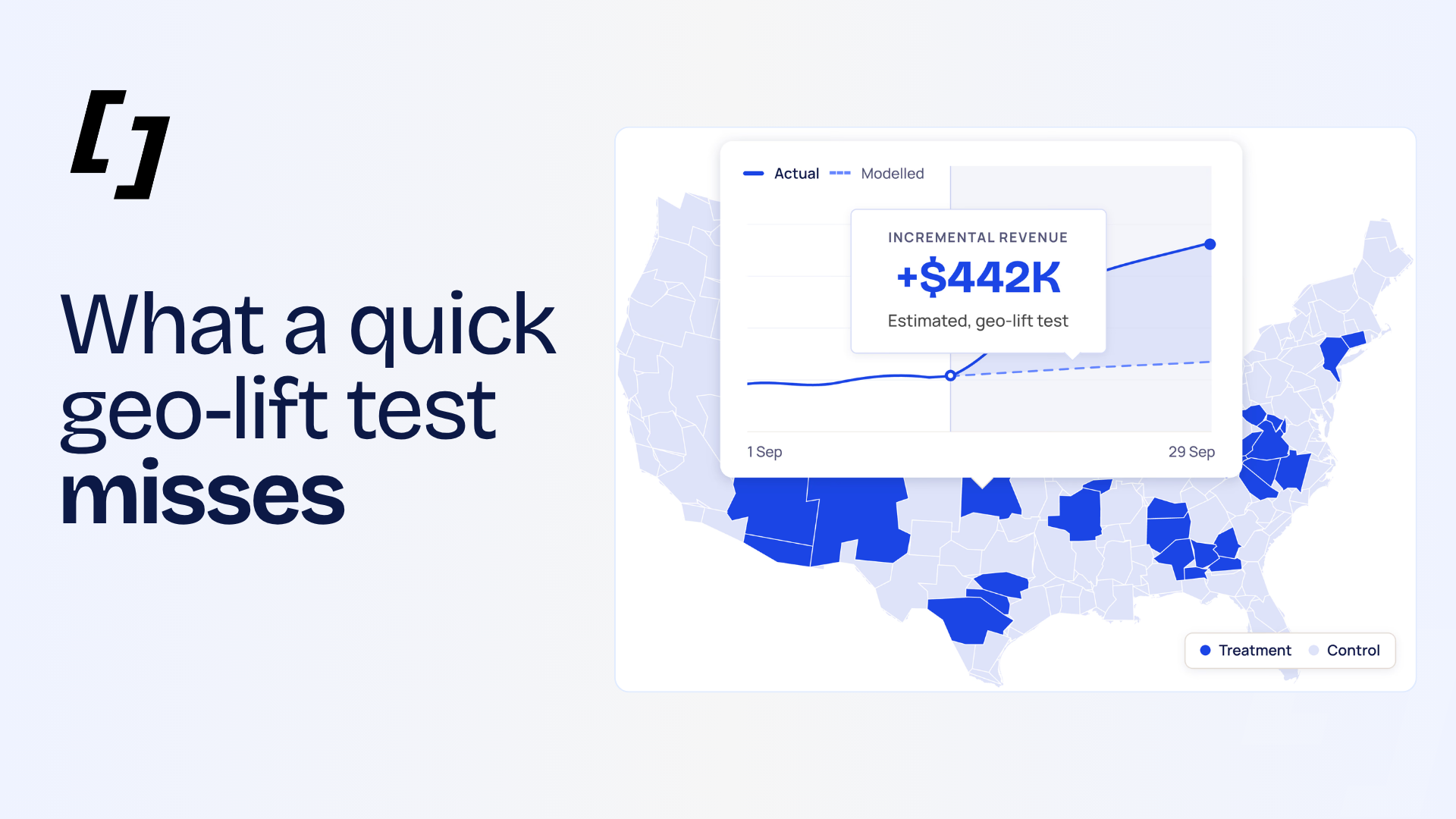
Ask any growth team whether they've considered running their own GeoLift test, and most will say yes. The concept is simple: change spend in a few regions, hold others steady as a control, and see what the difference tells you. That doesn't change whether you build the test yourself, run it through a self-serve platform, or bring in a team that does this for a living. What changes is how much the result can carry once it's behind a real budget call.
What is incrementality testing?
It's an experiment: you reduce, increase, or pause spend in a set of regions, while other, comparable regions keep running as normal, giving you something real to measure against. What comes out the other side is a measured effect: real outcomes compared against a modelled baseline of what would have happened if nothing changed. Like any experiment, that comparison carries its own margin of error, which is exactly what a good test design accounts for before the test starts, not once the result is already in front of finance.
.png)
What separates describing a test from trusting one
A budget decision needs a number that survives being questioned by finance, typically the most rigorous audience in the room for an estimate. That's a higher bar than "the chart moved after we changed some regions," and clearing it depends on design decisions made well before the test starts.
A confident-looking answer that doesn't hold up costs more than a test that simply fails to produce one. A clean chart can lead a team to scale a channel that wasn't working, or cut one that was, because the result was never properly checked.
What a design has to get right
None of this depends on whether you build the test yourself or bring in help. These are the decisions that determine whether any GeoLift test produces something you can act on.
Choosing which regions belong in the test means finding markets whose past behaviour can convincingly stand in for what your test regions would have done if nothing changed, a higher bar than picking your biggest markets and calling them representative. Get that wrong, and the test ends up measured against a baseline that was never a true match.
Then there's the noise every market carries in an ordinary week. Skip accounting for it upfront, and it's hard to tell later whether what you found was a genuine effect or just markets doing what markets do. The number still looks precise; it just isn't telling you anything you can rely on.
Test length is one of the clearest trade-offs. A shorter test can only catch a large, obvious shift in performance; stretch it out and the size of effect it can reliably detect gets smaller. Exactly where that threshold lands is specific to the channel and the test's own data, which is why it's calculated per test rather than assumed. That trade-off is worth understanding before the budget is committed, while there's still time to adjust the test length.
The shape of the test carries its own risk too. Cut spend entirely and you get the cleanest read, but the most exposure if that market mattered. Trim it and you protect revenue at the cost of a fainter signal. Increase spend in a channel already stretched thin, and you risk the costliest outcome of the three, since the extra money has nowhere useful left to go. None of these is a safe default: the right shape depends on the channel and the question you're trying to answer.
There's also a difference in how many test configurations get put in front of you, and how they got there. A design built around reliability filters out configurations that don't clear a reliability bar, on data coverage, on how much history backs the test, on how balanced the panel is, before you ever see them. Faster tools prioritize speed over that filtering step, which is part of what makes them faster, but it shifts some of that vetting onto whoever reads the result.
Every ad platform behaves differently once a test goes live too, in how it triggers changes, duplicates campaigns, and resets its own learning periods. A setup that works cleanly in one place can quietly distort results in another.
A tool built for speed and a design built to survive a finance review are solving two different problems, and that's a fair trade if speed is truly what the moment calls for. It gets costly when the goal was a number worth trusting, and the design wasn't built with that bar in mind.
Questions worth asking before you run your own test
Before committing budget to any GeoLift test, in-house or self-serve, it's worth working through these.
1. Are your test and control regions matched on past behaviour, or just similar in size?
2. Have you measured the normal week-to-week variance between those regions before the test starts, so you can tell a real effect from ordinary noise?
3. Does your test length match the size of effect you need to detect, or are you hoping a short test happens to catch a large swing?
4. Have you weighed the financial exposure of a full holdout against the weaker signal of a smaller spend change, for this specific channel?
5. Does your approach account for how this particular ad platform triggers changes, duplicates campaigns, and resets its own learning periods?
If most of these take more than a guess to answer, better to work through them before the test runs than to find out from a result that's already on a slide.
Whether a test is run in-house or by a specialist, someone has to hold every one of those variables in mind, catch the one that's off, and stay accountable for what the result actually means once the test ends, not just the chart it produces. That's the role Fospha's measurement science team plays.
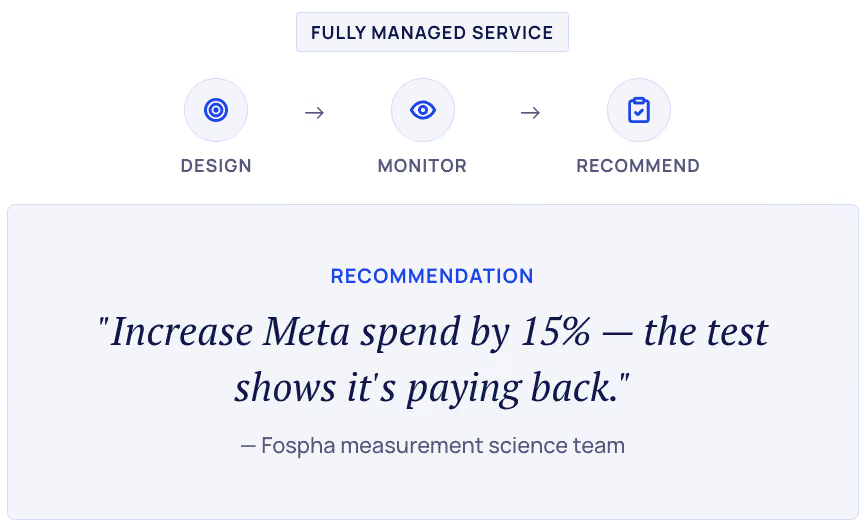
We design and run the full test end to end, so the only call left for you is whether and how much to change spend. The result feeds straight back into your budget forecast and marketing mix model, so what you learn from one test sharpens the plan you run on next.
A well-designed test earns you more than a chart. It earns you a plan finance doesn't have to take on faith.
See how a Fospha geo-lift test is designed: Explore Incrementality Testing

Stay ahead with the inside scoop from Fospha.
For over 10 years we've been leading the change in marketing measurement.
.png)