Product category reporting in measurement: what it means and what Fospha now enables
Fospha's Custom Categories lets enterprise brands report ROAS, spend, and revenue by product category - refreshed daily, no spreadsheets required.
Quick Answer: Custom Categories in Fospha now makes it possible to report on marketing performance by product category - showing ROAS, spend, and revenue grouped by category axis, refreshed daily. This is a grouping capability applied on top of existing attribution. It does not change how Fospha measures revenue, and it does not attribute sales to individual products or SKUs. It works best when products within a category are broadly comparable in average order value.
For enterprise brands running multiple category teams, each accountable for its own media investment, this turns one of the most persistent measurement questions - how is this part of our business performing? - into something answerable from a daily view.
One question comes up more than almost any other in enterprise measurement conversations. It surfaces in onboarding calls, quarterly reviews, and renewal discussions. It gets asked by category leads, by finance teams, and by CMOs preparing for board presentations.
The question is: can you show us how our marketing is performing by product category?
Until now, the answer has typically been: it depends on what you mean. "Product category reporting" covers two very different questions, and separating them clearly, being precise about which is answerable and which is not, has historically been the hard part. Getting that distinction right matters, both for what you can act on and for what you should not try to read into the numbers.
Why has product category reporting historically been so hard to answer?
When enterprise brands ask for product category reporting, they are usually asking one of two distinct questions.
The first is: how is the marketing spend that promotes this category performing? What ROAS am I getting from the campaigns that target our Floor Care customers, or our Sport nutrition line, or our Hair Care range? This is a question about grouping marketing activity by product axis and reading the aggregated performance back out. It is answerable from data most well-structured enterprise accounts already have.
The second is: which specific products are my campaigns selling? How much revenue came from hairdryers versus hoovers? What is my cost per unit sold by SKU? This is a question about product-level sales attribution - tying individual transactions to individual products at a granular level. It requires a fundamentally different type of model, and it is not what Custom Categories does.
The two questions often arrive together, and separating them has historically been the hard part. The result was a persistent gap for enterprise brands running multiple category teams - each accountable for their own media investment - who needed to see how their part of the business was performing but had no straightforward way to surface that view from within their measurement platform.
Custom Categories makes it possible to answer the first question cleanly, with a clear explanation of where the limits of that answer sit.
How does product category reporting work in Fospha?
Custom Categories is a grouping layer applied at query time on top of Fospha's existing model. It does not change how attribution works. The model attributes revenue at channel, source, and campaign level exactly as it does today. Custom Categories re-aggregates those already-attributed outputs into buckets the customer defines.
For product category reporting, the requirement is straightforward: the product or category needs to be identifiable in the campaign name. Most well-structured enterprise accounts already have this - the category is encoded as a token, a prefix, or a naming convention the team has used consistently.
An Admin creates the rules once: match all campaigns containing a given token to a given category. Fospha applies those rules across every campaign, sums the spend and attributed revenue, and returns category-level ROAS - refreshed daily, visible in the same dashboard the team already uses to make decisions.
Consider how this works for a global apparel brand running three distinct product lines - Menswear, Womenswear, and Accessories - each with its own media budget and its own performance targets. Their campaigns already follow a consistent naming convention that identifies the category. Three rules in Custom Categories, one per product line, are enough to group all spend and attributed revenue by category and return daily ROAS for each team. The head of performance for Menswear sees their view. The Womenswear team sees theirs. No export. No SQL query. No rebuild at the start of each reporting cycle.
The result: a single view that gives each category team the confidence to make their own media investment decisions, directly from the platform.
That is what Custom Categories makes possible, because the reporting now matches the structure the business already runs on.
What product category reporting is not
This distinction matters, and it is worth being explicit before drawing conclusions from category-level ROAS.
Custom Categories groups marketing performance by category axis. It does not track which specific products campaigns are selling. When a campaign promotes a product category, it drives consumers to a site where they browse and buy across the range. The attributed revenue reflects what was sold across the business during that period - not necessarily the specific products the campaign featured.
This means category ROAS should be used directionally. It is a useful signal for understanding how marketing investment in a given category is performing relative to other categories - most meaningful when campaign naming is consistent and products within the grouping are broadly comparable in price. It is not accurate to the individual product, and it should not be used as the basis for SKU-level spend decisions.
It also works best when the products within a category are broadly comparable in average order value. If a brand sells products with very large price variation across a category - for example, a business selling both low-cost consumables and high-value equipment in the same grouping - the ROAS figure will not reflect those average order value (AoV) differences. In those cases, category-level ROAS is a useful directional input, not a precise efficiency metric.
These are not limitations to work around. They are the honest scope of what category reporting can tell you and within that scope, it is genuinely useful for the decisions enterprise category teams make every week.
What changes when category teams can see their own performance
Before Custom Categories, a brand running multiple category teams had one of three options. They could report blended performance across the whole business - useful for overall efficiency but invisible to individual category accountability. They could build manual exports, mapping campaign data to category taxonomy in a spreadsheet that needed rebuilding every reporting cycle. Or they could not answer the question at all from within their measurement platform.
Each of those options has a cost. Blended reporting makes it hard to defend category-specific budget decisions. Manual exports introduce lag, fragility, and the constant risk that a new campaign or channel has not been mapped. Not answering the question leaves category leads making investment decisions without measurement to back them up.
With Custom Categories, each category team can see their own daily performance view - ROAS, spend, and attributed revenue - in the same dashboard, refreshed automatically, without anyone rebuilding the data structure each cycle. Budget cases become easier to make. Conversations with finance become more specific. Category leads can defend and adjust their own media investment from a view that reflects how they are accountable.
Where this sits in the broader measurement picture
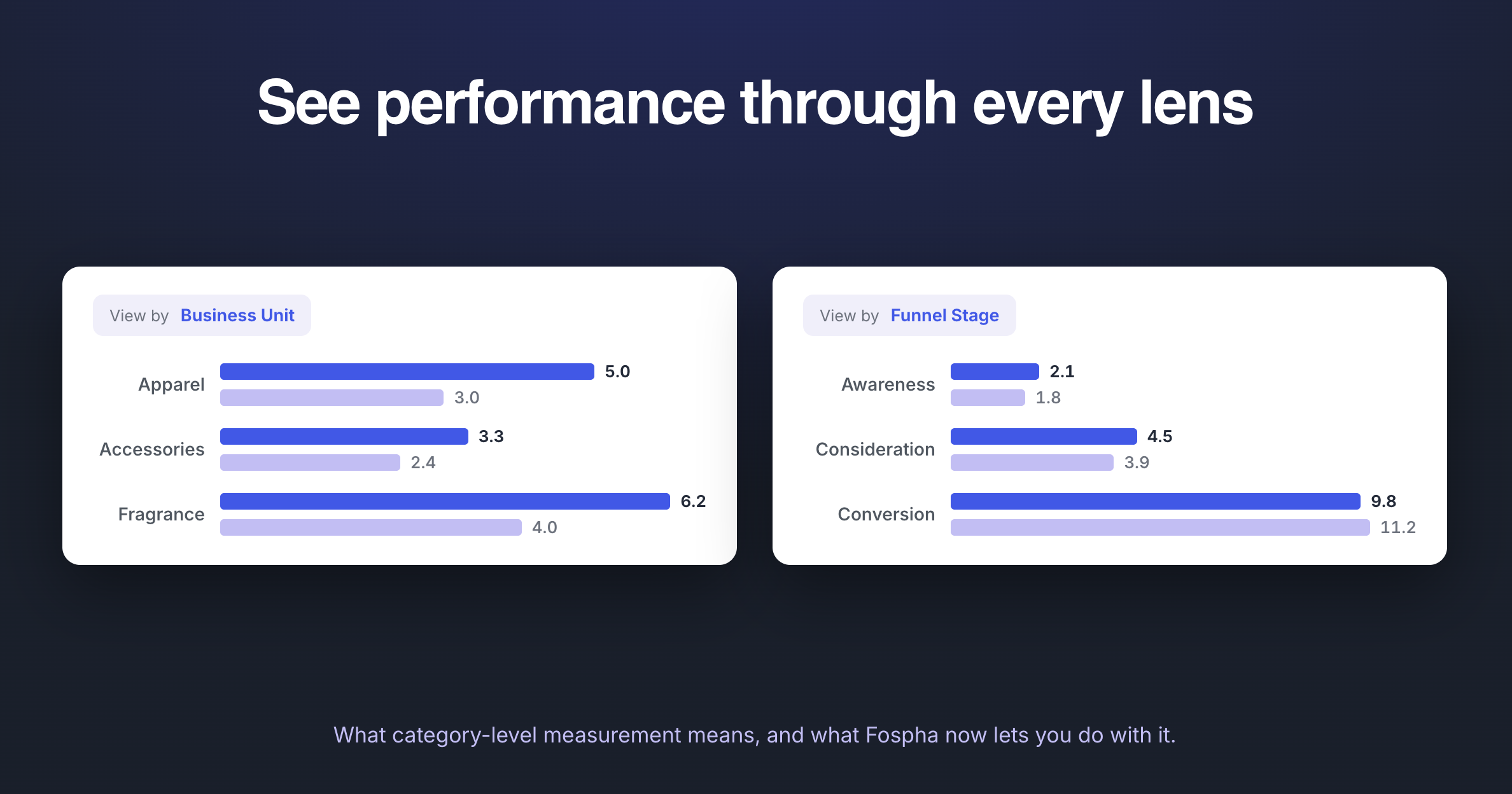
Product category reporting is one application of Custom Categories, and one of the most requested. The same capability supports any reporting axis an enterprise brand needs to see - business unit, region, funnel stage, influencer program - wherever that axis is identifiable in campaign naming.
The underlying principle is the same in every case: trusted daily measurement, read through the lens of how the business invests and reports. The model does not change. The attribution does not change. What changes is who can read the output, and in what language.
Custom Categories extends what Fospha can tell you, not by changing how the measurement works, but by adding a reporting layer that reflects how enterprise businesses are structured. Category performance is now a question the platform can answer, daily, without a spreadsheet in sight.
Custom Categories is live in Fospha today.
To explore how it maps to your product category structure, speak to your account team or book a demo.
👉 Book a demo: https://fospha.com/book-a-demo
Frequently asked questions
What is product category reporting in Fospha?
Product category reporting in Fospha means grouping already-attributed spend and revenue by product category axis, so you can read ROAS and performance at the category level rather than only at the channel or campaign level. It is enabled by Custom Categories, which applies grouping rules at query time on top of the existing attribution model.
Does product category reporting change how Fospha attributes revenue?
No. Custom Categories is a grouping layer. The attribution model runs exactly as it does today - at channel, source, and campaign level. Custom Categories re-aggregates those attributed outputs into the category buckets you define. The underlying measurement is unchanged.
Can Fospha show which specific products my campaigns are selling?
No. Custom Categories shows marketing performance grouped by category - ROAS, spend, and attributed revenue for all campaigns targeting a given category. It does not attribute revenue to individual products or SKUs. For that level of granularity, a different type of model would be required.
What do I need for product category reporting to work?
The product or category needs to be identifiable in your campaign names - a token, prefix, or consistent naming convention that an Admin can match against in a rule. Most well-structured enterprise accounts already have this in place.
When should I be cautious about using category ROAS?
Category-level ROAS is most reliable when the products within a category are broadly comparable in average order value. Where AoV varies significantly across a grouping, the ROAS figure will not reflect those price differences and should be used as directional context rather than a precise efficiency metric.
How often does category performance data refresh?
Custom Categories resolves at query time on top of Fospha's daily data refresh. Category-level ROAS reflects today's numbers, not a static export from a previous cycle.
Can each category team see their own view?
Yes. Once an Admin has set up the Custom Category rules, the dimension applies across every dashboard and export in Fospha. Teams can use saved views to surface their own category performance without affecting anyone else's view.

Stay ahead with the inside scoop from Fospha.
For over 10 years we've been leading the change in marketing measurement.
.png)