Quick answer: Privacy-safe marketing measurement tools are platforms that quantify paid media performance without relying on third-party cookies, user-level tracking, or pixel-based identity resolution. In 2026, the leading tools use Media Mix Modeling (MMM), aggregated data science, and first-party signals to deliver channel attribution, budget forecasting, and cross-channel ROAS accurately and in compliance with modern privacy regulation. This guide covers the top 7 options for retail and ecommerce brands running significant paid media budgets.
The measurement conversation has finally caught up with reality.
For years, "attribution" meant a pixel on your website, a cookie in a browser, and a dashboard that told you which ad got the last click. It worked, until it didn't. iOS 14 reduced signal fidelity. GDPR tightened enforcement. Third-party cookies became increasingly unreliable. And the customer journey expanded beyond your website onto Amazon, TikTok Shop, and a dozen other surfaces that a pixel was never designed to see.
Brands that rely primarily on last-click attribution in 2026 risk making systematically skewed budget decisions, under-crediting upper-funnel channels that drive demand and over-weighting bottom-funnel channels that capture it. The result is a measurement stack that finance finds difficult to trust and leadership finds difficult to act on.
A new generation of privacy-safe measurement tools is purpose-built for this environment. They do not need cookies. They do not rely on fragile identity graphs. And the best of them go beyond describing what happened - they help you think clearly about where to put your next dollar.
Here is what to look for, and which tools are worth considering.
What makes measurement "privacy-safe" in 2026?
Privacy-safe measurement means your measurement methodology does not depend on tracking individual users across sessions, devices, or platforms. In practical terms, a tool earns the label if it meets these conditions:
- No third-party cookie dependency. The measurement works at meaningful fidelity without third-party cookies - not through a fallback mode, but by design.
- No user-level cross-site tracking. The platform does not stitch individual user journeys together across domains using fingerprinting, probabilistic matching, or identity resolution that relies on third-party data brokers.
- Compliant with GDPR, CCPA, and emerging privacy regulation by design. Not through legal workarounds, but because the methodology does not require the data those regulations restrict.
- Aggregated modeling, not individual attribution. The platform uses statistical methods - Media Mix Modeling, geo-based lift studies, aggregate first-party signals - rather than user-level path attribution as the primary measurement approach.
What privacy-safe measurement is not: a multi-touch attribution tool with a cookie consent banner added on top. If the underlying methodology still depends on clickstream data and individual-level conversion events, the "privacy-safe" label reflects positioning rather than technical reality.
Notable trends shaping measurement in 2026
MMM has moved from enterprise luxury to practical default. Five years ago, Media Mix Modeling required six-figure analytics budgets and a dedicated data science team. In 2026, modern MMM platforms have compressed time-to-value from months to weeks, brought pricing into accessible SaaS ranges, and shifted outputs from quarterly strategy decks to daily, ad-level insights. Most serious measurement vendors now have MMM at their core or are building toward it.
Total commerce measurement has become essential for omnichannel brands. The brands most exposed by measurement gaps in 2026 are those selling on Amazon and TikTok Shop alongside their own site. Pixel-based tools were not designed to measure what happens on those platforms. The emerging standard is Total Commerce ROAS - a single metric that attempts to reflect performance across every surface where customers buy, not only where they land after clicking an ad.
Finance alignment has become a strategic priority. The CMOs winning internal budget conversations in 2026 tend to have measurement outputs that reconcile with revenue reality. When marketing and finance operate from different versions of performance data, the natural instinct is to cut what cannot be substantiated. The measurement tools gaining traction are those that produce outputs finance can interrogate, not only numbers marketing can defend.
Automation is reducing the gap between insight and action. Daily ad-level measurement has a natural downstream destination: feeding automated bidding systems. The tools pulling ahead are those designed to close the loop between measurement insight and execution - where a signal about saturation or headroom connects directly to a campaign adjustment without requiring a manual export-and-approval cycle.
AI-native measurement is emerging. The next frontier is measurement that is natively queryable by AI agents - platforms with MCP integrations that allow measurement data to flow directly into tools like Claude or ChatGPT. This is early-stage, but directionally significant: measurement that lives inside the AI workflows where decisions happen.
The 7 best privacy-safe marketing measurement tools for retail brands in 2026
1. Fospha: Best for unified full-funnel measurement across DTC and marketplaces
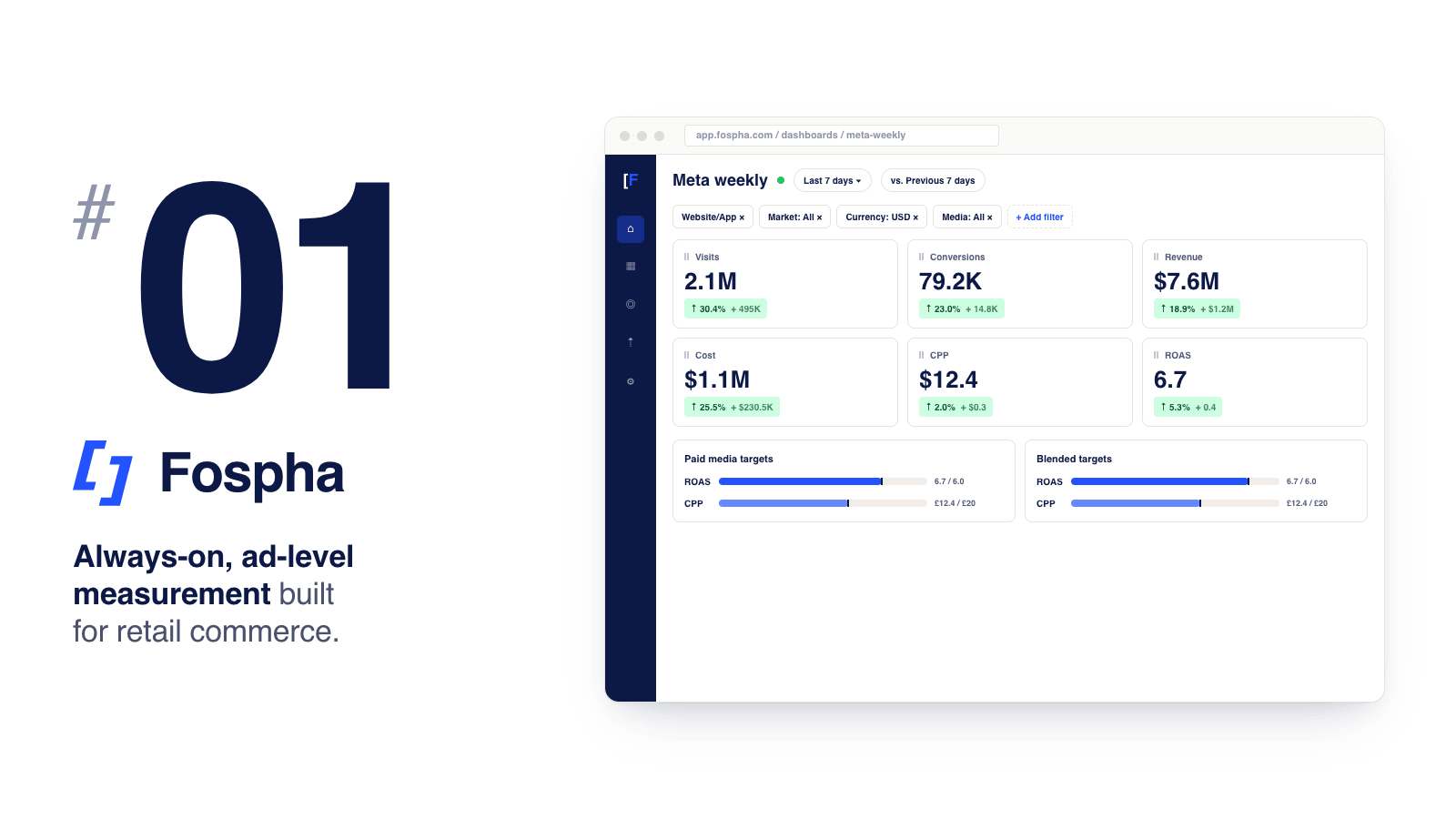
Quick answer: Fospha is a daily, impression-led Measurement Operating System for retail commerce brands. Its Media Mix Model updates daily at the ad level and unifies performance across DTC, Amazon, TikTok Shop, and other marketplaces. It is designed for brands running $1M or more in annual paid media who need measurement that marketing, finance, and leadership can act on together.
What it does
Fospha is the Measurement Operating System for retail commerce brands running paid media across DTC, Amazon, TikTok Shop, and beyond. Its impression-led Media Mix Model delivers daily, ad-level measurement that unifies performance across channels and sales destinations - making it one of the few platforms that quantifies how paid media spend influences revenue on Amazon and TikTok Shop as well as your own site.
Most attribution tools answer "which ad got the click?" Fospha is designed to answer a different question: what is every channel, every impression, every view, every ad contributing to revenue across the full business, everywhere customers buy?
Why it leads in 2026
Most ecommerce attribution tools stop at your homepage. Fospha's Total Commerce Integration ingests and models performance across owned sites, Amazon, TikTok Shop (including GMV Max), and emerging marketplaces, delivering a Total Commerce ROAS metric that reflects where customers buy, not only where they click. For brands running omnichannel commerce, that distinction is the difference between measuring part of the business and measuring all of it.
The core differentiator is glass-box science. Rather than delivering recommendations that cannot be interrogated, Fospha surfaces the workings of its model at every stage - from visit and transaction modeling to impression attribution and cross-channel halo effects. Finance teams can see how the numbers were produced. Marketing teams can explain them in budget meetings. That transparency is what turns measurement outputs into decisions.
Fospha is also built to make other measurement approaches more useful, not to replace them. Its daily MMM complements incrementality tests by providing continuous daily context between experiments, and reinforces attribution data by situating it within a full-funnel view. Marketers do not have to choose between methodologies - Fospha is designed to sit at the center of the stack and make each layer more actionable.
Key strengths
- Daily MMM updated daily at the ad level, combining the strategic scope of periodic modeling with the operational cadence of attribution
- Cross-channel halo effect visibility: quantifies how upper-funnel spend on one platform influences sales on another (Amazon, DTC, organic search)
- Forward-looking forecasting with saturation curves, providing a data-grounded view of where incremental spend is likely to generate most return
- Automated budget optimization via integrations with platforms like Smartly, connecting insight to execution
- Market intelligence benchmarks drawn from hundreds of retail brands, providing context for whether your ROAS reflects genuine outperformance or only looks strong relative to your own history
- AI-ready by design: Fospha's MCP server makes measurement data directly queryable by external AI agents, including integrations with Claude and ChatGPT, so measurement flows into the systems where decisions are made
Proof it works
- Brands working with Fospha achieve, on average, 30% higher ROAS than comparable market benchmarks, based on Fospha's network data across hundreds of retail brands
- Underoutfit scaled YouTube spend 315% and TikTok 93% using Fospha's forecasting, generating $3.3M in reported incremental revenue in a single month while reducing blended CAC by 15%
- CarParts invested an additional $223k in Meta guided by Fospha and generated $3.1M in incremental revenue - with Fospha's daily measurement subsequently validated through a live conversion lift study
- Give Me Cosmetics scaled TikTok Shop spend 73% using Fospha's Total Commerce halo data, driving +29% blended daily revenue and +56% year-on-year ROAS growth in a single quarter (March to April 2025 vs. 2024)
- Necessaire drove 47% higher Prime Day revenue than industry benchmarks after using Fospha's halo insights to maintain sustained top-of-funnel investment ahead of Amazon Prime Day (measured against a beta group of comparable brands, 2024)
- Gymshark connected Fospha's daily measurement to Smartly's budget automation, driving 39% higher observed ROAS on TikTok during peak periods through continuous, automated campaign rebalancing
Best for: DTC and omnichannel brands running $1M or more in annual paid media across Meta, TikTok, YouTube, Google, Amazon, and TikTok Shop who need measurement that marketing, finance, and leadership can trust and act on daily.
Limitations: Fospha is purpose-built for retail commerce. It is not designed for B2B, subscription-only businesses, or brands without significant paid media investment. Brands that are purely DTC with no marketplace presence will use a smaller portion of the platform's capabilities, though the daily MMM and market benchmarks still represent a meaningful step forward from last-click attribution.
2. Recast: Best for validated MMM with integrated lift test calibration

What it does
Recast is an incrementality measurement platform that combines a proprietary Bayesian MMM with universal lift test calibration and a full suite of forecasting and planning tools. It uses a fully probabilistic modeling approach, providing uncertainty ranges around every estimate rather than single-point outputs, and delivers refreshed model outputs on a regular cadence.
Key strengths
- Bayesian methodology provides calibrated uncertainty estimates rather than false precision
- Universal lift test calibration integrates experimental evidence directly into the MMM
- Weekly forecast accuracy reporting holds the model accountable to real-world outcomes
- Strong thought leadership around MMM methodology, published openly
- Operates without pixel or cookie data, genuinely privacy-native by design
How it fits alongside Fospha
Recast delivers channel-level and campaign-level outputs but does not currently operate at daily ad-level granularity. It is oriented toward strategic planning rather than daily operational decisions or automated budget execution, and does not offer total commerce measurement across Amazon or TikTok Shop. Brands that need daily execution cadence and unified DTC-plus-marketplace measurement will typically find Fospha more suited to those requirements. Recast and Fospha can serve complementary purposes - Recast's probabilistic rigor and lift test calibration can provide useful validation context alongside Fospha's daily operational layer.
Best for: Complex, high-spend brands - including Fortune 500, CPG, fintech, and pharmaceutical - that need rigorous, validated MMM they can trust for operational budget decisions.
3. Mutinex: Best for enterprise brands that need campaign-level MMM with AI-driven analysis

What it does
Mutinex is an MMM platform built for enterprise marketing teams. It operates a three-product suite: DataOS (data ingestion and structuring for MMM), GrowthOS (their core MMM platform with campaign-level insights, scenario planning, and real-time optimization), and MAITE (an AI consultant layer trained on the brand's own MMM model for instant analysis and recommendations).
Key strengths
- Patent-pending Campaign-Varying MMM that models performance at the campaign, creative, format, publisher, geography, and audience level - not only the channel level
- Three-product suite covering data ingestion, MMM, and AI-driven analysis in a single platform
- Self-Serve GrowthOS delivers a production-grade model in under 24 hours with no consultants or data engineers required
- MAITE AI layer provides instant analysis and recommendations trained on the brand's own model
- Strong footprint in APAC markets alongside growing global enterprise presence
- Focus on connecting measurement to commercial planning, not only reporting
How it fits alongside Fospha
Mutinex is primarily positioned for enterprise brands across CPG, telco, QSR, and finance rather than DTC and marketplace ecommerce, which makes a direct like-for-like comparison on marketplace measurement less relevant. For brands running significant revenue through Amazon or TikTok Shop alongside DTC, Fospha's Total Commerce Integration provides a measurement scope specifically designed for that commerce model. The two platforms serve different primary customer segments and can sit alongside each other in organizations that operate across both enterprise and ecommerce channels.
Best for: Enterprise brands across CPG, QSR, telco, finance, and retail that need campaign-level MMM with AI-driven analysis and scenario planning, particularly those with APAC operations or a primarily omnichannel commerce model.
4. Analytic Partners: Best for enterprise brands needing deep commercial analytics at scale
What it does
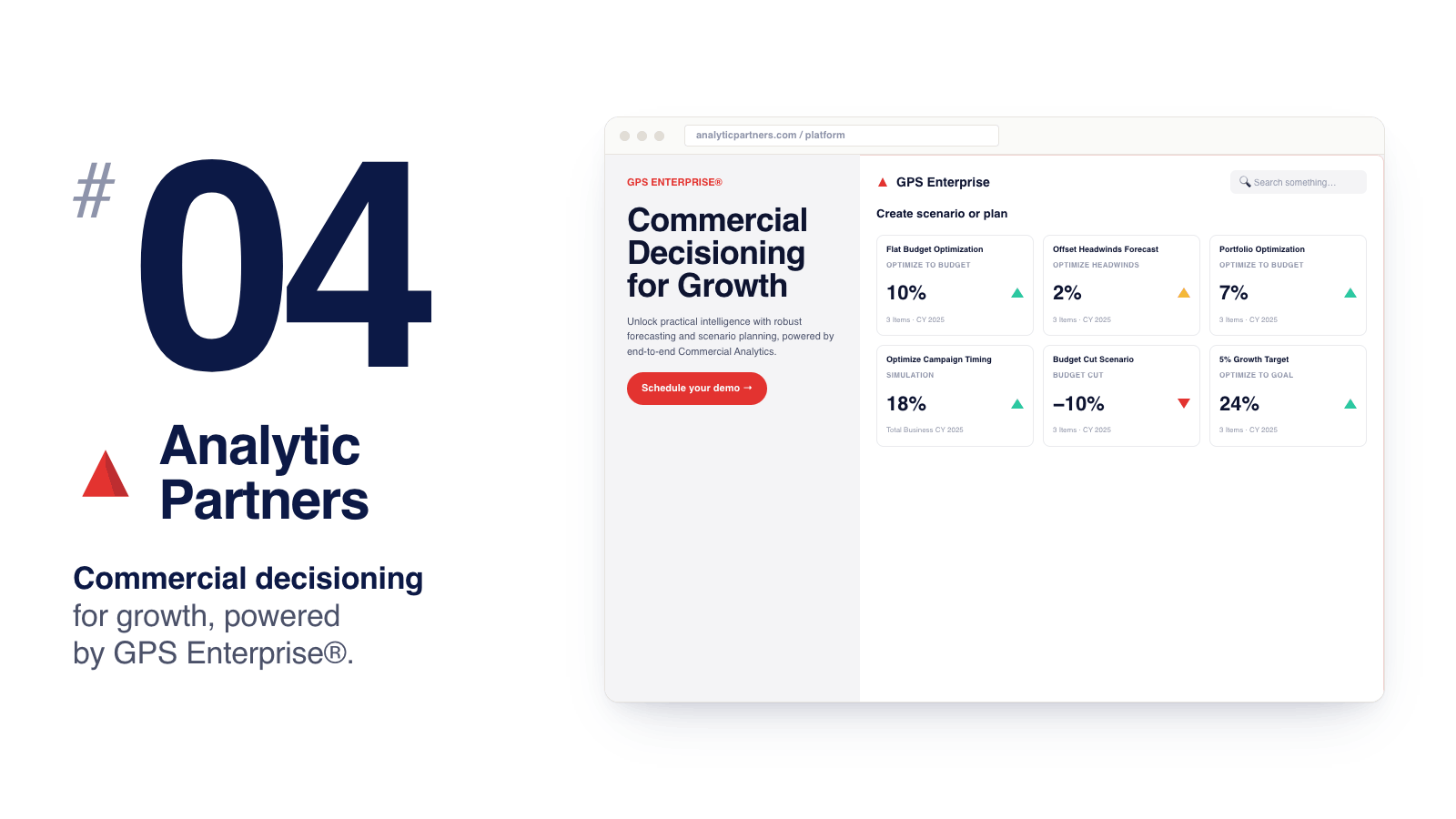
Analytic Partners delivers Commercial Analytics through their GPS Enterprise (GPS-E) platform - a consulting-and-technology model that goes beyond MMM to connect marketing, sales, operations, finance, and pricing into a unified commercial intelligence layer. Their ROI Genome is a proprietary dataset built from decades of cross-client measurement data.
Key strengths
- Decades of cross-client data supporting genuine competitive benchmarking through the ROI Genome
- GPS Enterprise platform connects marketing, sales, operations, finance, and pricing in a single commercial intelligence layer
- Strong multi-market and cross-country measurement capabilities
- Deep consulting relationship model with senior-level strategic support
- Covers both online and offline media channels including TV and out-of-home
How it fits alongside Fospha
Analytic Partners' model is built around a deep consulting relationship, with outputs oriented toward strategic planning cycles rather than daily budget execution - though their platform has been evolving to support faster decisioning. For brands that need daily budget adjustments or need to feed measurement signals into automated bidding at the campaign level, Fospha is designed specifically for that operational cadence. For organizations that need both strategic depth and operational speed, the two can serve different planning horizons within the same measurement program.
Best for: Large enterprise brands with $50M or more in media budgets across multiple markets and channels, particularly those with significant offline media investment where consulting-grade commercial analytics justify the engagement model.
5. Google Meridian: Best for data science teams wanting an open-source MMM foundation
What it does
Google Meridian is an open-source MMM framework designed to give advertisers a transparent, auditable methodology for measuring marketing effectiveness. It is publicly documented and intended to be deployed by brands' own data science teams or through implementation partners.
Key strengths
- Fully open-source and independently auditable methodology
- No licensing cost for the framework itself (implementation and ongoing maintenance cost applies)
- Integration with Google's advertising ecosystem and data products
- Methodology can be interrogated and validated by technical teams
- Meridian GeoX (announced, coming soon): geo-based incrementality calibration that integrates MMM with geo lift experiments directly within the Meridian framework
How it fits alongside Fospha
Meridian is a framework rather than a managed product. Deploying it requires meaningful internal data science resource, ongoing maintenance, and the expertise to translate model outputs into operational decisions - a significant capability requirement for most retail marketing teams. It is worth noting that Meridian is built and maintained by the world's largest digital advertising platform, which is a factor worth considering when evaluating objectivity in measuring Google channels alongside alternatives. It does not currently address total commerce measurement; Amazon and TikTok Shop performance sits outside its scope. Google has also announced Meridian GeoX, a forthcoming geo-based incrementality calibration module that will extend Meridian's capabilities beyond pure MMM into experiment-driven model calibration. Fospha is a managed, daily platform that does not require in-house data science to operate and extends measurement across the full commerce landscape.
Best for: Brands with in-house data science teams, strong technical infrastructure, and primarily Google-centric media mixes who want a transparent, auditable MMM foundation and have the capability to own and maintain it internally.
6. Lifesight: Best for brands wanting unified causal measurement with AI-driven budget execution
What it does
Lifesight is a Marketing Decision Intelligence platform that combines Causal MMM, geo-based incrementality testing, and calibrated attribution into a unified causal measurement engine - with an AI agent layer (MIA - Marketing Intelligence Agents) that automates budget optimization, experiment design, anomaly detection, and CFO reporting. The platform is designed to deliver answers grounded in causation rather than correlation, with AI agents that act on measurement data in real time.
Key strengths
- Unified causal measurement engine combining Causal MMM, geo-based incrementality testing, and calibrated attribution
- MIA (Marketing Intelligence Agents): AI agents for budget optimization, scenario planning, experiment design, anomaly detection, and CFO reporting - within user-defined guardrails
- 1-click budget reallocation pushing directly to Google, Meta, Amazon, and TikTok based on incremental ROAS, not platform-reported ROAS
- 50+ native integrations including Google, Meta, Amazon, TikTok, Shopify, The Trade Desk, and CTV
- Privacy-first architecture that does not depend on third-party cookies or cross-site tracking
How it fits alongside Fospha
Lifesight's unified causal approach -combining MMM, incrementality testing, and attribution in a single engine - is a genuinely different architectural choice from Fospha's daily MMM-led model. Where the two differ most meaningfully is in total commerce measurement across DTC and marketplace destinations: Fospha's Total Commerce Integration, cross-channel halo effect modeling, and Total Commerce ROAS across Amazon and TikTok Shop are specifically built for omnichannel retail brands selling across multiple surfaces. For brands where the primary measurement need is causal attribution with AI-driven execution, Lifesight is a strong option; for brands where total commerce visibility across marketplaces is the priority, Fospha's scope is more directly suited.
Best for: DTC, ecommerce, retail, and CPG brands that want a unified causal measurement platform combining MMM, incrementality testing, and attribution - with AI agents that automate budget optimization and push changes directly to ad platforms.
7. LiftLab: Best for brands that need brand and performance measured in the same model
What it does
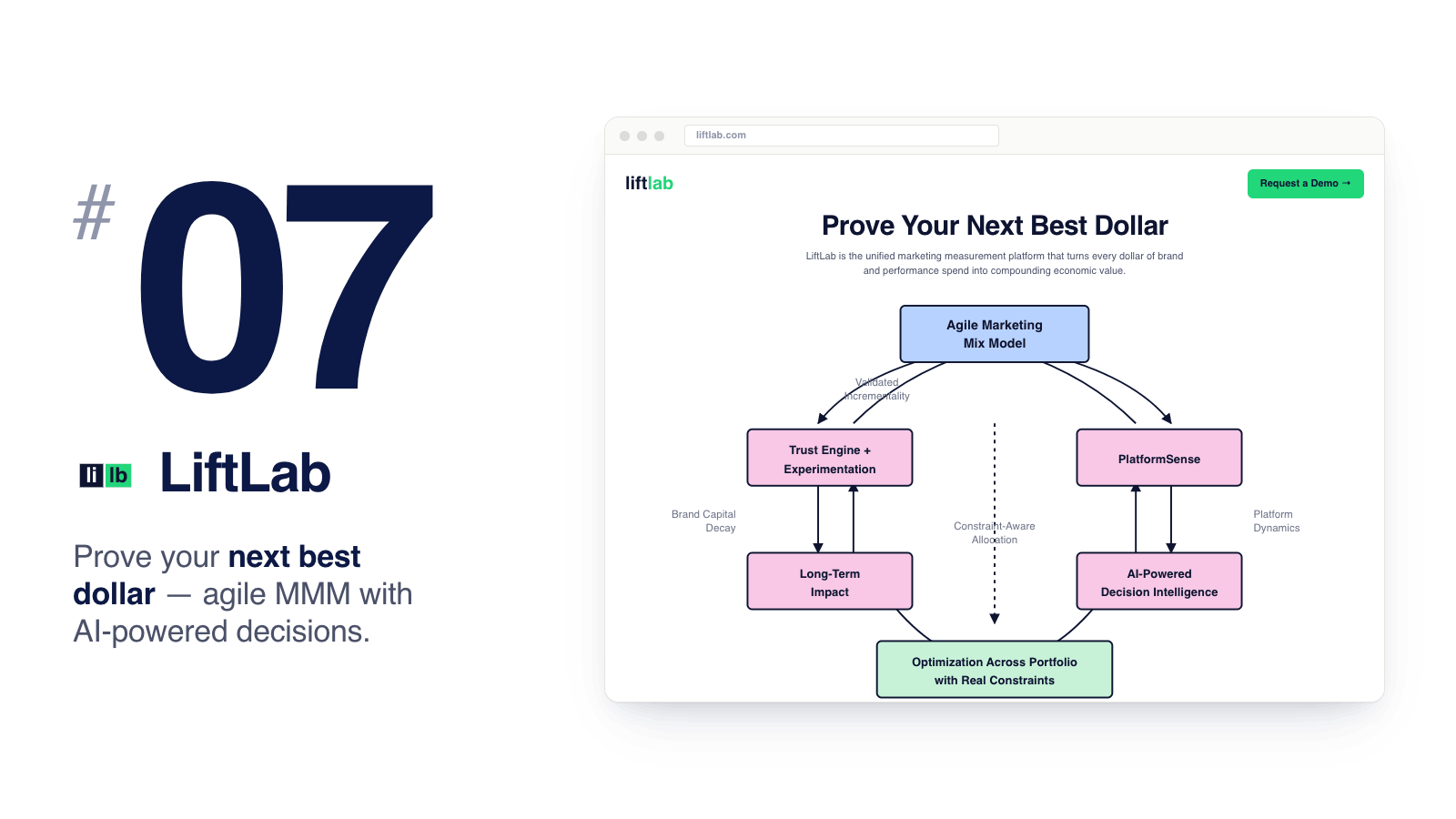
LiftLab is a unified marketing measurement platform built around Agile Marketing Mix Modeling (AMM), combining a proprietary Two-Stage MMM with an incrementality testing suite and a scenario planner - designed to turn every dollar of brand and performance spend into compounding economic value.
Key strengths
- Agile Marketing Mix Modeling (AMM): a Two-Stage MMM that separates ad auction dynamics from consumer response to build accurate diminishing returns curves
- Brand and performance spend measured in the same model over a 6 to 52 week horizon
- Incrementality Testing Suite using transparent geo experiments, with results fed back into the AMM through the Trust Engine to permanently sharpen response curves
- Scenario planner for forward-looking budget allocation decisions
- Auditable methodology designed for finance and leadership audiences
How it fits alongside Fospha
LiftLab's Agile MMM covers brand and performance spend in the same model and delivers accurate diminishing returns curves across longer planning horizons. Where it differs from Fospha is in daily ad-level granularity and total commerce measurement across DTC and marketplace destinations. The forward-looking forecasting at the daily ad level and market intelligence benchmarking across hundreds of retail brands that Fospha provides are not part of LiftLab's core offering. The two tools address different layers of the measurement stack and can reinforce each other - Fospha's daily measurement providing operational context alongside LiftLab's longer-horizon AMM and incrementality validation.
Best for: Growth-focused brands that need a unified, auditable MMM platform where brand and performance investment are measured in the same model, with integrated incrementality testing that continuously improves forecast accuracy - particularly suited to brands with complex full-funnel media mixes.
Frequently asked questions
What is the difference between privacy-safe measurement and traditional attribution?
Traditional attribution (last-click, multi-touch) tracks individual users across sessions and devices using cookies and pixels. Privacy-safe measurement uses aggregated statistical methods - primarily Media Mix Modeling - that do not require identifying or tracking individual users. It measures marketing effectiveness at the aggregate level, designed to work within GDPR, CCPA, and an environment where third-party cookies are increasingly unavailable.
Is Media Mix Modeling accurate enough for daily decisions?
Modern, daily MMM platforms like Fospha update daily and operate at the ad level - a meaningful technical advance on traditional quarterly MMM. The accuracy is generally sufficient for budget allocation and channel mix decisions when combined with the transparency that allows teams to interrogate the model's assumptions. Daily MMM is not designed to replace granular click-level data for creative testing and micro-optimization; both have a role in a well-structured measurement stack.
Do I need to stop using GA4 or my attribution tool?
No. GA4 and last-click attribution tools provide fast, useful signals for micro-optimization - which creatives are performing, which audiences are converting. The challenge arises when they become the primary source of truth for strategic budget allocation across channels. A well-designed measurement stack typically uses MMM for channel mix and budget decisions, and attribution tools for fast creative and audience iteration. Fospha is designed to sit alongside these tools and make the full stack more coherent.
Do these tools work for brands selling across DTC and marketplaces?
Most tools in this list were designed primarily for DTC or enterprise measurement. Fospha is the tool in this list most explicitly built for total commerce - ingesting and modeling performance across owned sites, Amazon, TikTok Shop (including GMV Max), and emerging marketplaces. Brands running significant revenue through marketplaces alongside DTC should evaluate how each tool handles that scope before committing.
What data does a privacy-safe MMM platform typically need?
Typically: aggregated media spend and impression data by channel and campaign, sales or revenue data by day, and context variables such as seasonality, promotions, and pricing changes. For total commerce platforms like Fospha, you also connect Amazon and TikTok Shop data. No user-level data, individual conversion events, or personally identifiable information is required.
How do I get finance to trust measurement outputs?
Choose a platform with transparent methodology - one where finance can see how credit is assigned and interrogate the model's assumptions. The measurement tools gaining internal traction in 2026 are those that produce a single, reconciled view of performance that marketing and finance can both operate from, rather than outputs that one function has to take on faith.
Ready to see what unified, full-funnel measurement looks like in practice? The companion piece to this guide - How to choose a marketing measurement platform: a practical guide for retail CMOs - walks through the decision by maturity stage, with specific questions to ask any vendor before you commit.
Or if you are ready to see how Fospha works for your channel mix and commerce destinations, book a demo with the team.