Plan Your 2026 Budget with Confidence: Beam’s Incremental Forecasting Upgrades
Discover Beam's new incremental forecasting upgrades designed to help marketing teams plan 2026 budgets with confidence using real-time performance data.
.png)
Q1 is when most marketing teams are deep in budget planning mode - setting 2026 targets, forecasting returns, and pressure-testing where spend should scale or pull back.
It’s one of the toughest moments of the year. Decisions made now don’t just determine budgets; they shape how confidently teams can operate once the year is underway.
The challenge here is that much of today’s measurement still isn’t designed for action. Insights can arrive too late, feel too abstract, or fail to reflect how teams actually spend and optimize day to day.
Fospha is built to help close that gap. As an always-on, MMM-led operating system - meaning full-funnel measurement designed to support ongoing spend decisions, not just periodic analysis - Fospha turns performance data into guidance teams can act on with confidence.
That’s why we’ve started the year by releasing a set of upgrades to Beam, our incremental forecasting tool. These updates are designed to help teams plan faster, align more easily, and move from insight to action with greater confidence, during Q1 planning and beyond.
Four upgrades in Beam's Incremental Forecasting that change how teams plan
1. Ground decisions in what’s actually happening right now
One of the biggest sources of tension in planning is the gap between forecasts and reality.
Teams are often asked to commit to future spend levels without a clear connection to recent performance. Even when a forecast looks strong, that disconnect can make decisions feel risky.
Beam helps reduce that gap by anchoring forecasts in recent performance. When you explore a new spend level on the saturation curve, you can see exactly how it compares to the last seven days of activity - across spend, conversions, and your lead KPI.
This makes it easier to bring real-world context into planning. Teams can quickly see whether they’re discussing a modest adjustment or a more meaningful shift, and understand the expected incremental impact before committing. Decisions feel grounded rather than theoretical.
.jpg)
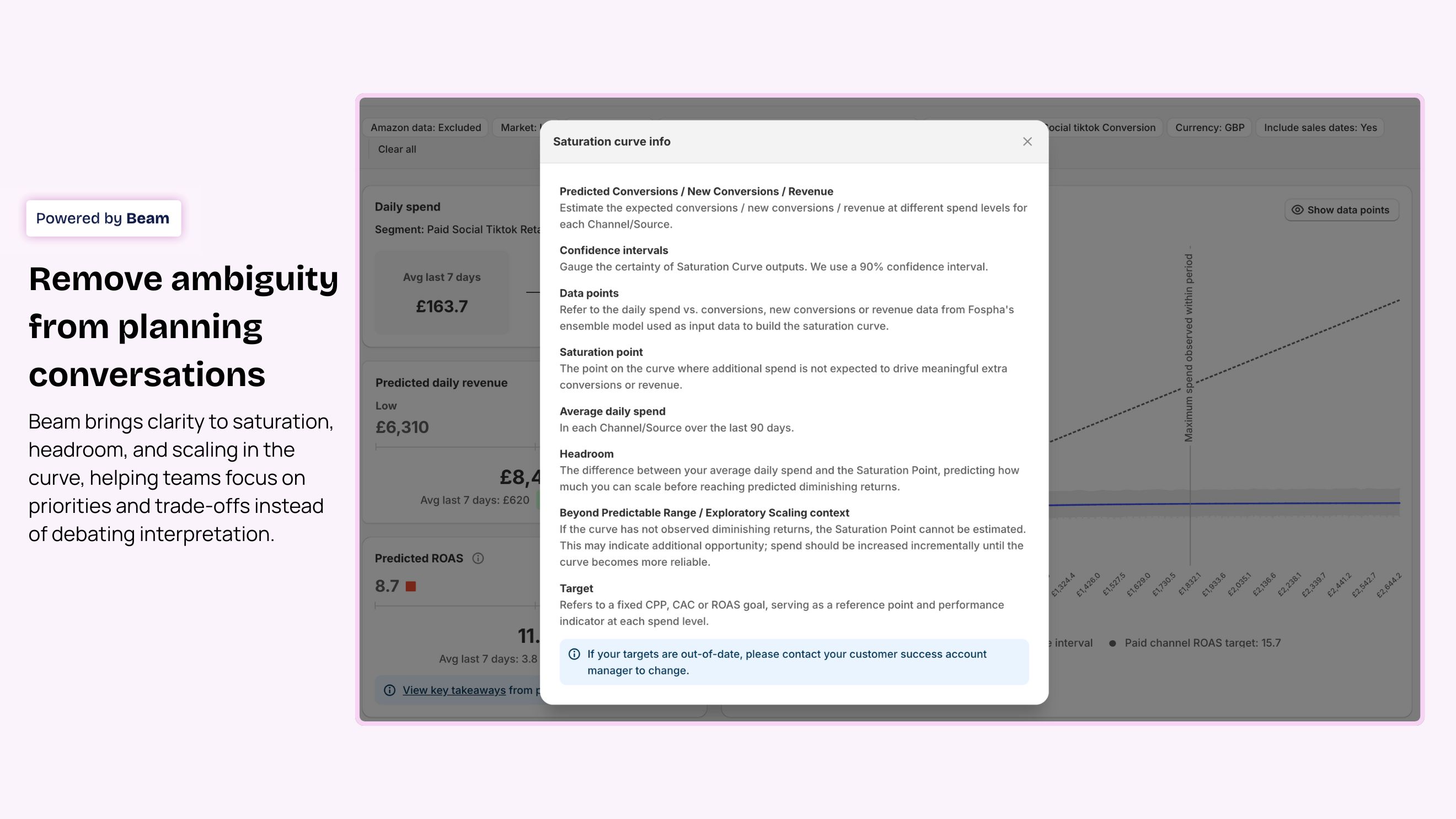
2. Remove ambiguity from planning conversations
Planning conversations often slow down not because teams disagree on goals, but because they interpret the signal differently.
Terms like saturation, headroom, and scaling are central to budget discussions, yet they’re often used inconsistently across growth, performance, and finance teams.
Beam now explains these concepts directly within the curve and summary table, so everyone is working from the same definitions and the same underlying model outputs. Instead of debating interpretation, teams can focus on priorities and trade-offs.
This shared understanding can help teams align faster and make decisions with less friction, particularly when budgets require cross-functional sign-off.
3. Turn headroom into a budget you can actually commit to
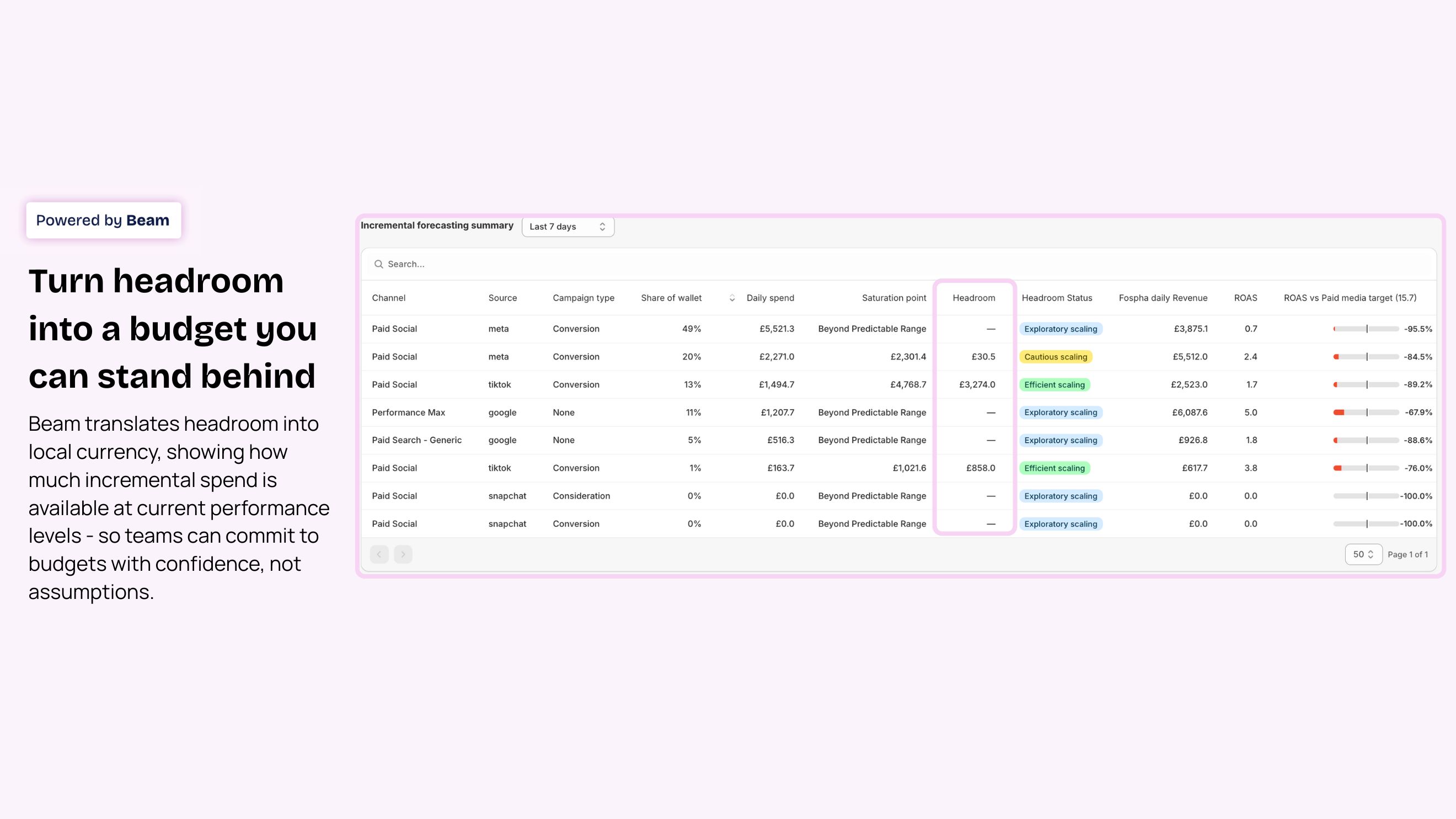
Knowing there is opportunity is only part of the planning challenge. Things often stall when teams struggle to translate insight into numbers they’re confident standing behind.
Beam now expresses headroom in local currency, showing how much incremental daily spend is predicted to be available at current performance levels before efficiency meaningfully declines.
This makes forecasts easier to translate into concrete budget ranges. Rather than relying on broad assumptions, teams can plan Q1 investment within clear boundaries and explain the reasoning behind those numbers with confidence to stakeholders outside marketing.
4. Focus investment where it is most likely to drive growth
Not every channel should be treated the same during planning. But without clear guidance, budget increases are often spread evenly as a compromise.
Beam now summarizes scaling potential using clear headroom statuses, indicating which channel segments are well positioned for efficient scaling, which should be approached cautiously, which are still in exploration, and which may already be past their point of diminishing returns.
This clarity helps teams prioritize earlier in the process. Instead of over-planning every scenario, they can focus time, attention, and budget where incremental growth is most likely and reduce the risk of waste as spend scales.

From insight to action, and into execution
Taken together, these upgrades reinforce a simple idea: measurement should support confident decisions, not just analysis.
Because Beam is built on Fospha’s full-funnel measurement, forecasts are refreshed as new data comes in and include uncertainty ranges that help teams understand how reliable predictions are at different spend levels.
Beam applies Bayesian modelling and causal inference techniques to estimate incremental impact, and is designed to work alongside incrementality testing. It helps teams stay decision-ready between tests, surface where experimentation may be most valuable, and carry insight from planning through into day-to-day execution.
This is how teams move from static plans to confident operation.
Start planning with confidence
The latest Beam upgrades are now live in your dashboard.
If you’re already using Fospha, explore the new features and start planning with greater confidence today. If you’re not yet a customer, our 2026 Marketing & Planning Guide shows how successful performance teams use always-on measurement and incremental forecasting to plan, align, and execute with greater certainty.

Stay ahead with the inside scoop from Fospha.
For over 10 years we've been leading the change in marketing measurement.

.png)