Model Spotlight: How Fospha measures the full funnel and why last click isn’t enough
A step-by-step walkthrough of Fospha’s measurement model, from GA4 validation to impression-led MMM, showing how we reveal the true impact of every channel.
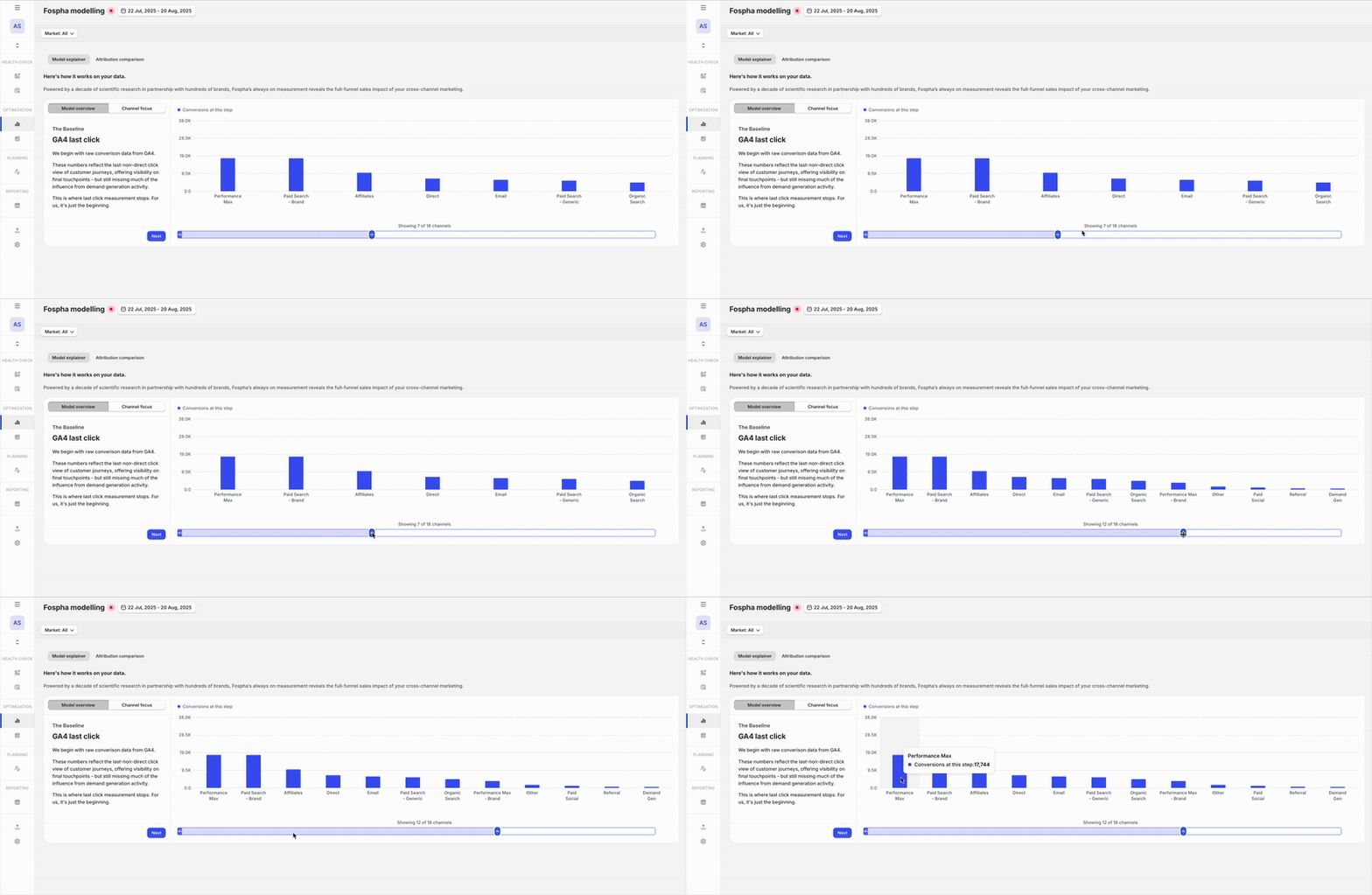
Fospha’s model spotlight gives you every detail needed on a channel. We’re able to give granular attribution values to demystify attribution. I’ll guide you through the steps with explanations on the way. This way you can get the most out of our tool when you next use it.
Let’s first begin - counter intuitively - with football! In football, the goal scorer often grabs the headlines, but any good manager knows it’s never just the striker who wins the match. It takes an entire team working together to put the ball in the right place at the right time. If you only paid players based on who touched the ball last, you’d blow your budget on strikers and lose every game in the midfield.
Marketing is no different. Most tools focus solely on the "goal scorer" (Last Click), ignoring the wingers and midfielders (Social and Brand Awareness) who created the opportunity.
Fospha’s model spotlight is your full match analysis. We give you the granular detail needed to understand every player on the pitch, not just the one who finishes the move. Below, I’ll guide you through our analysis—from validating the match stats to measuring off-the-ball movement—so you can demystify your attribution and get the most out of our tool.
GA4
Most marketeers start and end at last click attribution when they’re making decisions. At Fospha, this is only the beginning. Last click values allow us to anchor our attribution to give directly comparable results between our MMM-powered attribution values and what ad platforms claim.
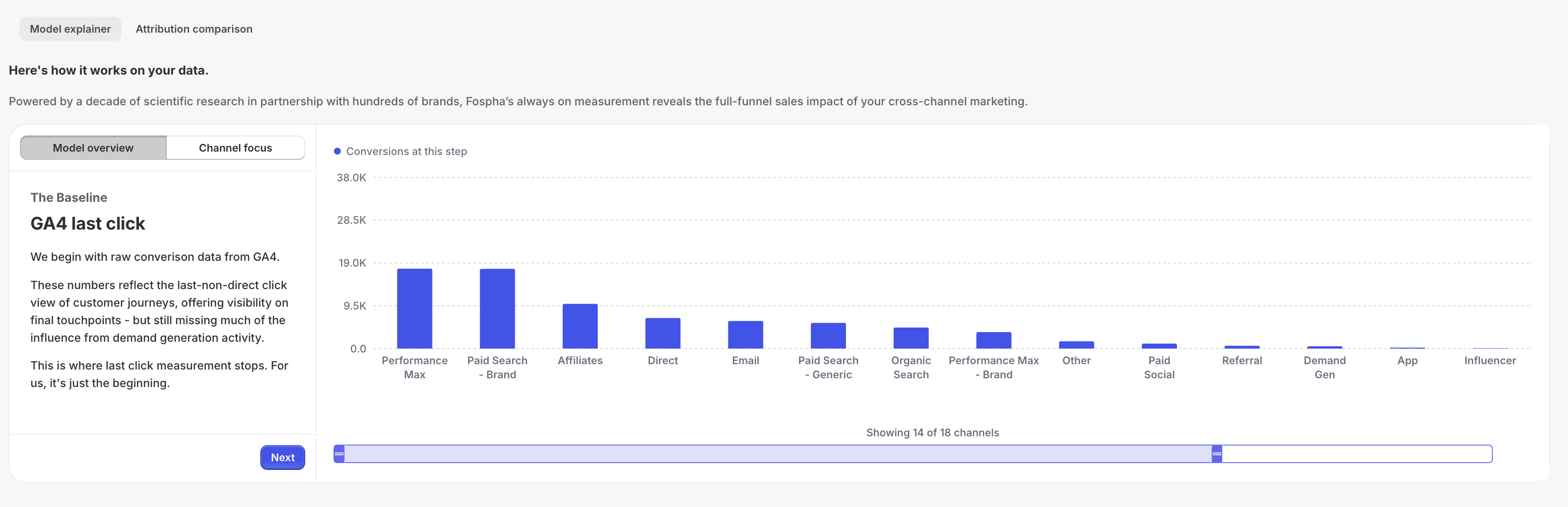
GA4 Data Validation
During this stage, we ensure we’re only modelling valid transactions. We conduct the following hygiene checks and changes:
- Match order IDs between ecommerce and GA
- Deduplicate orders that have snuck in through GA
- Properly exclude your excluded transactions
- Correct channel groups and UTMs
- Exclude flagged UTMs
With these data quality changes, the data is ready for modelling.
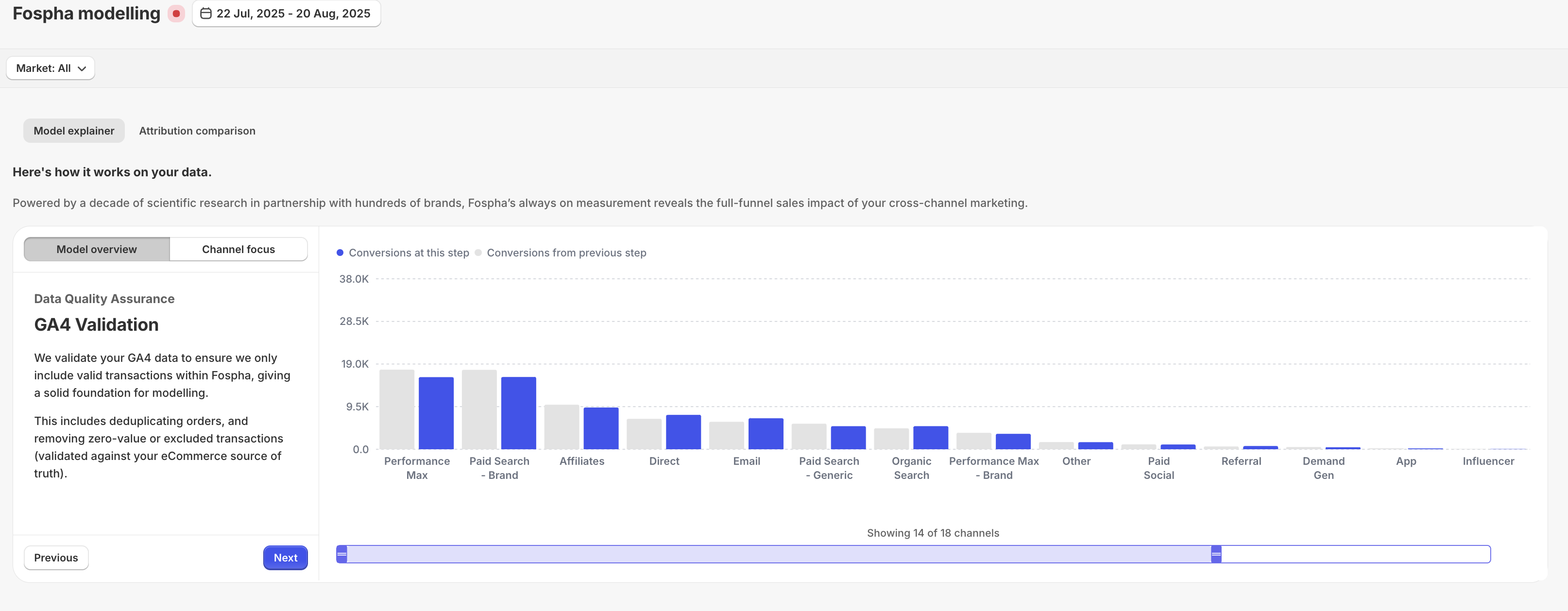
Click Measurement
This is the first modelling step in our MMM. We start with click measurement where we use an ensemble of models to get robust attribution values. We use two click models from Google - DDA (data driven attribution) and LNDC (Last Non-Direct Click), and two machine learning models - a linear (Elasticnet) and a non-linear (XGBoost) model using aggregated data. The combination of these models together means we’re always giving an accurate attribution view, no matter the types of relationships between marketing events and conversion.
This stage doesn’t factor impression-led activity in yet, so you’ll be able to see the impact of purely click-led activity in our breakdown. We tend to see bottom-of-funnel conversion channels claim most credit in this step. Channels like Direct usually have stronger relationships with same-day engaged sessions to conversions. Paid social, or other impressions-led activity tends to get deceptively lower amounts of credit at this stage. Bottom of funnel channels therefore end up cannibalising some of the credit actually due to impressions-led activity. Thankfully, our impressions measurement solves this problem.
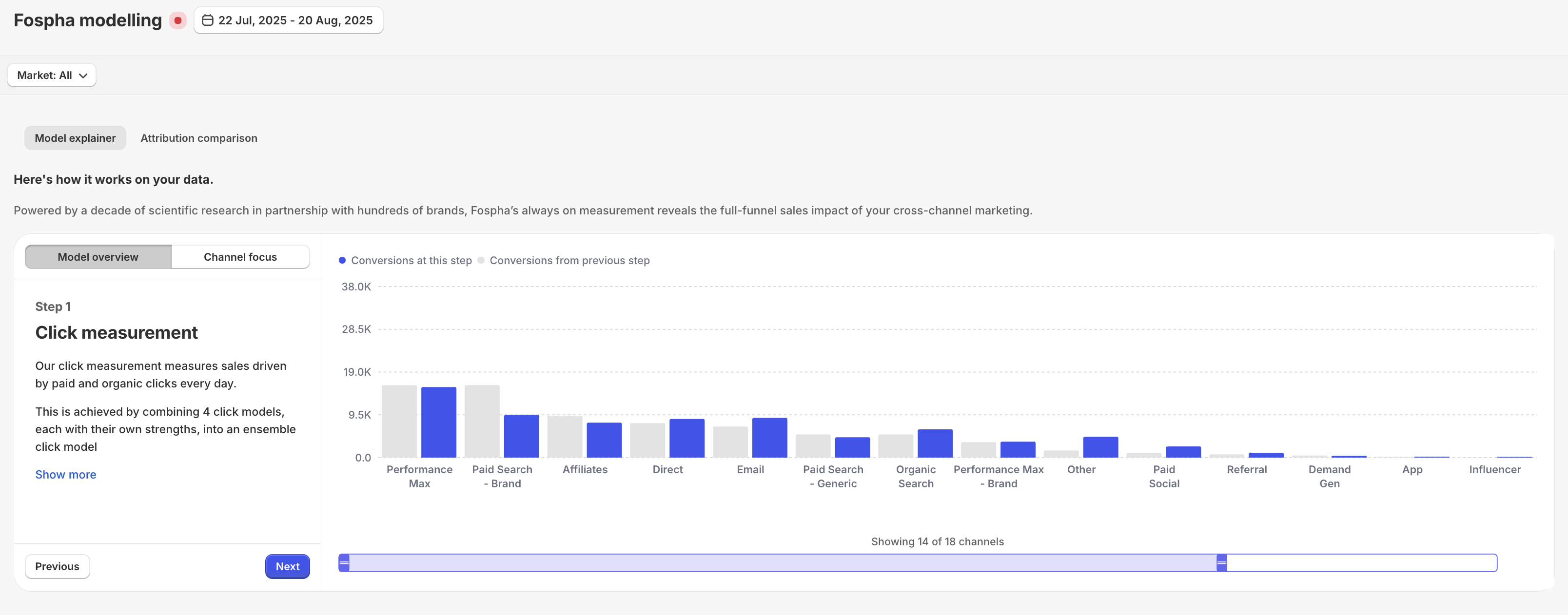
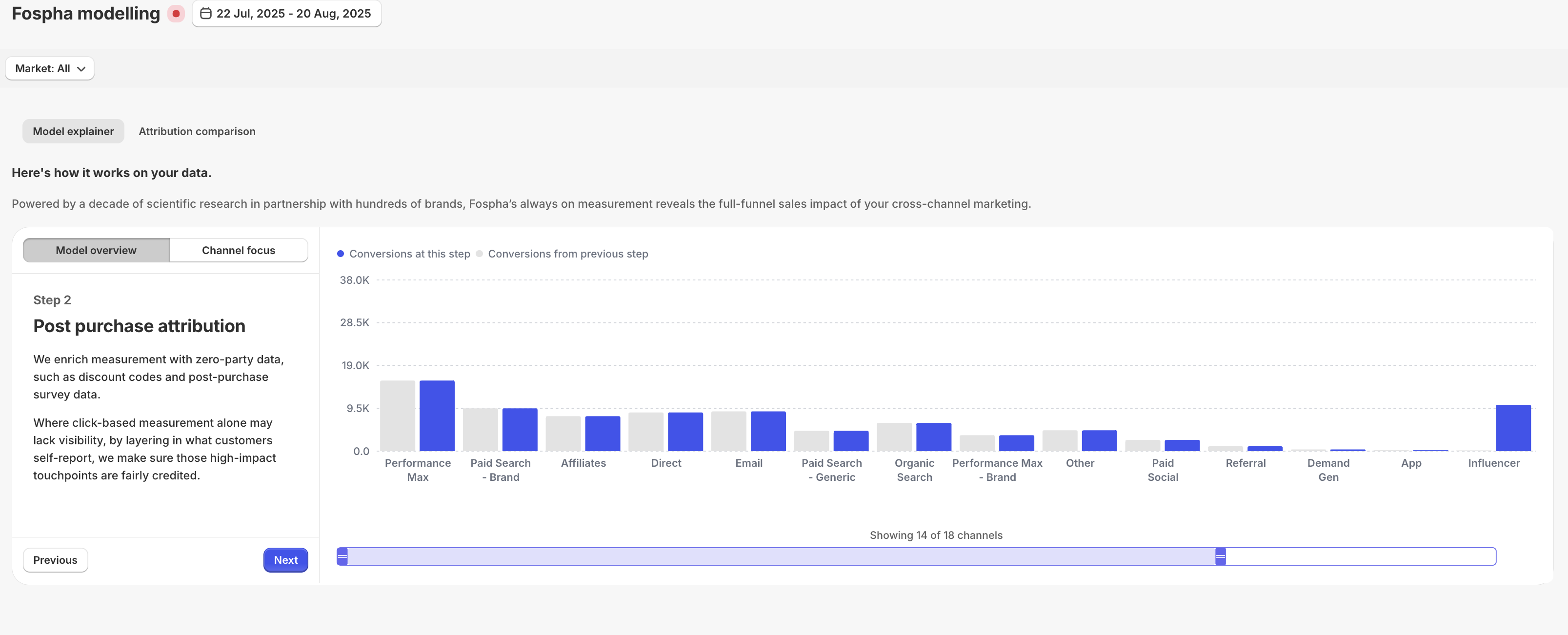
Post Purchase
For this stage, we leverage zero-party data to enrich our attribution numbers. By using discount codes and post purchase surveys, we’re able to give credit to many other sources, like influencer activity. We allow configurable discount code attribution mapping, so our clients can customise a code’s impact on attribution. Through these two approaches, we can attribute to channels that are difficult to track using our privacy-safe aggregated modelling.
Reconciliation
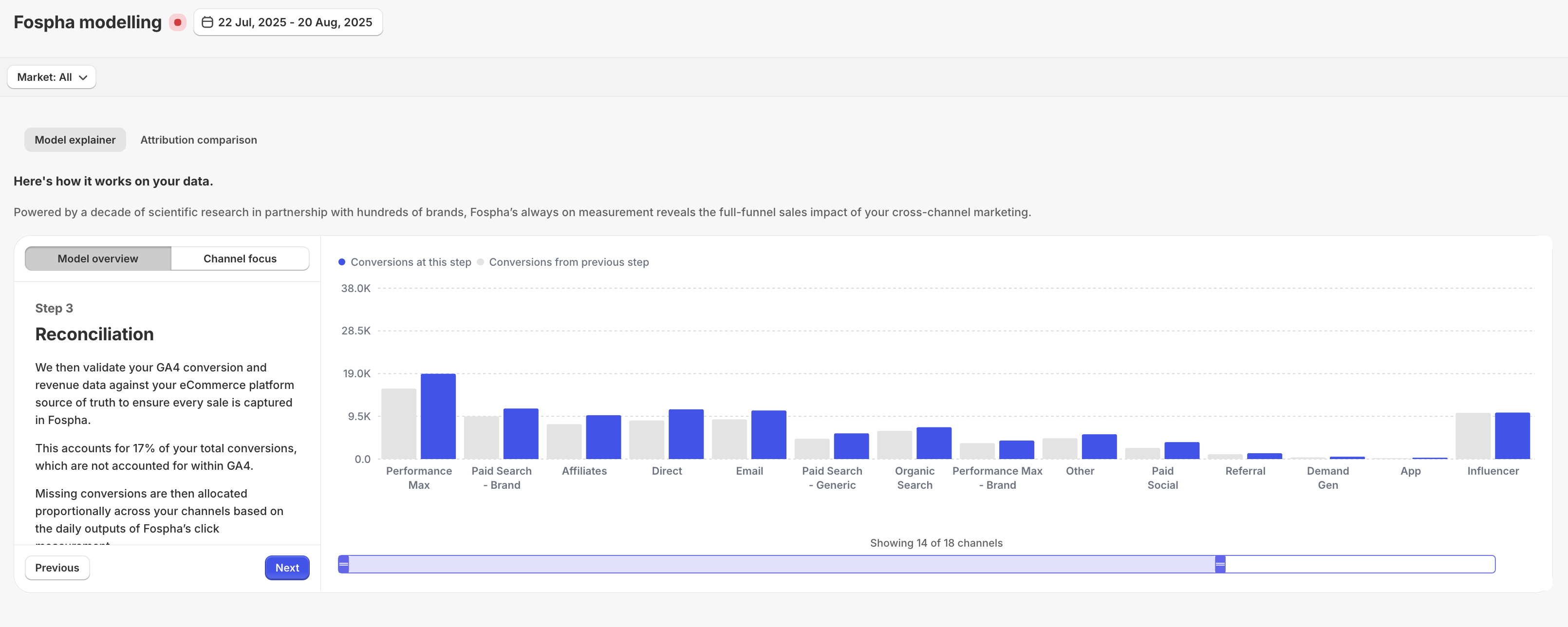
Fospha validates your GA4 conversion and revenue data against your eCommerce platform's source of truth to ensure every sale is captured.
This step addresses two critical issues:
1. GA4 undercounts sales due to cookie consent banners, tracking blockers, and other data loss. Without the additional transactions, you’d risk only getting part of the picture.
2. Ad platforms often over-credit sales to their own ecosystem, which never aligns cross-platform. This creates a reporting headache that we solve by keeping things comparable to a single source of truth.
The steps are as follows:
1. Calculate the shortfall: Each day, Fospha calculates the gap between GA4-tracked conversions and eCommerce-reported sales.
2. Proportional redistribution: The missing conversions (the delta) are redistributed across channels using proportional weights from the click measurement step.
3. All channels increase: During reconciliation, you shouldn't see any decreases - all channels should increase by a proportion as missing conversions are added back.
The reconciliation uses coefficients based on each channel's share of GA4 transactions to determine how to distribute the unmatched eCommerce orders, ensuring that the model aligns with your actual business revenue.
Impressions Measurement
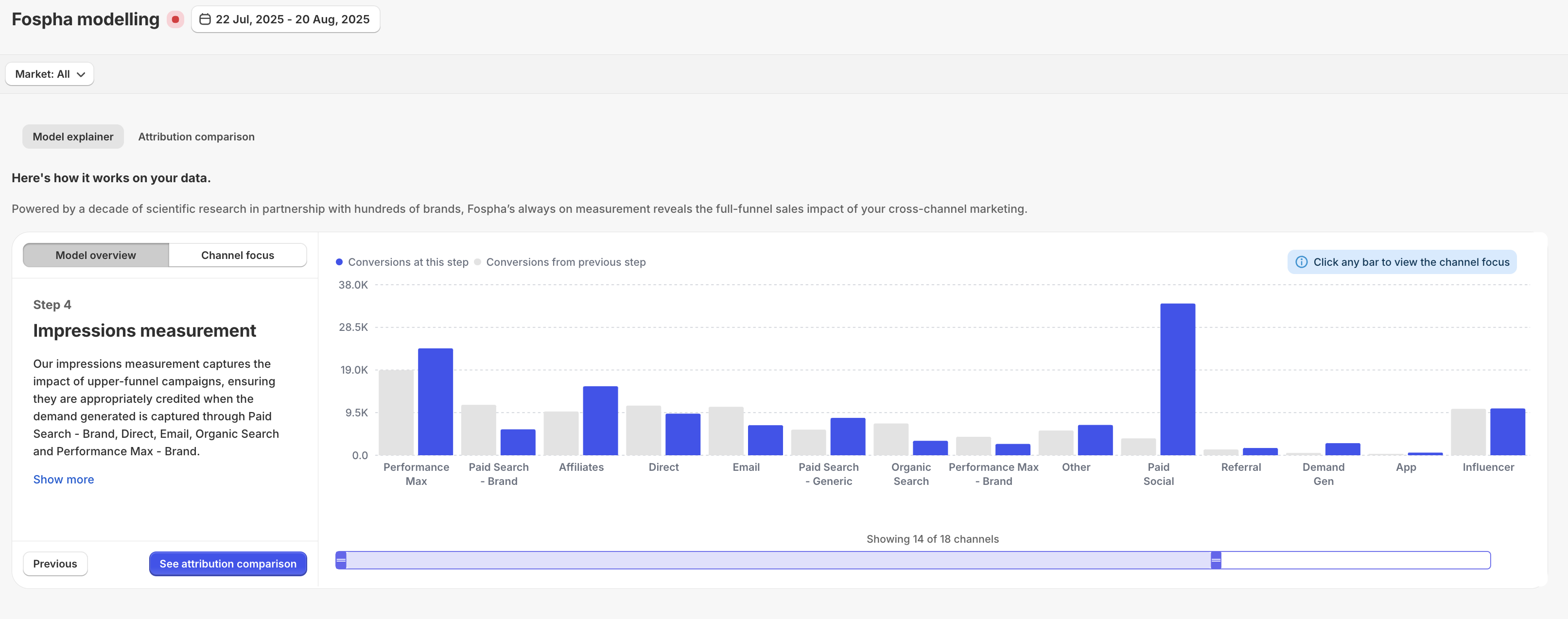
Now we’re ready to discuss how we incorporate impressions into our MMM. Brand-building channels like YouTube, TikTok, Snapchat, and Meta often create awareness and demand, but customers later convert through channels like Direct, Organic Search, or Brand PPC—meaning those bottom-funnel channels cannibalize the credit that upper-funnel impressions deserve.
To mitigate this problem, we’ve build an XGBoost model to assess which parts of the bottom-funnel channels are due to impressions-led activity. We use impressions and our click measurement for these bottom-funnel channels likely to absorb credit unfairly. After fitting, we’re able to split the actual impact of channels like Direct and what’s due to impressions-led activity.
By moving through these steps—from basic click measurement to advanced impression modelling—we stop looking at just the highlight reel and start understanding the full game.
When you rely on Last Click or basic GA4 data, you risk benching your best playmakers because they aren't scoring the goals themselves. By using Fospha’s model spotlight to identify the true contribution of your upper-funnel activity and impressions, you get a clear view of who is actually driving the team’s performance.
Now that you know how the model works, you can stop guessing and start selecting a winning squad that drives real revenue, ensuring every channel gets the credit—and the budget—it actually deserves.

Stay ahead with the inside scoop from Fospha.
For over 10 years we've been leading the change in marketing measurement.
.png)